Went to see Milos at ABC today where he told me that he'd sold more paintings from the last exhibition than from any previous. This had encouraged him to investigate new materials and the results were on the walls. The morphing creatures were still there but now exploding with solar yellows and shocking reds. He's done fifteen since October and won't be slowing down soon. Another exhibition will be in the air soon.
Also, without my prompting he suggested the resumption of Shadows. Nothing in stone as yet but he wants the summer clear before he can get into it again so we're thinking March. Begin the year with an autumn collection. Well that's when I began in 09 and started weekly screenings last year. So why not?
I'm thinking one or two preliminary nights perhaps a fornight apart before the new programs and am happy to entertain suggestions as to what those screenings might be (assuming they eventuate).
Talks continue. Watch this space.
PJ
Thursday, December 30, 2010
Wednesday, December 29, 2010
Didn't you torture my bruvver?: Antipodean horror movies of recent times
Britain had one of the earliest working fiction film industries. We did, too. It worked like a Trojan up to the mid 60s. Same here. Then it slowly disintegrated. Ditto. But the quality that had been there turned up unexpectedly on the small screen. Er ... that didn't happen here.
UK tv from the 50s to the mid 90s boasts some of the best ever committed to the medium: great comedy, a kind of unforgiving toughness, sheer world leading style and, when it wanted to, a kind of creeping horror made of location, atmosphere, good acting and the kind of writing more usually found between two hard covers. Minds like that of Nigel Kneale saw to it that ideas could travel as effectively as the alien DNA in one of the earliest examples of alien invasion that needed nary a metre of tin foil costuming. All those concepts needed was a bit of video production and hey presto stories to entertain and disturb. None of this ended up on the big screen apart from a few adaptations from the tv originals. And don't bother citing Hammer movies. They have their fans but they are too ... campy and bright for me.
Lately, the industry (such as it is in that gem set in the silver sea) has been producing scarefests meant for the cinema. Here are a few I've taken in.
EDEN LAKE
A yuppie couple head out to the lush green and pleasant forest for a camping holiday before it gets developed into a concrete slab. A bunch of untamed youths set up nearby and act like right yahoos. While our heroes are splashing about in the paradisical lake o' the title our young chavs are busy vandalising the yup-mobile and nicking what they can. Discovering this on their return, the male of the two upwardly mobile ones decides to confront the hooligans who meet them with feigned ignorance. Little by little the two parties build a case against each other until it's guerilla warfare home counties style and everyone's a potential victim.
The makers of this film would only celebrate comparisons to Deliverance, Last House on the Left etc and feel honoured to be placed in that tradition. Deserved? Why not? All of these films centre on the violence of survival when the cloak of civilisation is torn off. Whether it's inbred hillbillies, Mansonish manipulators or bored unsupervised teenagers the idea that these bipedal dangers walk among us and could stab into our veneer of order at any moment. And then where would we be? Dead or fighting like savages is the usual answer. There's nothing particularly flawed about this argument at this level, scratch a yuppie and find a bogan, but the differences between outings lies in the depth of what this might mean.
In Deliverance the milquetoasts and weekend warriors from the city are shown where their status as citizens end and the test of their manhood begins. For all the machismo of the Burt Reynolds character on screen it's the perceived failure of Ned Beatty's tenderfoot fat man that strikes the hardest. Burt's always going to be ready to come back with a slammin' right hook. Ned in the world of the film can really only exist in the support system of the urban sward. His humiliation (which kickstarts the narrative proper) is what is meant to anger audiences but at the same time it's an example many in the seats would have savoured in the dark of the cinema. Deliverance's power derives from this contrary motion resolved in Reynold's heroism. No one needs to see the Vietnam parallells but they are there in spades.
Last House on the Left is both more complex and goofier than Deliverance but its points are still strong. The long first two acts follow a group of hippies closer to the Manson family than the Mamas and the Pappas. Krug, charismatic and bored, uses the people around him for his amusement, manipulating them to all kinds of atrocities including finally murder. The final act is the revenge of the relatives of the deceased which is where the civilisation is stripped and sheer bloody fury is loosed. Even though there is a confusion of themes here (are we meant to share the outrage against the hippies? are we meant to laugh ironically at the bourgeois couple turning feral?) the themes are yet there on the screen. Eden Lake doesn't suffer from a thematic problem.
That's because outside of a premise, Eden Lake doesn't have a theme. It doesn't have much beyond a series of payoffs and a subversion of survivalist horror films at the end. There are some well observed moments of peer pressure which carry the added weight of atrocity. After the ordeal, the terror, the violence, torture and suspense there seems less point to this film than the other examples I've given here. Bad things happen, says Eden Lake. I knew that.
MUM AND DAD
If Eden Lake seemed well made and pointless, Mum and Dad goes one step further and demotes the "well made" to competent.
Lena the Clena from Poland misses her bus one night and can't get back from the airport where she scrubs the loos. A smoko mate, Birdie says she can put the Pole up for the night and lives but a walk away. Home is a domestic prison with a knockoff Fred and Rosemary West except the two kids are in on it as well. There's a human abattoir downstairs and a cellar full of stolen goods. What do we do for depth? Well, what about having the victim come across ... kind of ... but still have enough in her to revolt at the end if she needs to.
What would make her revolt?
Have we tried cross dressing yet? Dad cross dressing. And she has to do it with him.
Ok, put that in then. Have we done dismembered but still alive? How about hanging on the wall?
Yes! Oh, at Christmas! Do it then. Like a decoration!
Half a bloke nailed to the wall in a santa hat! Still squirming!
You're a genuis. What about wanking?
We're doing enough of that ourselves, mate.
Seriously, let's put some wanking in. No one shows that. We can shoot from behind if the actor's too self conscious.
How do we know it's wanking, then?
Shoot the jizz ... so to speak.
Right. Alright.
A shot of the jizz IN the liver he's just cut out of one of his victims!
How much are we paying you, again? Right. Let's set it up before it gets cold!
Sorry (it's me again) but all this film shows that its creators can think up nasty stuff. So can I. So can the average five year old. Schoolkids regularly do this while waiting for the teacher. It really only works when there's a point to it. The point of torture porn films like Hostel is getting to see self centered yuppies get their tongues drilled in. I can daydream that, too, but at least it's something.
Texas Chainsaw Massacre? Don't you bloody dare! TCM has a similar shock survival premise but crucially shows only as much as it needs so that its audience can do the rest. Imaginative audiences (ie pretty much all of them) are always going to make something worse than could ever be shown on screen. That's the real aesthetic crime of Mum and Dad. It seems to think the unrelenting graphic ghastliness is going to provide substance enough for all the great unwashed cor-blimeys out there in the dark. The effect isn't horrifying but bland. Oh, they're doing that now. Oh, they're trying that. Right. Ok. The problem is not that the gore and cruelty is confronting, it's that it's smug. Smugness has no place in horror. An effective horror film cannot afford to put anything between its audience and the screen. This is like almost every example of a non-genre filmmaker trying genre out; there's often a sense of them slumming it and throwing a bone to the audience now and then. It's like finding out the mark in a filmed practical joke was in on it. Blargh!
Mum and Dad starts, gets nasty, gets nastier and ends. You've just lost 85 minutes of your life.
THE CHILDREN
Hmmm. Better. Actually, a lot better.
A couple of small families get together for a weekend in the snowy country. One of the kids is ill. The others start acting odd then violent and become literal little terrors. Survival hijinks ensue.
Here's what's good about this film that the two above left out. There are characters to care about. The transition from happy holiday to nightmare is made in smooth and easy paces and never feels forced. The atrocities are variously aggravated accidents or believably childlike in conception. There is a recognisable allegory all the way through about the unpleasantness of infection in childhood and how alarming it is to see something (even just colds) spread through school populations. Making the victims of infection the threat is not new, nor is rendering childhood innocence sinister, but having the two together pretty much is. The young chavs in Eden Lake are just uncontrolled yahoos. The kids in The Children are bound by microbes, monstrous, soured, ruined. Ask any parent about the point where they lost the bond with one of their own, however briefly, and their account will be imaginably close to the events here. See? All you need's a point.
HEARTLESS
This is more like it. Phillip Ridley who made the sustainably weird The Reflecting Skin makes few films. His other careers include childrens books, written and illustrated, as well as installation art. That might tell you that he has a taste for fable and its often gruesome innards. But three films in about twenty years is Terrence Malik territory. But instead of hours of screen time filled with botany and murmurs we get one of the most engaging pacts with the devil I've seen since Angelheart.
Jamie works as a photographer in his uncle's business but also goes out in his time off taking photos of the derelict buildings and odorous underpasses of his native London. Jamie has Britpop looks (Jim Sturgess) which are interrrupted by the heart shaped birthmark which covers half his face. One afternoon he takes a picture of a figure in a window which he can't explain. Returning to the scene later he finds a backlot teeming with demonic figures around a bonfire. Gang attacks are on the rise on the tv news, hoodies like these demons attacking people with molotov cocktails. One of the victims is his own mother whose death by fire he witnesses helplessly. Life could be better.
Through his extreme emotional state he is finding it increasingly difficult to tell the difference between the cruelty of reality and the nightmarish ugliness of his visions. He is led to a hulked out towerblock where a scarred Cockney called Papa B trades him the beauty he ought to have for a few trivial favours. Jamie agrees and gets a full body burn for his compliance. Then again, when he emerges from his scars his face is clean. Life is beautiful. Well, we all know it isn't.
No spoilers here. You only got that much plot to indicate how much more work was done on this film than the others featured in this post. Ridley likes his realism magical and knows how that will always reveal something wicked if left to its own devices. But he also knows that the glories it promises can themselves be an uneasy mix of awe and horror. Jamie's pact with Papa B is a wish fulfillment and carries the cost they always demand.
Beauty and its capture, boredom and violence, lights and lightlessness, all of it adds up to the London where Phillip Ridley grew up and turned into a city of shopping and drunkenness. There is a little nostalgia here but more than that there is anger and seldom has that emotion been painted so seductively. Maybe this film shouldn't be in this post. While it does contain some generic elements it's far closer to being a fable, three wishes with the devil. But it should be here because it shows that a film can be British, new, inventive to the point where it's almost of its own tribe and yet still perfectly acceptable to the mainstream audience. It shows that good British film doesn't have to be a distillate of the glory years of British tv and it doesn't have to be as smug, try hard or as flat and charmless as Eden Lake or Mum and Dad (or for an example from our own shore, the abject hollowness of Wolf Creek) ... and still be a horror movie.
Out locally on dvd. See it if you can find it.
UK tv from the 50s to the mid 90s boasts some of the best ever committed to the medium: great comedy, a kind of unforgiving toughness, sheer world leading style and, when it wanted to, a kind of creeping horror made of location, atmosphere, good acting and the kind of writing more usually found between two hard covers. Minds like that of Nigel Kneale saw to it that ideas could travel as effectively as the alien DNA in one of the earliest examples of alien invasion that needed nary a metre of tin foil costuming. All those concepts needed was a bit of video production and hey presto stories to entertain and disturb. None of this ended up on the big screen apart from a few adaptations from the tv originals. And don't bother citing Hammer movies. They have their fans but they are too ... campy and bright for me.
Lately, the industry (such as it is in that gem set in the silver sea) has been producing scarefests meant for the cinema. Here are a few I've taken in.
EDEN LAKE
A yuppie couple head out to the lush green and pleasant forest for a camping holiday before it gets developed into a concrete slab. A bunch of untamed youths set up nearby and act like right yahoos. While our heroes are splashing about in the paradisical lake o' the title our young chavs are busy vandalising the yup-mobile and nicking what they can. Discovering this on their return, the male of the two upwardly mobile ones decides to confront the hooligans who meet them with feigned ignorance. Little by little the two parties build a case against each other until it's guerilla warfare home counties style and everyone's a potential victim.
The makers of this film would only celebrate comparisons to Deliverance, Last House on the Left etc and feel honoured to be placed in that tradition. Deserved? Why not? All of these films centre on the violence of survival when the cloak of civilisation is torn off. Whether it's inbred hillbillies, Mansonish manipulators or bored unsupervised teenagers the idea that these bipedal dangers walk among us and could stab into our veneer of order at any moment. And then where would we be? Dead or fighting like savages is the usual answer. There's nothing particularly flawed about this argument at this level, scratch a yuppie and find a bogan, but the differences between outings lies in the depth of what this might mean.
In Deliverance the milquetoasts and weekend warriors from the city are shown where their status as citizens end and the test of their manhood begins. For all the machismo of the Burt Reynolds character on screen it's the perceived failure of Ned Beatty's tenderfoot fat man that strikes the hardest. Burt's always going to be ready to come back with a slammin' right hook. Ned in the world of the film can really only exist in the support system of the urban sward. His humiliation (which kickstarts the narrative proper) is what is meant to anger audiences but at the same time it's an example many in the seats would have savoured in the dark of the cinema. Deliverance's power derives from this contrary motion resolved in Reynold's heroism. No one needs to see the Vietnam parallells but they are there in spades.
Last House on the Left is both more complex and goofier than Deliverance but its points are still strong. The long first two acts follow a group of hippies closer to the Manson family than the Mamas and the Pappas. Krug, charismatic and bored, uses the people around him for his amusement, manipulating them to all kinds of atrocities including finally murder. The final act is the revenge of the relatives of the deceased which is where the civilisation is stripped and sheer bloody fury is loosed. Even though there is a confusion of themes here (are we meant to share the outrage against the hippies? are we meant to laugh ironically at the bourgeois couple turning feral?) the themes are yet there on the screen. Eden Lake doesn't suffer from a thematic problem.
That's because outside of a premise, Eden Lake doesn't have a theme. It doesn't have much beyond a series of payoffs and a subversion of survivalist horror films at the end. There are some well observed moments of peer pressure which carry the added weight of atrocity. After the ordeal, the terror, the violence, torture and suspense there seems less point to this film than the other examples I've given here. Bad things happen, says Eden Lake. I knew that.
MUM AND DAD
If Eden Lake seemed well made and pointless, Mum and Dad goes one step further and demotes the "well made" to competent.
Lena the Clena from Poland misses her bus one night and can't get back from the airport where she scrubs the loos. A smoko mate, Birdie says she can put the Pole up for the night and lives but a walk away. Home is a domestic prison with a knockoff Fred and Rosemary West except the two kids are in on it as well. There's a human abattoir downstairs and a cellar full of stolen goods. What do we do for depth? Well, what about having the victim come across ... kind of ... but still have enough in her to revolt at the end if she needs to.
What would make her revolt?
Have we tried cross dressing yet? Dad cross dressing. And she has to do it with him.
Ok, put that in then. Have we done dismembered but still alive? How about hanging on the wall?
Yes! Oh, at Christmas! Do it then. Like a decoration!
Half a bloke nailed to the wall in a santa hat! Still squirming!
You're a genuis. What about wanking?
We're doing enough of that ourselves, mate.
Seriously, let's put some wanking in. No one shows that. We can shoot from behind if the actor's too self conscious.
How do we know it's wanking, then?
Shoot the jizz ... so to speak.
Right. Alright.
A shot of the jizz IN the liver he's just cut out of one of his victims!
How much are we paying you, again? Right. Let's set it up before it gets cold!
Sorry (it's me again) but all this film shows that its creators can think up nasty stuff. So can I. So can the average five year old. Schoolkids regularly do this while waiting for the teacher. It really only works when there's a point to it. The point of torture porn films like Hostel is getting to see self centered yuppies get their tongues drilled in. I can daydream that, too, but at least it's something.
Texas Chainsaw Massacre? Don't you bloody dare! TCM has a similar shock survival premise but crucially shows only as much as it needs so that its audience can do the rest. Imaginative audiences (ie pretty much all of them) are always going to make something worse than could ever be shown on screen. That's the real aesthetic crime of Mum and Dad. It seems to think the unrelenting graphic ghastliness is going to provide substance enough for all the great unwashed cor-blimeys out there in the dark. The effect isn't horrifying but bland. Oh, they're doing that now. Oh, they're trying that. Right. Ok. The problem is not that the gore and cruelty is confronting, it's that it's smug. Smugness has no place in horror. An effective horror film cannot afford to put anything between its audience and the screen. This is like almost every example of a non-genre filmmaker trying genre out; there's often a sense of them slumming it and throwing a bone to the audience now and then. It's like finding out the mark in a filmed practical joke was in on it. Blargh!
Mum and Dad starts, gets nasty, gets nastier and ends. You've just lost 85 minutes of your life.
THE CHILDREN
Hmmm. Better. Actually, a lot better.
A couple of small families get together for a weekend in the snowy country. One of the kids is ill. The others start acting odd then violent and become literal little terrors. Survival hijinks ensue.
Here's what's good about this film that the two above left out. There are characters to care about. The transition from happy holiday to nightmare is made in smooth and easy paces and never feels forced. The atrocities are variously aggravated accidents or believably childlike in conception. There is a recognisable allegory all the way through about the unpleasantness of infection in childhood and how alarming it is to see something (even just colds) spread through school populations. Making the victims of infection the threat is not new, nor is rendering childhood innocence sinister, but having the two together pretty much is. The young chavs in Eden Lake are just uncontrolled yahoos. The kids in The Children are bound by microbes, monstrous, soured, ruined. Ask any parent about the point where they lost the bond with one of their own, however briefly, and their account will be imaginably close to the events here. See? All you need's a point.
HEARTLESS
This is more like it. Phillip Ridley who made the sustainably weird The Reflecting Skin makes few films. His other careers include childrens books, written and illustrated, as well as installation art. That might tell you that he has a taste for fable and its often gruesome innards. But three films in about twenty years is Terrence Malik territory. But instead of hours of screen time filled with botany and murmurs we get one of the most engaging pacts with the devil I've seen since Angelheart.
Jamie works as a photographer in his uncle's business but also goes out in his time off taking photos of the derelict buildings and odorous underpasses of his native London. Jamie has Britpop looks (Jim Sturgess) which are interrrupted by the heart shaped birthmark which covers half his face. One afternoon he takes a picture of a figure in a window which he can't explain. Returning to the scene later he finds a backlot teeming with demonic figures around a bonfire. Gang attacks are on the rise on the tv news, hoodies like these demons attacking people with molotov cocktails. One of the victims is his own mother whose death by fire he witnesses helplessly. Life could be better.
Through his extreme emotional state he is finding it increasingly difficult to tell the difference between the cruelty of reality and the nightmarish ugliness of his visions. He is led to a hulked out towerblock where a scarred Cockney called Papa B trades him the beauty he ought to have for a few trivial favours. Jamie agrees and gets a full body burn for his compliance. Then again, when he emerges from his scars his face is clean. Life is beautiful. Well, we all know it isn't.
No spoilers here. You only got that much plot to indicate how much more work was done on this film than the others featured in this post. Ridley likes his realism magical and knows how that will always reveal something wicked if left to its own devices. But he also knows that the glories it promises can themselves be an uneasy mix of awe and horror. Jamie's pact with Papa B is a wish fulfillment and carries the cost they always demand.
Beauty and its capture, boredom and violence, lights and lightlessness, all of it adds up to the London where Phillip Ridley grew up and turned into a city of shopping and drunkenness. There is a little nostalgia here but more than that there is anger and seldom has that emotion been painted so seductively. Maybe this film shouldn't be in this post. While it does contain some generic elements it's far closer to being a fable, three wishes with the devil. But it should be here because it shows that a film can be British, new, inventive to the point where it's almost of its own tribe and yet still perfectly acceptable to the mainstream audience. It shows that good British film doesn't have to be a distillate of the glory years of British tv and it doesn't have to be as smug, try hard or as flat and charmless as Eden Lake or Mum and Dad (or for an example from our own shore, the abject hollowness of Wolf Creek) ... and still be a horror movie.
Out locally on dvd. See it if you can find it.
Tuesday, December 28, 2010
Review: Severed
I'm going to see if I can do this in 500 words, starting after the colon:
Severed is a Canadian film set in a forest where loggers are fighting protesters. Two scientists, meanwhile, find an anomaly in the tree sap. The loggers merrily lop old life forms until one of them nicks himself with his chainsaw and his blood mashes with the gluggy red sap which looks like the strawberry jam in market donuts. The other loggers run to his aid but he turns nasty, biting them and glaring into the light of the world with wild red eyes.
Back on the shore of the corporation , the boss shows the suits some old school and ropes his only begotten in to enter the forest and investigate the slackened production. Scene of father-and-son-drift and the boy goes off and finds the zombies who are all like the first, rabid, red eyed and hungry. He meets up with a small group of survivors. George A. Romero anyone?
Well, yes and no. First, it's unashamedly on video which lends it the authenticity it needs if it insists on being so generic. Second, the score is a low key drone that shifts the lush Canadian forest from visually pacifying to disturbing. Characterisation and performances are on a par with the average Romero piece: competent enough to keep the narrative going. There is the obligatory stronger settlement where the survivors have fortified themselves to weather the terror until the zombies are gone and the company's gunships stop flying over. The company's a big pig intent on filling the world with the junk of GM forestry. The climactic scene and final sequence play out as a call for responsibility and bring the whole exercise some unexpected dignity.
Isn't this a little like 28 Days Later? 28 Days refined an old idea of zombies being infected from industrial science (Jean Rollin's Grapes of Death). Danny Boyle's film bloats and lumbers into line early. Severed, by comparison is like a groove- rather than note- perfect blues band grinding out standards with style. They're a covers band but that shouldn't stop them being sexy.
If you're going to cover Romero you need do it right. Remember that relentlessly slow moving zombies are more frightening than ones that can run. Remember that if you can't pull off a suspense sequence with performances and minimal editing you're in the wrong business or you're Michael Bay (same thing). Remember if you are going to hammer big business you should put some effort into bringing something fresh to that creaky old table. Overall, go back and watch Night of the Living Dead and remember how much can be made of how little if your idea can survive the premise.
Severed checks out. It's not a remarkable entry in the subgenre but it does its job very well. It also avoids tiresome attempts at injecting stoogey comedy into a situation that works well enough as horror. Leave your eight barrelled shotties and ironic one liners in the first draft. Everyone finds them grating and no one will miss them.
Recommended.
Did it.
Severed is a Canadian film set in a forest where loggers are fighting protesters. Two scientists, meanwhile, find an anomaly in the tree sap. The loggers merrily lop old life forms until one of them nicks himself with his chainsaw and his blood mashes with the gluggy red sap which looks like the strawberry jam in market donuts. The other loggers run to his aid but he turns nasty, biting them and glaring into the light of the world with wild red eyes.
Back on the shore of the corporation , the boss shows the suits some old school and ropes his only begotten in to enter the forest and investigate the slackened production. Scene of father-and-son-drift and the boy goes off and finds the zombies who are all like the first, rabid, red eyed and hungry. He meets up with a small group of survivors. George A. Romero anyone?
Well, yes and no. First, it's unashamedly on video which lends it the authenticity it needs if it insists on being so generic. Second, the score is a low key drone that shifts the lush Canadian forest from visually pacifying to disturbing. Characterisation and performances are on a par with the average Romero piece: competent enough to keep the narrative going. There is the obligatory stronger settlement where the survivors have fortified themselves to weather the terror until the zombies are gone and the company's gunships stop flying over. The company's a big pig intent on filling the world with the junk of GM forestry. The climactic scene and final sequence play out as a call for responsibility and bring the whole exercise some unexpected dignity.
Isn't this a little like 28 Days Later? 28 Days refined an old idea of zombies being infected from industrial science (Jean Rollin's Grapes of Death). Danny Boyle's film bloats and lumbers into line early. Severed, by comparison is like a groove- rather than note- perfect blues band grinding out standards with style. They're a covers band but that shouldn't stop them being sexy.
If you're going to cover Romero you need do it right. Remember that relentlessly slow moving zombies are more frightening than ones that can run. Remember that if you can't pull off a suspense sequence with performances and minimal editing you're in the wrong business or you're Michael Bay (same thing). Remember if you are going to hammer big business you should put some effort into bringing something fresh to that creaky old table. Overall, go back and watch Night of the Living Dead and remember how much can be made of how little if your idea can survive the premise.
Severed checks out. It's not a remarkable entry in the subgenre but it does its job very well. It also avoids tiresome attempts at injecting stoogey comedy into a situation that works well enough as horror. Leave your eight barrelled shotties and ironic one liners in the first draft. Everyone finds them grating and no one will miss them.
Recommended.
Did it.
Monday, December 27, 2010
Unsungquels II
DAMIEN: OMEN II
Cautionary qualification: you will need some form of silliness suspension but if you made it through the first Omen film you should be ok.
All the bad stuff of the first movie has happened and a pubescent Damien is now lodged with his uncle and family. He and his cousin are borders at a posh American military school. Here Damien is getting acquainted with his birthright and some nifty powers that come with it. At home his aunt is having to fend off the attacks of her mother in law who sees Damien for the Antichrist he really is. Meanwhile at the mega corporation run by Damien's uncle, the middle eastern digs have turned up a mural depicting the apocalypse starring Damien's likeness as Mr Anti. Enough plot for you? Happy now?
Ok, well this is a pretty good film taken within its scope as an entry in a horror franchise. The first film still strikes me as a collection of effective set pieces cuffed to each other with some overwrought performances and fanciful reinterpretation of scripture. Reinterpretation? Rewriting, more like. There's a famous faux pas credit from the glory days of Hollywood of a Shakespeare play which begins "additional dialogue by..." I was actually interested enough in the first Omen to read Revelation (don't let anyone at all try to sell you the book as a plural, it's ONE revelaTION given to St John, everything, the trumpets, horsemen, quakes and hail, New Jerusalem, the lot happens in that ONE revelation). Anyway, none of the Nostradamus-ish prophecy in the movie made it into St John's prose. Disappointing but true. And telling. For all its success as an hysterical horror piece, The Omen is projected from a proveable fabrication. I don't mean that it's fiction but that the text it bases its narrative on is easy to check. The one they come up with might as well have been penned by the guy who did the additional dialogue for Shakespeare. Anyway, Damien: Omen II doesn't have that problem.
Damien: Omen II is superior to its predecessor in that it makes no pretence to biblical authority beyond the idea of the Antichrist itself. Actually, as all the overacting and silly expository dialogue (less here than in the first one) the Antichrist as a teenager is pretty compelling stuff. Damien is a likeable and popular boy among the kids at uniform school. He's going through changes the same as they are. Well, apart from the pubic hair and the bumfluff on the upper lip, acne and stirring hormones, he's getting some extras (while they're getting boners he enjoying a bonus).
Two scenes at the school show this splendidly and they arise from the narrative rather than are obviously engineered by it. The first is when a bully tries it on the dark one and pushes him to the limit. A series of quick cuts between the gazes of the two show the sweet faced Damien suddenly become icily intense. No make up or lighting, just acting. The bully is reduced to a twitching wreck seeing untold horrors while writhing on the floor. We don't see what he sees. We don't need to. The next is my favourite. Damien in history class is brought up by the teacher and drilled by him about some significant dates of military history. Damien's face again freezes over as he not only gets every one right but starts to answer questions the teacher hasn't yet asked, in a rapid fire exchange that derails into a shattered teacher and almost oblivious student. Dialogue, editing and performance. This not only fulfills the promise of the first one where the preverbal Damien showed some tantalising power over the big nasty black doberman and made the apes go ... all baboony in the safari park. This is a sequel doing what it says on the tin.
Other set pieces include a blinding by raven on a lonely country road, everyone's nightmare lift ride as one goes plummeting twenty floors, a extended drowning scene under an iced over lake, the revelation of Damien's likeness on the mural and a fine fiery furnace of a finale. All that and a younger Lance Hendriksen as a kind of minder who cautions Damien against revealing his nature too early. Mention must also be made of Jerry Goldsmith's improvement on the already impressive work he did on the musical score for the first one. The black mass extends out into the gutteral squawks of ravens and a darker, more insidious aural landscape on this outing. The look of the film also has a richer palette than the first, in line with the heightened senses of a teenager.
On that, one of my favourite scenes from the film again testifies to Jonathon Scott Taylor's title role performance when he offers the hand of Satanic protection to his cousin. No lightning bolts or gothic music, just two kids arguing the stumbling awkward way teenagers do when going through hurtful disputes about things like loyalty or jealousy. It's not kitchen sink realism but it isn't goth central either. It could have been a scene from Summer of 42.
This film needs its predecessor but by the sequel's finale the original feels like a prequel. Like it.
Cautionary qualification: you will need some form of silliness suspension but if you made it through the first Omen film you should be ok.
All the bad stuff of the first movie has happened and a pubescent Damien is now lodged with his uncle and family. He and his cousin are borders at a posh American military school. Here Damien is getting acquainted with his birthright and some nifty powers that come with it. At home his aunt is having to fend off the attacks of her mother in law who sees Damien for the Antichrist he really is. Meanwhile at the mega corporation run by Damien's uncle, the middle eastern digs have turned up a mural depicting the apocalypse starring Damien's likeness as Mr Anti. Enough plot for you? Happy now?Ok, well this is a pretty good film taken within its scope as an entry in a horror franchise. The first film still strikes me as a collection of effective set pieces cuffed to each other with some overwrought performances and fanciful reinterpretation of scripture. Reinterpretation? Rewriting, more like. There's a famous faux pas credit from the glory days of Hollywood of a Shakespeare play which begins "additional dialogue by..." I was actually interested enough in the first Omen to read Revelation (don't let anyone at all try to sell you the book as a plural, it's ONE revelaTION given to St John, everything, the trumpets, horsemen, quakes and hail, New Jerusalem, the lot happens in that ONE revelation). Anyway, none of the Nostradamus-ish prophecy in the movie made it into St John's prose. Disappointing but true. And telling. For all its success as an hysterical horror piece, The Omen is projected from a proveable fabrication. I don't mean that it's fiction but that the text it bases its narrative on is easy to check. The one they come up with might as well have been penned by the guy who did the additional dialogue for Shakespeare. Anyway, Damien: Omen II doesn't have that problem.
Damien: Omen II is superior to its predecessor in that it makes no pretence to biblical authority beyond the idea of the Antichrist itself. Actually, as all the overacting and silly expository dialogue (less here than in the first one) the Antichrist as a teenager is pretty compelling stuff. Damien is a likeable and popular boy among the kids at uniform school. He's going through changes the same as they are. Well, apart from the pubic hair and the bumfluff on the upper lip, acne and stirring hormones, he's getting some extras (while they're getting boners he enjoying a bonus).
Two scenes at the school show this splendidly and they arise from the narrative rather than are obviously engineered by it. The first is when a bully tries it on the dark one and pushes him to the limit. A series of quick cuts between the gazes of the two show the sweet faced Damien suddenly become icily intense. No make up or lighting, just acting. The bully is reduced to a twitching wreck seeing untold horrors while writhing on the floor. We don't see what he sees. We don't need to. The next is my favourite. Damien in history class is brought up by the teacher and drilled by him about some significant dates of military history. Damien's face again freezes over as he not only gets every one right but starts to answer questions the teacher hasn't yet asked, in a rapid fire exchange that derails into a shattered teacher and almost oblivious student. Dialogue, editing and performance. This not only fulfills the promise of the first one where the preverbal Damien showed some tantalising power over the big nasty black doberman and made the apes go ... all baboony in the safari park. This is a sequel doing what it says on the tin.
Other set pieces include a blinding by raven on a lonely country road, everyone's nightmare lift ride as one goes plummeting twenty floors, a extended drowning scene under an iced over lake, the revelation of Damien's likeness on the mural and a fine fiery furnace of a finale. All that and a younger Lance Hendriksen as a kind of minder who cautions Damien against revealing his nature too early. Mention must also be made of Jerry Goldsmith's improvement on the already impressive work he did on the musical score for the first one. The black mass extends out into the gutteral squawks of ravens and a darker, more insidious aural landscape on this outing. The look of the film also has a richer palette than the first, in line with the heightened senses of a teenager.
On that, one of my favourite scenes from the film again testifies to Jonathon Scott Taylor's title role performance when he offers the hand of Satanic protection to his cousin. No lightning bolts or gothic music, just two kids arguing the stumbling awkward way teenagers do when going through hurtful disputes about things like loyalty or jealousy. It's not kitchen sink realism but it isn't goth central either. It could have been a scene from Summer of 42.
This film needs its predecessor but by the sequel's finale the original feels like a prequel. Like it.
Sunday, December 26, 2010
Rock on Film Part 6 : Pistols on Parade
I'll out myself again as being an early x-er which places me as a teenager when punk rock happened. This is important for this post as it might tell you that I don't buy the American origins revisionism about punk nor do I care much about disputes as to what the first punk rock actually was. All you need to know about the value I assign to punk rock is in the following brace o' paragraphs.
Christmas holidays 1976. I was in the rumpus room with my brothers Stephen (two years older) and Greg (I think nine years older). Countdown had just finished and we were just zoning out in front of Weekend Magazine before the ABC news. Weekend Magazine was a soft news show that could have anything from models of the Sydney Harbour Bridge made of matchsticks and guano or the Birdsville Races. This day it had a story on punk in London and featured the Sex Pistols. In those few minutes (about four of them) I watched the screen in rapture as behind my chair a divide was forming between my older brothers and me. As Greg ridiculed the name of the band and its singer I was aglow with freedom. For my tens and two teen years I had been eagerly taking his lead on music and culture in general, loving some of it and wincing at a lot of it but having nothing of my own to replace it with beyond the garbage on the radio. That door opened in those few minutes and still hasn't closed.
It took a long time for the Pistols album to be released but when it was everything I'd kept as a fading memory came explosively true when the needle hit the vinyl that fateful day late in 1977. Between the two times I devoured as much as I could about what was happening over there. There were inklings in some quarters that there were things worth the listen happening in America, too. When I heard them they didn't really stick. There's merit there, of course but none of it had the violent excitement of the British stuff. So, now when I hear that it all came from New York I ask people to go back and listen to what was actually coming from there and compare it to the Brit stuff. Old hippy ravings of Patti Smith (sorry, never heard much in her), cartoony thrash of the Ramones (never seemed serious enough), and garbage like the New York Dolls didn't convince me. Put all of them against Anarchy in the UK and I know who I'll declare the winner. Subjective? It has to be. Anyway...
Here are some representations of my favourites from the time, The Sex Pistols on screen.
THE GREAT ROCK AND ROLL SWINDLE
This is the one we all waited for. We knew it would be manager Malcolm McClaren's encomium to himself, a grand ninety minutes of after dinner lies about how much influence he had over the residents of the Milky Way in the late seventies. We knew that. We grumbled about it in the cinema queue. We sat in front of it in sheer overwhelming awe and went to the pub afterwards and whinged about what a wanker McClaren was. He wasn't going to win and didn't deserve to.
He did, however, bring the Pistols to the big screen and we in the Anitpodes who would probably never get to see them for real (that changed in the nineties) had this experience. It's still hip to damn the piece for its message of narcissism and tits 'n' bums 'n' raincoats attempts at offence, hip among people who weren't born until years after the band broke up. Odd how trad youth can get in the struggle to distinguish themselves from the previous guard (did it myself and still find it funny).
So what's the film really like? It is indeed McClaren's show. He is the first to fill the screen in a rubber fetish suit, hissing the introduction to what will be ten lessons in how to get cash from chaos. Guitarist Steve Jones plays a private detective on McClaren's trail and the two threads make enough of a weave to hang a babel of imagery from the band's brief public career augmented by animated sequences. McClaren's claims are grand and often completely out of sorts with the facts as they emerged.
McClaren tells the tale to a dwarf in punk regalia, variously on London Bridge, bathing in a mansion, bamboozling press drones at a private airstrip and other locations suggesting he is in control of all the cultural elements he boasts of altering. Steve Jones' detective goes from one sleazey situation to the next, having sex in a cinema, having sex in a bondage club, crapping on the floor of McClaren's abandoned office. The animations are similarly what was referred to in the seventies as blue (though there are some genuinely atmospheric serious sequences too). Sid Vicious plays up his rep as a walking chaos generator on the streets of Paris, riding a Harley down a country lane and most infamously emptying a pistol into the audience after singing his version of My Way (still my favourite, btw). Jones and Cook apparently reveal themselves as McClaren's loyal abettors in Brazil (Jones in another sex scene) writing songs with Great Train Robber Ronnie Biggs and someone playing exiled Nazi Martin Bormann. Everything ends with an animated credit sequence on a pirate ship set to Steve Jones' version of the highly blue Good Ship Venus as something more like the real story of the band is told through members being forced off the plank or just falling off and drowning.
A feature length fabrication by someone who never quite admitted he was lying but also never seemed ashamed at being exposed as a liar. It's all Benny Hill and vaudeville, a kind of romp made of elements that all seemed embarrassingly obsolete in the "ideologically sound" early eighties when it was released.
SID AND NANCY
All I'll say about this one is that it joins films like The Doors as depictions of rock music history that lose themselves in their own adolescent wish fulfillment. I hate this try hard bullshit waste of time.
THE FILTH AND THE FURY
In the late nineties, Julien Temple shot new interviews with the surviving members, dredged any archives he had access to and recut the footage he had shot and recut them to produce this film in a kind of atonement for having made the McClaren atrocity and put his name to it.
What emerges is a documentary (which Swindle doesn't pretend to be) in which the members reminisce with what sounds like more authority than they were previously allowed. From this a clarity develops to the picture of the origins of the people in the band, the culture they moved through, reacted against and then contributed to. Context setting footage from news, shockingly out of touch youth-orientated tv shows, etc trades screen time with some great unearthed material from the time. Temple had been recording the band on video and film from their earliest days. This way he establishes a direct connection with the band that tends to squeeze McClaren out. Indeed, of all the talking heads on screen the self styled Fagin is absent in the contemporary plane.
On that, the Pistols themselves are interviewed backlit and any suggestion of their aged facial features incidental as they are almost entirely in shadow. Temple's justification for this was that he didn't want to put a lot of middle aged men on screen whose appearance might distract from the message.
This is where the problems I have with Filth and the Fury begin. I just don't buy the distraction excuse. Temple is doing something insidious here while appearing to be benign. Not only has he edged out McClaren who, tosser notwithstanding, was always articulate and worth the listen, he has put his own contribution higher than it deserves. But worse than that, his keeping of the flame has a jealous feel to it. No, you can't see what they look like now. Only I can. No, you can't project your own emotional responses on to this story, it's MY story.
Worst of all, The Filth and the Fury constitutes a kind of betrayal of the legacy. The Pistols, between being art directed and actually delivering substance (go and listen to the recordings if you don't believe that) constituted a generation's worth of confrontational culture based on a do it yourself ethos, promoting an unforgiving view on the rubbish doled out by the mainstream. This film undercuts that ethos by sentimentalising its subject. I don't, for the record, mean the moment where John Lydon breaks down while talking about Sid. That looks nothing but sincere and profoundly felt. I mean the us against them nonsense that the members contribute to themselves. Oddly, for a band whose interview with a drunk and smug tv host gave them massive press coverage, the air of the film, especially its concluding moments, feels smug.
This is a relative criticism, though. If you want an engaging and exciting account of one of the most important bands in rock music history this is a superb place to start. It will take you through the cultural need for punk rock and might give you pause to wonder if the self pleased assurance of "indy" rock might not itself be due for a similar onslaught. It's a great experience. Just don't let it be your only one.
CLASSIC ALBUMS NEVER MIND THE BOLLOCKS
This should be watched soon after Filth and the Fury as it cuts all the sentimentality away and has the surviving members simply talk about themselves, the band and the times candidly and pithily. As the task here is relating how the album was made any historical anecdotes outside of that immediate context carry a veracity that feels unforced. The members appear on camera in full middle aged glory, apparently unashamed of their looks and time's effects. They are interviewed separately and seem at ease. McClaren, too, is allowed his accounts and opinions which, juxtaposed with the others' seem small and self aggrandising.
The album's producer and engineer as well as the artist behind the epochal sleeve art are also interviewed which reinforces the task at hand and all supply depth through professional insights as well as their own anecdotes. A fairly detailed account is given of the recording process and some fascinating deconstructions at the mixing desk provide some brass tacks clarity to the overall image.
To my mind, this is the most satisfyingly coherent acccount of the Sex Pistols as a band as well as a cultural phenomenon. It is purposed, unassuming and fact packed. If you only watch one account of the band make it this one.
Christmas holidays 1976. I was in the rumpus room with my brothers Stephen (two years older) and Greg (I think nine years older). Countdown had just finished and we were just zoning out in front of Weekend Magazine before the ABC news. Weekend Magazine was a soft news show that could have anything from models of the Sydney Harbour Bridge made of matchsticks and guano or the Birdsville Races. This day it had a story on punk in London and featured the Sex Pistols. In those few minutes (about four of them) I watched the screen in rapture as behind my chair a divide was forming between my older brothers and me. As Greg ridiculed the name of the band and its singer I was aglow with freedom. For my tens and two teen years I had been eagerly taking his lead on music and culture in general, loving some of it and wincing at a lot of it but having nothing of my own to replace it with beyond the garbage on the radio. That door opened in those few minutes and still hasn't closed.It took a long time for the Pistols album to be released but when it was everything I'd kept as a fading memory came explosively true when the needle hit the vinyl that fateful day late in 1977. Between the two times I devoured as much as I could about what was happening over there. There were inklings in some quarters that there were things worth the listen happening in America, too. When I heard them they didn't really stick. There's merit there, of course but none of it had the violent excitement of the British stuff. So, now when I hear that it all came from New York I ask people to go back and listen to what was actually coming from there and compare it to the Brit stuff. Old hippy ravings of Patti Smith (sorry, never heard much in her), cartoony thrash of the Ramones (never seemed serious enough), and garbage like the New York Dolls didn't convince me. Put all of them against Anarchy in the UK and I know who I'll declare the winner. Subjective? It has to be. Anyway...
Here are some representations of my favourites from the time, The Sex Pistols on screen.
THE GREAT ROCK AND ROLL SWINDLE
This is the one we all waited for. We knew it would be manager Malcolm McClaren's encomium to himself, a grand ninety minutes of after dinner lies about how much influence he had over the residents of the Milky Way in the late seventies. We knew that. We grumbled about it in the cinema queue. We sat in front of it in sheer overwhelming awe and went to the pub afterwards and whinged about what a wanker McClaren was. He wasn't going to win and didn't deserve to.
He did, however, bring the Pistols to the big screen and we in the Anitpodes who would probably never get to see them for real (that changed in the nineties) had this experience. It's still hip to damn the piece for its message of narcissism and tits 'n' bums 'n' raincoats attempts at offence, hip among people who weren't born until years after the band broke up. Odd how trad youth can get in the struggle to distinguish themselves from the previous guard (did it myself and still find it funny).
So what's the film really like? It is indeed McClaren's show. He is the first to fill the screen in a rubber fetish suit, hissing the introduction to what will be ten lessons in how to get cash from chaos. Guitarist Steve Jones plays a private detective on McClaren's trail and the two threads make enough of a weave to hang a babel of imagery from the band's brief public career augmented by animated sequences. McClaren's claims are grand and often completely out of sorts with the facts as they emerged.
McClaren tells the tale to a dwarf in punk regalia, variously on London Bridge, bathing in a mansion, bamboozling press drones at a private airstrip and other locations suggesting he is in control of all the cultural elements he boasts of altering. Steve Jones' detective goes from one sleazey situation to the next, having sex in a cinema, having sex in a bondage club, crapping on the floor of McClaren's abandoned office. The animations are similarly what was referred to in the seventies as blue (though there are some genuinely atmospheric serious sequences too). Sid Vicious plays up his rep as a walking chaos generator on the streets of Paris, riding a Harley down a country lane and most infamously emptying a pistol into the audience after singing his version of My Way (still my favourite, btw). Jones and Cook apparently reveal themselves as McClaren's loyal abettors in Brazil (Jones in another sex scene) writing songs with Great Train Robber Ronnie Biggs and someone playing exiled Nazi Martin Bormann. Everything ends with an animated credit sequence on a pirate ship set to Steve Jones' version of the highly blue Good Ship Venus as something more like the real story of the band is told through members being forced off the plank or just falling off and drowning.
A feature length fabrication by someone who never quite admitted he was lying but also never seemed ashamed at being exposed as a liar. It's all Benny Hill and vaudeville, a kind of romp made of elements that all seemed embarrassingly obsolete in the "ideologically sound" early eighties when it was released.
SID AND NANCY
All I'll say about this one is that it joins films like The Doors as depictions of rock music history that lose themselves in their own adolescent wish fulfillment. I hate this try hard bullshit waste of time.
THE FILTH AND THE FURY
In the late nineties, Julien Temple shot new interviews with the surviving members, dredged any archives he had access to and recut the footage he had shot and recut them to produce this film in a kind of atonement for having made the McClaren atrocity and put his name to it.
What emerges is a documentary (which Swindle doesn't pretend to be) in which the members reminisce with what sounds like more authority than they were previously allowed. From this a clarity develops to the picture of the origins of the people in the band, the culture they moved through, reacted against and then contributed to. Context setting footage from news, shockingly out of touch youth-orientated tv shows, etc trades screen time with some great unearthed material from the time. Temple had been recording the band on video and film from their earliest days. This way he establishes a direct connection with the band that tends to squeeze McClaren out. Indeed, of all the talking heads on screen the self styled Fagin is absent in the contemporary plane.
On that, the Pistols themselves are interviewed backlit and any suggestion of their aged facial features incidental as they are almost entirely in shadow. Temple's justification for this was that he didn't want to put a lot of middle aged men on screen whose appearance might distract from the message.
This is where the problems I have with Filth and the Fury begin. I just don't buy the distraction excuse. Temple is doing something insidious here while appearing to be benign. Not only has he edged out McClaren who, tosser notwithstanding, was always articulate and worth the listen, he has put his own contribution higher than it deserves. But worse than that, his keeping of the flame has a jealous feel to it. No, you can't see what they look like now. Only I can. No, you can't project your own emotional responses on to this story, it's MY story.
Worst of all, The Filth and the Fury constitutes a kind of betrayal of the legacy. The Pistols, between being art directed and actually delivering substance (go and listen to the recordings if you don't believe that) constituted a generation's worth of confrontational culture based on a do it yourself ethos, promoting an unforgiving view on the rubbish doled out by the mainstream. This film undercuts that ethos by sentimentalising its subject. I don't, for the record, mean the moment where John Lydon breaks down while talking about Sid. That looks nothing but sincere and profoundly felt. I mean the us against them nonsense that the members contribute to themselves. Oddly, for a band whose interview with a drunk and smug tv host gave them massive press coverage, the air of the film, especially its concluding moments, feels smug.
This is a relative criticism, though. If you want an engaging and exciting account of one of the most important bands in rock music history this is a superb place to start. It will take you through the cultural need for punk rock and might give you pause to wonder if the self pleased assurance of "indy" rock might not itself be due for a similar onslaught. It's a great experience. Just don't let it be your only one.
CLASSIC ALBUMS NEVER MIND THE BOLLOCKS
This should be watched soon after Filth and the Fury as it cuts all the sentimentality away and has the surviving members simply talk about themselves, the band and the times candidly and pithily. As the task here is relating how the album was made any historical anecdotes outside of that immediate context carry a veracity that feels unforced. The members appear on camera in full middle aged glory, apparently unashamed of their looks and time's effects. They are interviewed separately and seem at ease. McClaren, too, is allowed his accounts and opinions which, juxtaposed with the others' seem small and self aggrandising.
The album's producer and engineer as well as the artist behind the epochal sleeve art are also interviewed which reinforces the task at hand and all supply depth through professional insights as well as their own anecdotes. A fairly detailed account is given of the recording process and some fascinating deconstructions at the mixing desk provide some brass tacks clarity to the overall image.
To my mind, this is the most satisfyingly coherent acccount of the Sex Pistols as a band as well as a cultural phenomenon. It is purposed, unassuming and fact packed. If you only watch one account of the band make it this one.
BUT
Of all the fare on offer here, my favourite watch is Swindle. For all its clunking attempts at prefabricated offence, laddism and the woeful faux sophistication of its host, it is yet in the idiom of the times it describes. The late seventies were years of tits'n'bums comedy and appeals to humour that didn't ask questions as to why it guffawed at difference. There's an authentic charm to this which is completely devoid of the fireside sentimentality of Temple's revision. Swindle is a time capsule, unreconstructed and bare in its plain mendacity. Also, of all the accounts, it's simply the most fun. You already know the real story. Now see the silly version. You know you want to....
Comics to movies: please exercise caution
When I heard that From Hell was going to be made into a film I smiled. This comic with a bovine constitution courageous enough to follow it's Jack the Ripper theory to its heart rending ending was a gift to filmmakers, depth and pace already tried out in a storyboard you could only call deluxe. What happened? Well, it wasn't embarrassingly bad but it had so little of what had made the comic so wonderful in its frames. The film had all the heaviness it needed in the scenes it showed but it plummeted from my estimation in one detail lasting only seconds on screen.
First, From Hell the comic is not a whodunnit but the film is so it would be wrong of me to reveal all the details about the big bad few seconds. I'll only say that when the Ripper reveals himself to the policeman there is a shot where his eyes change, going from normal to a pair of thick black coals. The filmmakers tried a comics technique to render the villain ... villainous. But it just looks try hard. Nothing as cheesy as that happens in the comic. It just isn't told that way. It was like the gag in the show Frontline where John Clarke and Brian Dawe are being courted by a commercial channel for their singular characterisations of figures in the news. They are scrupulous in not adopting vocal impressions or using makeup but that is exactly what the commercial interests want them to do. The big eye swap in From Hell is the same thing: cinema falling short of its source medium.When I saw V for Vendetta I was better pleased but the climactic scene completely missed the point of the original. Both of these titles, I'll just add, are from comics authored by British graphic novellist Alan Moore who has released a few of his significant works to the Hollywood machine with winceable results. He signs off, accepts the returns, knowing that the comics are still there for any who want the undiluted version.
There are exceptions. Terry Zwigoff's Ghost World has the depth and flow of the Dan Clowes comic. The dizzily wonderful Kickass was adapted for the screen before the comic was finished, being developed in tandem with the film. The two are appreciably different but it works. What's good for the comic happens in the comic and good for movie is in the movie.
But not everything can be this way. Might as well wish for a star athlete with two hearts. So when I hear of a possible movie adaptation of Charles Burns' Black Hole I nearly gag.
Black Hole is a series of comics published eventually as a single volume. The story is the convergence of the twin themes of teenage romance and its rapid fortune shifts and a plague spreading throughout the teenage population in the suburbs of Seattle. A movie is only going to be a disappointment for this one. First, the visual style is arresting. When I showed local comics flame keeper, practitioner Bernard Caleo few pages of Black Hole some years ago the sheer volume of his "WHOA!" made me take a backward step.
Burns takes his immediate cue from the extraordinary work of Lynd Ward whose wordless graphic novels were composed of woodcuts that can take the breath of the most stilted away. Burns applies this to a 70s aesthetic and the result and the result is more than just wonder at the force of his drafting. I read Black Hole per issue from the 90s to recently when the series ended. Years went by between some issues. Very little ever happened in each issue's story but there was so much going on in the depth of the detail in each painstakingly constructed frame. This fed back into the deceptive simplicity of the dialogue and narration. What you got was a comic that you had to read frame by frame, not speeding between them as in a superhero outing; it was something you had to revisit to make sure you'd got it right.
The experience of reading Black Hole is so dependent on its being a comic, at once moving and static, it would be defeated by the narrative film treatment. It would take the David Lynch of Eraserhead or the Peter Bogdanovich of The Last Picture Show rammed together to do the look any justice and then, well god knows who could do justice to the pacing and depth needed for the story itself. I can't think of anyone who could handle all that. Then again, why do they need to? The comic works without cinema, however much it evokes cinema in its pages. Black Hole depends on the moments of contemplation forced on the reader that a film is too unlikely to achieve without a destructive compromise. Please, whoever you might be, leave Black Hole as a comic. If you like it that much, discern what you like about it and film that.
First, From Hell the comic is not a whodunnit but the film is so it would be wrong of me to reveal all the details about the big bad few seconds. I'll only say that when the Ripper reveals himself to the policeman there is a shot where his eyes change, going from normal to a pair of thick black coals. The filmmakers tried a comics technique to render the villain ... villainous. But it just looks try hard. Nothing as cheesy as that happens in the comic. It just isn't told that way. It was like the gag in the show Frontline where John Clarke and Brian Dawe are being courted by a commercial channel for their singular characterisations of figures in the news. They are scrupulous in not adopting vocal impressions or using makeup but that is exactly what the commercial interests want them to do. The big eye swap in From Hell is the same thing: cinema falling short of its source medium.When I saw V for Vendetta I was better pleased but the climactic scene completely missed the point of the original. Both of these titles, I'll just add, are from comics authored by British graphic novellist Alan Moore who has released a few of his significant works to the Hollywood machine with winceable results. He signs off, accepts the returns, knowing that the comics are still there for any who want the undiluted version.
There are exceptions. Terry Zwigoff's Ghost World has the depth and flow of the Dan Clowes comic. The dizzily wonderful Kickass was adapted for the screen before the comic was finished, being developed in tandem with the film. The two are appreciably different but it works. What's good for the comic happens in the comic and good for movie is in the movie.
But not everything can be this way. Might as well wish for a star athlete with two hearts. So when I hear of a possible movie adaptation of Charles Burns' Black Hole I nearly gag.
Black Hole is a series of comics published eventually as a single volume. The story is the convergence of the twin themes of teenage romance and its rapid fortune shifts and a plague spreading throughout the teenage population in the suburbs of Seattle. A movie is only going to be a disappointment for this one. First, the visual style is arresting. When I showed local comics flame keeper, practitioner Bernard Caleo few pages of Black Hole some years ago the sheer volume of his "WHOA!" made me take a backward step.
Burns takes his immediate cue from the extraordinary work of Lynd Ward whose wordless graphic novels were composed of woodcuts that can take the breath of the most stilted away. Burns applies this to a 70s aesthetic and the result and the result is more than just wonder at the force of his drafting. I read Black Hole per issue from the 90s to recently when the series ended. Years went by between some issues. Very little ever happened in each issue's story but there was so much going on in the depth of the detail in each painstakingly constructed frame. This fed back into the deceptive simplicity of the dialogue and narration. What you got was a comic that you had to read frame by frame, not speeding between them as in a superhero outing; it was something you had to revisit to make sure you'd got it right.
The experience of reading Black Hole is so dependent on its being a comic, at once moving and static, it would be defeated by the narrative film treatment. It would take the David Lynch of Eraserhead or the Peter Bogdanovich of The Last Picture Show rammed together to do the look any justice and then, well god knows who could do justice to the pacing and depth needed for the story itself. I can't think of anyone who could handle all that. Then again, why do they need to? The comic works without cinema, however much it evokes cinema in its pages. Black Hole depends on the moments of contemplation forced on the reader that a film is too unlikely to achieve without a destructive compromise. Please, whoever you might be, leave Black Hole as a comic. If you like it that much, discern what you like about it and film that.
Friday, December 24, 2010
Jesus on film: a meditation
Islamic works are fobidden to pictorially depict the prophet Mohammed. Much sport was made earlier this year when a film about Mohammed was unearthed which didn't show him once (apart from a hand in this shot or a foot in that). An early British film depicting the last days of Christ was done entirely point of view. The idea is a sound one, as far as I'm concerned. Got something sacred you want to celebrate on film? Keep it off screen. And that's from a lifelong atheist.
Anyway...
Now the day is here again and we get down to our gluttony and greed (well, that's what I'm doing) I feel it's time to observe the effect of the day's cause as it has appeared on the screens. Not a history as such just a few notable examples.
If, on the other hand, you want to show some of the reasons why the being might deserve sanctity, it's not a bad idea to show said entity among the people, acting and reacting comparably. That's what this here collection this day celebrateth.
So, sit back, take another sip o' something fine, find room for yet more plum pudding and with me sing: happy birthday Jesus.
JESUS CHRIST SUPERSTAR
This one almost made me a Christian. Really. I got into the story through the music and was impressed by the central figure who now wasn't just a tightly coloured image on a Christmas card but a rebel standing with strength against the man. There was doubt and self doubt. There was anguish and humour. The entire course of music and yarn was coloured entirely by a hippidom it was a little too old for but it presented so well, such a great use of music to tell a story and when I saw the film (my first experience of it was as the soundtrack album) I continued to be impressed. Why, though, when it has such a reputation for sheer unbridled nafness?
Mainly, it works as a film. It declares itself to be stylised piece from the word go with the construction of the sets depicted during the overture (what else are you meant to do with it when in the theatre it's usually just the orchestra and a curtain?). This introduces both the Israel location and it's historical remnants and the modern dress and scaffolding approach to the aesthetic. In other words it looks like it's going to be a typically radicalised theatre production from the early 70s but soon proves itself as a cinema piece. Judas' opening number Heaven on Their Minds sees him walking from the glare of the desert to the warmth of a sizeable cave. This will not be a filmed play, folks.
Nor will it be a movie musical as such. JCS is alone among rock operas by ... being an opera with rock music. Naive statement? Well compare and contrast Hair, more a manifesto of hippydom than a story (and with music I can't listen to) or Tommy (good music but only barely makes any sustained sense ... just had an idea for another post). Jesus Christ Superstar takes its cues from the Bible and revoices them in the idiom of its time, using rock music that doesn't sound like it was played by session drones (though it probably was) and a really tasteful orchestral weave. The libretto can, I'll admit, stray towards the self consciously hip (ie not even remotely hip) but the transposition of the gospels to something more like an early 70s vibe of neat casual seriousness works well.
And then there's the film itself. If the set construction at the beginning didn't clue you in, this is going to be a big busy mix of costumes, locations and props from any era that might work in juxtaposition. Roman soldiers look like US Marines on the Merry Prankster bus. King Herod sings a sustained taunt to Christ in ragtime, looking like an LA cocaine lord surrounded by an extra from every porn movie made between 1968 and 1973. The pharisees have a kind of Greek orthodoxy to them but their black robery reveals some serious chest action. Pilate looks like a king from a medieval passion play. Judas is a kind of Black Panther in homespun with an intensity to match and a cyclone of a voice. He's seen in a later torment being chased by a squadron of tanks. Jesus looks trad but again he almost has to considering how he gets most of the hippier lines, something has to anchor him.
By the crucifixion and the big closer title number which however big 'n' brassy sadly ponders the impact Christ might have had now, we've been through a rapidly changing series of scenes and sets with a lot more dramatic conviction than anyone might have expected from this piece. Don't be put off by being caught drinking in the daggy 70s, the anachronistic bag has already been opened on screen. Just rejoice, exult and pray along with this one. Really, one of the best on offer in this post.
Four crosses.
LIFE OF BRIAN
As a Python fan from childhood (when affecting it could get you otracised) I couldn't wait for this one.
I saw this at the Townsville twin cinema complex (The Forum and the Odeon: same building, two names, they knew how to multiplex back in the 70s) and it was preceeded by a travelogue which started like any other crackly afterthought from a dusty bygone age but quickly took a strange turn when the narrator started getting frustrated with the imagery and began to rant at it. At that point we realised we'd been listening to John Cleese's voice and then savoured every clipped syllable as he hurtled into an intimidating fury. That was just the short.
(Incidentally, I have never seen this in any other presentation of the film, not on video, dvd or bluray, unlike the Crimson Permanent Assurance one that Terry Gilliam made for Meaning of Life which was on every version. Be nice to see it again.)
Anyway, if Jesus Christ Superstar interested me enough to read the Bible, Life of Brian was enough to turn me from it for anything but the enjoyment of myth.. Not least of which was the insane reaction by religious groups who thought that the film was ridiculing religion. In fact, Brian celebrates the simple goodness of the Christ message and sprays contempt on the agenda laden interpretation and subsequent distortion of that message.
First up, Brian isn't Jesus. He's just Brian, the boy born a few mangers west of the messiah whose very proximity causes such embarrassment to the magi when they turn up with approapriately sobering epic music, bearing gifts of myrhh and frankinsence. Brian grows up to sell Romanesque treats at the local bread and circus where he catches sight of the vision-lovely Rebecca, a vocal welsh-accented fighter for the Judean People's Front (sworn enemies of the despised People's Front of Judea). He is smitten and the rest of the story is his attempts to win her affections thwarted by the rest of the world trying to turn him into the messiah ... while the real one is going about preaching and sowing the seeds for the next couple of millenia of European culture.
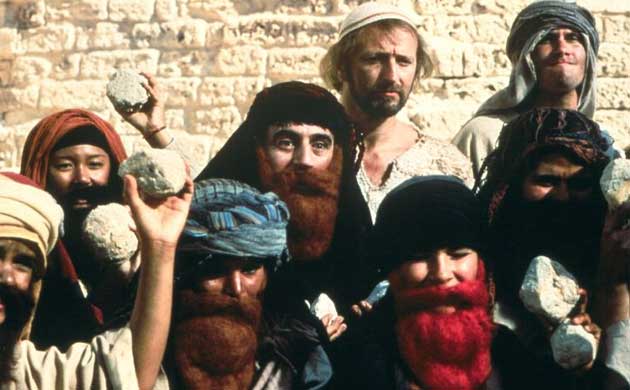
From this point Brian's life is so closely alligned to the Jesaic one that all the gospel scenes of soberer movies can be lampooned often to savage effect. From the women disguising themselves as men to take part in stonings, the bullseye evocation of Biblical prose at its most tiresomely pedantic, the credulity of those so blind they will only see what they're told, the ludicrous infighting of the resistance movement, a very very funny twist on the Barabas/Christ mob choice scene. And finally there's a Spartacus joke at the end just before a chorus of Always Look on the Bright Side of Life sung by the mass crucified. At that point a younger audience has probably been given as good a primer on religion origin myths as they are going to get.
Five crosses!
THE PASSION
![]() | |
| Jim Cazeivel shares a joke with Cleophas in The Passion |
But the driving idea behind this film is not linguistic authenticity but an altogether other realism. Gibson's stated aim was to depict Christ's ordeal as graphically as possible. He wanted to confront the easy of faith with the searing example of Christianity's central figure. And that's what happens. We begin in the garden of Gethsemane where Jesus is praying hard and close to faltering. He is approached by a waxily pale woman with a voice like a first violin lesson who suggests he throw off his burden of mission. In case you hadn't twigged who this figure represents Mel organises a fly to emerge from one of her nostrils. Oh ... it's Satan. Good call on the casting, there, Mel. Threw me.
Then the Romans barge in, wake everyone up and seize Jeeze and pack him off to the Procurator of Jerusalem, one Pontius Pilate. If you know your gospels (and Jesus Christ Superstar lead me to mine) you know the rest. In the film version the rest is a constantly amping catalogue of humiliation, torment, torture and degradation to the point where Jesus' ribcage is visible through his flogging wounds. Then it's off to Golgotha for some nailin' and wailin' and -- END.
Ok, Mel meant what he said. The passion of the Christ and nothing but. But while this concept alone might strike us as honest we ought to remember the filter its director pushed it through when making it. Mel Gibson is an avowed Catholic he's made a lot of that. But he's not just any Catholic, he's a pre-Luther, lightning casting, blood literalising, transubstantiating, monster of Catholicism. He didn't just go all medieval on Jesus' ayis because getting medieval and depicting Christ are indistinguishable to him. His is not the soft golden figure on bookmarks and cards, He is not an exalted blow waved glowing alien hybrid of Michaelangelo or Titian, he's a Grunewald Christ, torso ripped with splinters which make its viewers wince with pain. The Northern European rennaissance made its religious imagery hard won, remembering that while no one can easily imagine divine eternal light, they only need a splinter under a fingernail or a toothache to understand hell and suffering.
But here we come to my real problem with The Passion and it's the same as any depiction of suffering toward a religious end. Isn't the fact of seeking to outdo all other attempts and provide the most churningly violent protestation of faith not the kind of hubris that might well constitute a mortal sin? Is Gibson's grandstanding humility not the thing centre screen? It seems to me that the most glaring question of this film is not the extent of its gore but the huffing and wheezing orgasmic blindout that cannot provide the difference between passion and pornography.
Four crosses for the attempt at authenticity but two off that for the sleaze from the director's chair.
THE LAST TEMPTATION OF CHRIST
![]() | |
| Passion play ... Sopranos style |
Scorsese had always attracted me with the honesty swirling in there among the violence. The trouble taken to play out situations so awkward that they felt like the audience's own memories. Marty was a New York Catholic from Little Italy and knew his neighbourhood and its religion. He even studied to be a priest. Lapsed or not, his Christ story was going to be compelling. And it is.
Dafoe breaks through my image of him as a slimy psycho and rises high into the Christ persona. I'm not saying that because he's playing the son of god, I'm saying it because he's playing someone who is surprised and frequently terrified by his sense of mission. It covers a multitude of pains as he walks from moment to moment accommodating the ridicule of others and his burning self doubt. When he does act and speak like the Christ of the gospels it is either emboldening or heart rending. All this with an understatement that seems like a natural self-armor. Dafoe's Christ is constantly so many things at once it's like watching a Bach fugue walking around in a homespun robe.
And that's just Jesus. The most prominent figure besides Jesus is his old mate Judas, played by the leonine Harvey Keitel (who voices a real lion that appears to Christ in the desert). Judas, in this account from the novel by Nikos Kazantsakis, is Christ's minder, not just his disciple but the voice of a human conscience. In an early scene Judas goads Jesus in the carpentry shop, attacking him for making crosses. This could have been a scene from Life of Brian (it isn't easy keeping a straight face through the initial dialogue) but it sets the tone of the rest of the film and if you can accept it you're in for something strong.
And these are the goods Scorsese delivers. A north African location shoot with period costumes and a selection of Renaissance aesthetic performed with the voice of the mean streets of Little Italy. There's a lot of tough stuff in the novel which Marty puts right up there on screen in this his second last great work. Oh, and when I said Renaissance I meant the ugly northern one as well as the more teatowel friendly one that happened in Italy. If Willem is a Boticelli Jesus, Harvey Keitel is a Hieronymous Bosch Judas. A scene close to the end which is a frightening cover version of one of Breughel's visions of Hell.
But the thing that made this telling contraversial is the notion in the title. Christ's torment on the cross comes to a sudden silent halt as an angelic little girl bids him come down and leave his suffering. He does so and walks into a world that at first reveres him and then patches up any earthbound temptations he picks up. Legend diverges from life until he meets Paul (an angry Harry Dean Stanton) tells him his continued corporeal existence has become an embarrassment to the industry built around the inspiring version of the story. A final confrontation with a still living and judgement-heavy Judas and we are whisked back to Golgotha which is no longer a nightmare of human pain but an exultation of the spirit. "It is accomplished," murmurs Booby Peru on the cross. But he's smiling and not Bobby Peru anymore.
Four crosses
THE GOSPEL ACCORDING TO MATTHEW
... or, more usually and against the director's wishes, THE GOSPEL ACCORDING TO ST MATTHEW
![]() |
| Who cares if it's trad. It's beautiful. |
Christ and his disciples here are pretty clearly as Marxist as the limitations of the source text will allow. This is the Jesus who says he comes bearing a sword but, as this is not an American movie, he knows his audience is not going to take it literally and expect him to tie a band around his head and get all ripple abbed on Judea. The control Pasolini exerts over the text and even his own fiery anti-religious fervour results in a depiction of the Christ story that is clearly serving an agenda (Satan appears as a modern day Catholic priest, for example)
but also quite sincerely serving its origins as well.
Pasolini was a complex figure capable of brutal work, bombast and quiet beauty. Here, he almost challenges himself to find something he can put his name to and still serve a traditional audience (though one prepared for more depth than usual in this central account). Neo-realist religion? Here it is. Plain, if not entirely simple, and the pick o' the bunch.
It's out on local dvd. Find it.
Also recommended but so difficult to find it's almost futile mentioning it, is Dennis Potter's television production Son of Man. Christ and apostles are drawn from Potter's Forest of Dead childhood but the creulty and heart tearing gravity he could wrest from his dialogue are all present. And, another thing I've only seen on tv, a realisation of the Pilate and Christ sections of Bulgakov's Master and Margarita. Also, funny and heavy as Russian lit and UK tv. I can't even give you the title of it but I wish it would appear somewhere.
As to earlier tellings like Life of Jesus, Jesus of Nazareth,The Greatest Story Ever Told etc, they aren't for me. I like the story itself, still, but accounts that give no edge to the figure of Christ seem like wasted time to me. Anyway, there were a few that couldn't escape my attention. But if it's real post prandial viewing on the day of days for the king of kings you want I'd track down a copy of the 60s St Trinians movies or the Tawny Pippet. Relax, sit back, drink, digest. It's Xmas. Speaking of which. Merry....
Subscribe to:
Comments (Atom)