Sunday, March 31, 2019

10th Anniversary Autumn Program


So, I was referring to some old blog entries and noticed that I hadn't for a long time done any of the lists I used to do about how I'd like to see some remakes done or simple top tens. This meant I had to come face to face with the timeline and realised that this blog and the film night it supported were begun ten years ago. In fact the month o' March is the anniversary.

So, I thought, instead of a nostalgic post, how about I think up screening seasons the way I used to. I'll think of themes for the sets of titles and even cobble a trailer together if time and materials permit. Here's the first one I did: https://pj-shadow.blogspot.com/2009/02/

It'll be like that. I don't have a venue and won't be doing any screenings the way I used to but I can make some recommendations and you can do the rest. We're almost out of the beginning of autumn (when the original one began) but I'll start with that and go until summer at the end of the year.

Autumn 2019: THE MAGIC REEL
Magical realism began as a literary term and covered Jorge Luis Borges and a number of South American novelists in his wake and thence to Europe (Gunther Grass, Patrick Susskind) and even our own shores (Peter Carey). To say cinema was slow to adopt this is to miss how magical realist it has been from the time of Melies films onward. There are films that took their cue from the literature and others that, by dint of their own intense individuality, stumble into it. Here are some for the most magical realist season: Autumn.


TIGERS ARE NOT AFRAID (Issa Lopez Mexico 2017)
My favourite of the 2018 Melbourne International Film Festival this mix of grimness and airy whimsy can create a frantic fear one moment and a great warmth the next. A girl in Mexico City has her life disintegrated by gang violence and, left with nothing else, she must find and join the underworld of drug war orphans who are gathering in the city. Blood streams from corpses on the footpaths and slithers along walls and follows her into her house. An embossed dragon on a phone case takes life and flies through the darkness. And then there are the tigers of the title, sometimes figurative and legendary, sometimes all too real.

SPECIAL (Hal Haberman/Jeremy Passmore USA 2006)
This is a superhero origins story unlike any other. Les is a young parking officer who volunteers for a pharmaceutical experiment for his depression. It doesn't just ease his condition it gives him superpowers. He can go through walls and levitate. When other people see him demonstrate them, though, he's just running into walls or sitting in chairs. Two big pharma guys are after him for his signature on a non-disclosure about the failed drug trial but they increasingly take on the vibe of super villains. Les, alone, faces a world of crime that only he can meet. Coming across like something from the realm of the cult movie heyday of Repo Man or Love and Human Remains, Special wears its indy badge with pride and digs in despite the budget constraints to offer some real heart along with the action and the comedy.

SAUNA (Antti-Jussi Annila Finland 2008)
As an exhausted conflict ends in the 16th century two brothers travel to a remote region of Russia to map the new border. The intensely withdrawn inhabitants of the village they stop in do little to assuage their fears of potential fresh conflict. Oh and there's a strange building in the swamp that has no doors ... sometimes. This thickly atmospheric folk horror will feel like home to both fans of Tarkovsky and Clive Barker.

THE ENDLESS (Justin Benson and Aaron Moorhead USA 2017)
Benson and Moorehead are emerging as the keepers of Lovecraftian mythology in independent cinema with outings like the fabulous Spring, the mumblecore weirdness of Resolution and now this setting in one of the creepiest cults you could imagine. Two brothers who escaped the cult as children are sent a tape encouraging them to return. The younger is eager for one last look. The elder is wary but agrees to go along with the condition that they stay for a day and leave again, this time for real. Nothing ever goes to plan.

TIMECRIMES (Nacho Vigalondo Spain 2007)
My favourite time travel story deals with the paradox of doubling head on as an alarming crime seen by chance through binoculars reveals ever more bizarre persectives once the witness begins his investigation. Only as long as it needs to be, this break neck sci-fi will leave you tracing the events backwards looking for the seam.


GOD TOLD ME TO (Larry Cohen USA 1977)
In honour of Larry Cohen who died this year is this strange piece from the seventies that won't sit still and accept a genre label, having liberal doses of police procedural, cultism, supernatural horror and some truly buzzy sci-fi. Cohen had a cosmic imagination and plied it on a shoestring budget. A series of murders is taking place in New York. The perpetrators are unconnected save for one detail: they all claim that God told them to do it.

MAN FACING SOUTHEAST (Eliseo Subiela Argentina 1986)
A new patient appears in a mental hospital without official admission. He claims to be from another planet. He warns anyone who will listen that earthlings are doomed if they continue to live so violently. His psychiatrist, who must listen, is surprised out of his own flattened morale to accept the newcomer's charm. Who, in the long run, will be treating whom? This '80s arthouse favourite form Argentina takes its time to build its world but does so with a lightness that never drags and suggests much beneath its currents. A quiet classic that begs a revisit down the line.

THE CABINET OF DR CALIGARI (Robert Weine Germany 1919)
Early horror cinema that didn't come from theatre looked only like itself. Nosferatu and Vampyr played by new rules, having more to do with fine art than books or the stage. This expressionist nightmare of the sleepwalker from a travelling sideshow plays out with a deadly dream logic made solid in its zigzag sets and misshapen city scapes. If you haven't seen it you need to. This is one of the originals.

If watching a silent film bothers you, know that its 67 minute running time shouldn't break the attention bank of the least legacy-tolerant.


PHANTASM (Don Coscarelli USA 1979)
Mike is noticing some strange stuff around town. His older brother Jody doesn't believe him but soon has to as he starts seeing them, too. Shadowy munchkins in the trees, a funeral director who lifts occupied coffins like rolls of carpet and severed fingers in foam cups that ... well, you'll see. One of the oddest sci-horror films ever takes an imaginative ride from a sense of the other into a deep well of WTF. Too adult for a kid's adventure but too kid-led to be quite grown up it would have been a nightmare to market and that's before you get to some very strange concepts and a great flair for necessity-driven invention. There's only one of these (I know there are sequels but even counting them).

THE SPIRIT OF THE BEEHIVE (Victor Erice Spain 1973)
Little Ana and her sister go to see Frankenstein when a travelling cinema show comes through their village. Ana is haunted by it, believing her sister who tells her the monster lives nearby. It is Spain as the civil war is drawing to a close and the bad guys are winning. Ana goes roaming and does find something. It's kind of like what she's expecting but every day is a new volume of information when you're that young and all sorts of lessons wait in the dark to take shape at sunrise. Victor Erice's haunting tale of childhood discovery uses stillness and solitude to create an increasingly compelling narrative of the emotional extremity of childhood with the spectre of the worst of adulthood whispering in the fascist symbols on the walls and in the distance.

BLISS (Ray Lawrence Australia 1985)
I was already a fan of Peter Carey's strange Australia which was openly a renewed colony. Bliss in the novel is set on the edge of the American empire. The film doesn't need to do that. All it needs to do is show an Australian family whose survival depends on advertising. The rest is toward or away from this reference point. This was the first film I went to at a cinema after I moved to Melbourne. Ray Lawrence, in the middle of his own career in advertising, brought Carey's absurdist fable to full rich car ad colour. It immediately stood out in Australian cinema for its strong characters and meaty performances to go with the strong vision. It also came into the cinemas with a reputation for having disgusted the audiences at Cannes into walkouts. I sat in a half full cinema at a mid morning screening and heard two women talking behind me as the production badges came up. "I hope it's not too revolting," one said. It took Lawrence decades to return to the cinema with the intense, brooding Lantana. Until then, this carried his name as the director of one of the strongest Australian films ever made.

BEING JOHN MALKOVICH (Spike Jonze USA 1999)
This might seem a mainstream choice but it's a way of celebrating a great year in cinema where mainstream and arthouse briefly became indistinguishable. Spike Jonze's bizarre fantasy moves with an increasing clip stuffing our heads with concepts that are hard to cope with but served up with delicious sauce.


Some of these are a lot easier to find than others. Few, if any, are likely to appear on the video on demand services but the hunt can be fun. Enjoy!

Friday, March 29, 2019

Review: US

In a prologue set in 1986 young Adelaide wanders from her inattentive father's care at the Santa Cruz fun park, makes her way down to the nocturnal beach and enters a hall of mirrors. There she finds her double who smiles as though to prove she is not a reflection. Adelaide is so traumatised that she loses her power of speech and begins years of therapy.

A title sequence moves back from a rabbit in a cage to show a wall of them is what looks like a classroom as an unsettling choral piece that mixes modal melodies with dissonance and electronic percussion.

In the present, the adult Adelaide is driving with her young family to their holiday home Santa Cruz. The family loads in for the holiday, they bicker at the dinner table but settle in to their vacation. Adelaide keeps noticing coincidental moments happening around them and feels increasingly off. And then their son comes in to tell them there's a family standing in the driveway. Going down to look they see a group of four, a mother and a father and a daughter and her brother. Apart from their strange red uniforms they seem the exact doubles of Adelaide's family.

There is too much to spoil beyond that point but I can say that the second act is a deftly controlled quilt of Adelaide's childhood memories and the weird home/life/identity invasion story that cracks and bangs like a string of penny bungers. And while it gets busy with the middle act struggle new themes emerge which at first feel like enrichment but are all foreshadows. Which is to say that the machine is a little more evident in this serious horror piece than you might expect. We are being informed as clearly as we were with the same team's Get Out that this horror of the Other across the divide (of stratification, privilege, culture and knowledge) wants you to reconsider the title itself as one character says: "We are Americans."

Jordan Peele has gone even further than his debut in approaching the horror movie as sociology lecture. But when it's delivered with such style and compulsion I'm not going to complain and call it preachy. While the denouement takes longer than it has to and starts dragging it does bear a payoff that seals the queasiness of the ideas of the film and sets in to haunt you after the credits have finished rolling.

If your thang is spotting cultural references you'll have a library of them in these frames. There is a Kubrickian sense of un-submersible units with the prologue and each act having its own distinct pallet (which makes things easy when the memory/current action montages really get swinging) and the cast led by the powerful Lupita Nyong'o is solid. I cannot fault the score that takes its job seriously and blends well with sourced music.

I was sold on the premise and the pedigree. I'm a lifelong horror nerd and appreciate any genre piece that gets down to work as hard as this does. If there's anything I wince at in a horror film it's moments where pact is broken with a situational laugh here or a flatly routine approach to what constitutes a scare (a trailer at my screening for the new James Wan guff was almost all jumps). Instead of sudden jolts or an over reliance on convention Us goes for our mental satisfaction, planting seeds of distaste and self-recognition there which we cultivate whether we want to or not. If this is what Jordan Peel can do then I can't think of anyone I'd rather at the helm of a ressurected Twilight Zone. Submitted for your approval....


PS. There are some massive plot holes in this film. I didn't mention this as it's an allegory rather than a realistic drama and I tend not to care too much about plot holes anyway. I understand why some people can't get past them I just tend not to share the concern.

Monday, February 25, 2019

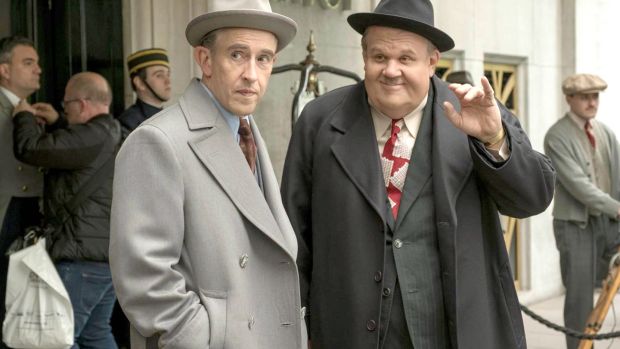
Review: STAN AND OLLIE

Biopics are handicapped. Everyone knows their subjects and will pat them on the head indulgently as they recall the great moments without having to do much as movies. The exceptions use the lives they depict to get us thinking about our own. Amadeus doesn't match up to the timeline but it's really a story about genius getting attacked by mediocrity. Love and Mercy takes that further by adding an aggressive external influence to exploit low self esteem and further still by jolting its audience between a past that looks like the past and a present that feels ugly and confronting. Stan and Ollie begins with a shot that takes our minds off our expectation that the actors will or should exactly resemble their historical characters: we see the famous comedy duo from behind, chatting in makeup chairs. We're not even invited into the conversation but we do get a good idea of how the pair relate to each other.

And then we're into it, a present day (meaning the 1950s) story of the two reconciled after ears of estrangement with saliently placed scenes from the cause of the rift. In the '50s, Laurel and Hardy are touring Britain with a live show towards the promise of a new movie. The venues are small and underfilled and the sense that they are treading on territory forbidden them by the passing years is strong. The idea of the movie spurs them as they develop Stan's routines. Meanwhile, we follow the timeline of Hardy's betrayal of Laurel for the sake of job security which brought the partnership to an end. A begrudging agreement to start publicity stunts wins them new audiences and their fortunes reverse. Their wives join them on tour and the success balloons. But old resentments and the charge of ageing are going to want their own hour upon the stage.

See, already that's more than a series of great moments in history. This is largely due to the story starting after the years of inspiration and rise. No one snaps their fingers and says, "that's it," with a shock cut to the fully realised bit. These artists work on their routines as they would have, here a tweak there a tweak with the writer Laurel receiving light but knowing reward from Hardy's laughter. For the benefit of the uninitiated (like me) their interaction quotes a trove of gags and the writers remember to make sure they are funny. On that generational divide in one scene Stan tries breaking the indifference of a receptionist with some great bits which only puzzle her.

But this is less the story of Laurel and Hardy than of two longtime colleagues who harbour gripes and still need to cope with them while their livelihood and friendship are at stake. So much of this is polished through performance and the onscreen chemistry of Steve Coogan as Laurel and John C. Reilly. Coogan runs against type by acting a character rather than fitting one to his public persona and his Stan Laurel keeps a strained control over his growing anger. John C. Reilly is a dependable character actor and fills Hardy out with a quiet pathos that can vanish beneath a roar of worldly laughter. The pair's spouses have also been well written and steal their scenes. Shirley Henderson lets show the strength that gets her through a loving but difficult marriage as Lucille Hardy and Nina Arianda allows her sincerity to peep through a hilarious brashness.

The sole complaint I have about the film is something that serves as a hobby horse for me and probably won't be noticed by most who see this film: the score. Given that the writing, tight direction and masterclass performances keep the frequently threatening sentimentality well at bay the orchestral score which has a an old TV movie heavy handedness too often breaks through and tinkles and noodles around like a fan who doesn't quite know what to do on finding their hero, so makes a lot of goofy appreciative sounds and hangs around too long. Less would have definitely have been more. It really cheapens things.

That one thing aside, this is a film of entertainers and shows up ready to entertain. It's also a film about ageing and feeling out of step with time, about friendship, marriage and their inconvenient demands so it puts those things in the way they appear in life, sharp, burning, hard and, now and then, sometimes, in moments of relaxation or abandon, purely joyous. The best thing I can say about this biopic is that it doesn't have to be a biopic.

Friday, February 15, 2019

Review: BORDER

Tina has the jutting forehead and forward mouth of an early humanoid. We see this in the film's second shot. It's not a spoiler to reveal that she later attributes this to chromosomes. She works as a border inspector, using her heightened sense of smell to pick out the kind of border crossers who are walking in fear or nervous states. Her accuracy is impeccable. One such she catches leads to her involvement in a police investigation.

One day a man with her peculiar looks passes through. He has no perceptible smell. The two regard each other with powerful and confusing emotion. His unsettling confidence returning, he tells her where to look for him and passes on. Tina tries to resume normal life sharing house in an uneasily platonic life with a young dog breeder called Roland but is too haunted and seeks the man, Vore, finding him at a local hostel. After an encounter which draws her into his normality she relaxes into relief and invites him to stay in the small bungalow at her place.

There is far too much to spoil if I described more of the plot. Vore and Tina's increasing intimacy changes everything she was confident of in her world. Having learned to keep her place at the level of a sniffer dog, enduring the audible insults of the normals who pass by her intimidating gaze at the border she learns extraordinary things about herself from Vore.

Up to this point the film deftly challenges us to feel more than we wanted to for Tina. A few scenes later we are asking ourselves questions about our own acceptance of difference to degrees we would be too automatically guarded if the story involved the more recognisable spectre of intra-human racism. It's not just Tina who's getting a few life lessons. The expertly handled blend of magical realism and Nordic grit help us here. Tina and Vore look like Neanderthals but they are considered ugly rather than impossible. It's clever but it's also unfailingly warm. So, it works.

And then it gets dark. And then it gets darker. Unrelieved by sentimentality but rather leavened by the commitment of anyone who makes it to the third act, Border is a triumph of sustained credulity, a kind of prolonged dare to call it impossible and it is issued without a moment's collapse into cuteness or the dilution of comic relief. My cinematic year has begun.

NEXT OF KIN: Going Home Again

I bought my first copy of Cinema Papers because it had this image on the cover. Wow, an Australian horror movie that looks like a European one! That's for me. Also for me was the opportunity to read an industry magazine that made this film undergrad look and feel important. The story was thorough though a thinly veiled promo for the upcoming release. Except it wasn't a release. I waited months, looking for the title among the lists at both mainstream chains and arthouses around Brisbane to no avail. The cinematographer was touted as one of the nation's finest and costar John Jarrat was if not a household name more recognisable than most. This was in the early '80s, the era of The Thing and Alien, genre was news. But nothing. I went back up to the parental seat in Townsville where I found it on VHS. Straight to video was soon to be the judgement phrase to mean genre crud for pizza and beer nights. So, I rented it and watched. It was ok.

So, what's it about? Ok. Young Linda returns to her mother's country mansion as part of her inheritance. It's also an old people's home. She gets along with the staff and guests alike and even picks up a young and hot John Jarrat as a boyfriend. An ongoing narration of her mother's diary seems to reveal a kind of evil presence in the house. Some of the guests die. Eventually it ends with a big finish. I returned it the same day and moved on.

Recently, the film has resurfaced on Blu-Ray and I thought I might as well try it again. Maybe it fared badly in 4X3. Maybe the mono mix of Klaus Schulze's electronic score would bloom in multi-channel. Maybe I expected a more generic horror movie and forgot to see the subtleties of an energetic young team who wanted to form their own atmospheric genre.

Well, it's not bad but you have to ignore any of the hints you get in the first ten minutes that you are about to see a horror film. Jacki Kerrin is not a scream queen nor a Ripley, she's relaxed to the point of sedation. Often it feels like she's acting intentionally under the key of the writing to avoid cliche. There's no lack of intelligence in her demeanour just a lack of fear. John Jarratt perks her up a tad as his own presence is dependable. The cast of old eccentrics do their work and the third act does the heavy lifting on a movie that contains almost none of the horror it starts with. There is almost no tension in this film. But that might be the game.

A scene that in today's money would warrant a double jump scare is played out without alarm but plenty of aesthetic detail (e.g. a sudden uplit face). The figure of the girl with the bouncing ball only appears to guide the living to discoveries but none of them are remarkable. The deaths could easily be due to old age. Are the creepy doctor and administrator in cahoots? Find out. The sex scene happens with the lights out (really, all the lights are out; you see a back, kind of). And so on.

So it plays against genre, then. We'll it's so listless that it's hard to tell. If you take it as anti-gothic what does it offer in place of payoffs? Playing more like documentary style but in a creepy house would have to wait until the noughties and the post-Blair Witch trend. And there are those few moments in the closing scenes which are straight out of contemporary horror cinema (no spoilers here, though the reveals are so irrelevant it's hard to spoil them). Is that a satire? It doesn't feel like it.

In the end Next of Kin works best as a curio, a horror movie without scares or suspense but big colourful style in the era of low-key realism in Australian cinema. You could put it on to enter a new world where the bizarre rates little mention but looks like a million bucks. For me it was a little like going back to Townsville in summer by train and finding my parents not only alive but the age they were when I was young (but I would be the age I am now). So, maybe Thomas Wolfe was right about going home again. You can do it but you can't but if you do there are films like this to tell you why.

Monday, December 31, 2018

2018: THE HIGH


THE FAVOURITE
Yorgos Lanthimos escaped the yoke of being the leader of Greek weirdcore a few films ago without needing to do much more than change languages. His third film in English is an energetic and deep essay on power with a cast for the ages.

HEREDITARY
This caused a lot of whinging as its massive midstream shift was seen as a letdown. I went with it and enjoyed it more than most of the new films I saw this year.

A QUIET PLACE
The story of a family struggling to maintain itself in the face of an existential threat. Beautifully realised by a first timer.

THE SHAPE OF WATER
Maestro Del Toro tells a fable like no other, this time of pride in difference opposed by the shame of keeping it secret.

OUR HOUSE
Parallel universe or haunting? This strange debut feature from a student of Kyoshi Kurosawa brings back what the teacher has apparently abandoned, the sublime in horror.

TIGERS ARE NOT AFRAID
Tough and mean but heart rending in the most beautiful way.

THOROUGHBREDS
Nasty and stark but the more powerful for that. Great performances all round. Still waiting for a release locally.

HERE TO BE HEARD
Strong rockumentary that neither elevates nor bores which makes it almost unique in its genre.

LUCKY
A poignant farewell to an old hand managed also to serve as a deceptively light tribute to finding treasure in the everyday. Haunting.

BEAST
Unexpected. Like Ben Wheatley meets Ken Loach and a commitment to a devastating conclusion.

SORRY TO BOTHER YOU
Satire writ large in this lashing of contemporary and future capitalism. Might well prove to be the cinematic satire of its era.

TULLY
Tale of impossibly angelic stranger improves the more thought it's given afterwards. Good turns by the two leads and a very funny subversion of the let's-party drive to a golden oldie.

2018: THE MIDDLE


GAME NIGHT
It began, progressed and ended without great strides in the art de cinema but it was a well paced comedy that stuck to its guns. I don't see enough of them.

UNSANE
Stephen Soderberg is prolific filmmaker but has never been an auteur. Any of his films could be by anyone as he doesn't appear to be obsessed with making the big scratch of cinematic signatures. This tight thriller with the preposterous plot works a charm, never claiming to be anything else. Shot on a modified phone but you wouldn't know it.

CARGO
Interesting take on zombie/infected tale in the Australian outback is an efficient story of family, the land and its first peoples. Could have been a lot darker to better effect.

COLD WAR
Same director's Ida left me with more shivers of delight at seeing a great small film. This, though, was a fine piece.

LADY BIRD
My initial enthusiasm for this one was, I think, too driven by my relief that it wasn't a Noah Baumbach/Wes Anderson cringe but a genuine account told with underplayed flash. Superb performances are where most of the work went and it paid off.

BOHEMIAN RHAPSODY
Sheer joy when I saw it at the cinema but it doesn't linger so finely in the memory.

THREE BILLBOARDS OUTSIDE EBBING, MISSOURI
Solid plot of righting injustice with a powerhouse central performance by Frances McDormand. Some misdeeds by its chief lunkhead character never examined after his redemption which leaves a bad taste.

I, TONYA
A blend of redneck ridicule and the divergence of personal recollections of the same events could not resolve itself for me. Good performances and an appreciable treatment of domestic violence almost take it into the High list but not quite.

THE DEATH OF STALIN
Mighty cast and some tough satire give this grim political fable a place at today's political table but perhaps too many easy dismissed moments of horror which play lightly and move toward overload.

DISOBEDIENCE
Compelling tale of freedom and morality in a guarded culture let down by a few too many obvious metaphors where more concentration on the already strong central relationship might have served better.

NICO 1988
A good rock bio movie that has a good look at post-fame careers. Not quite loveable but impressive for its contempt of the hagiographic approach.

THE CHILDREN ACT
A decent tale of ethics and impressionability goes further than it needs to prove its point. Very good performances, though.

LADIES IN BLACK
Coming of age tale diluted by lack of sense of struggle despite great charm in some of the performances. Also, scores like this one don't belong in the cinema.

CAN YOU EVER FORGIVE ME
Some very fine performances and an intriguing premise can't quite lift this one from its over-even treatment.

THE WIFE
Fine central performance in a story that could have done with more muscle from the writers and director. Not quite a waste of Glenn Close but ... close.

MY FRIEND DAHMER
Decent enough adaptation of the graphic novel but couldn't eclipse it.

THE BREAKER UPERERS
Consistently funny and subversive but perhaps a little too neatly wrapped.