Saturday, November 27, 2021

Review: LAST NIGHT IN SOHO

Ellie is dancing to Peter and Gordon in a puffy paper dress of her own design when her nan calls her downstairs. The post has just come. She's got into fashion school in London. London looks and feels just as she imagined, lights, life and colour (and creepy cabbies) but when she gets to the dorm it's all bitchface girls thankful for a non volunteer leper. So, she gets a job and moves into a bedsit and all is well. Well, she starts having dreams that she is back in her beloved sixties, strolling in a hoodie through streets of Aston Martins, dolly birds and black tie clubs. 

At one of the latter something strange happens. The attendant takes her hoodie, referring to it as a cloak and she's in. But when she looks in the mirror a blonde stunner in the haute couture is staring back. When that girl, introducing herself as Sandy to one of the megasleazy tuxedo oldies in the club, moves about her mission to start her shobiz career at the top, we see Ellie in mirrors. When Sandy starts getting too deep into Soho's Babylonian underworld things get darker and nastier as Ellie first observes but increasingly gets involved.

That's much more plot than I usually give but the setup is fairly complicated at first so the rest can flow with ease. Writer/director Edgar Wright speaks of the1960s as the decade he just missed out on and invests a lot of this longing for a former era into Ellie. So, whether it's on an old portable record player in the bedroom or bluetooth headphones in the train we get a wall to wall '60s jukebox. No complaints from me, there. But the other nostalgia on show here is for the tough thrillers like Repulsion and Don't Look Now (which Wright himself cites as influences) but the whole raft of Italian Giallo thrillers with its hallucinatory dreamscapes, lysergic colour, violence with blades rather than bullets, and transported Hitchcockian paranoia.

That nostalgia is going to keep returning to centre screen the way real nostalgia does to each of us, but not just in design or sourced music but in the characters themselves. Ellie missed the '60s by about four decades and to her it is a vision whose life is one of unattainable longing. When she enters Sandy's world the logic of what Sandy is trying to do bumps up grossly against her own vision. She doesn't get to go on stage after Cilla Black in the first '60s scene but she does get to audition at a lesser club. Her sultry rendition of Downtown (Anya Taylor Joy's own unaccompanied rendition, and it's sensational) is squashed into a caryard cube when we see the part she really gets. 

In a striking scene a performer costumed as a marionette mimes Sandy Shaw's Puppet on a String in an outfit so oldie it's gold. Around her, a line of dancers with chairs perform robotic burlesque moves, gyrations, leg spreads, with doll-like expressionless faces. They are clapped on by a group of men done to the nines for a night on the town, all blue suits (you can almost smell the cocktail of cologne and sweat). Sandy is not even the lead mime, she's one of the dancers, looking, as they do, like she's coping with shock. This scene is pure Kubrick. It's not a copy of any of his scenes, mind you (although you could think of it as a reversal of the end of Paths of Glory) it's just that the collision of Sandy's ambition and what her world prefers her to be have a visibly brutalising effect. The detail and icy precision of it hammer that in. This is a bridge between Swinging London and the Soho of the Krays and holding on to nostalgia is going to feel druggy in the ugly sense, loss of control and amped-up threat.

While these themes are given rich time on screen by Wright 'n' the gang he curiously falls short in the thriller department. Halfway through the middle act there is a drag as the action that tightens the bonds between now and then, Ellie and Sandy starts to get repetitious. The film starts to feel long rather than deep. I wish the trope of the ghostly figures (not that much of a spoiler) had more eeriness to it. A case of less is more on that one.

But I wonder if I'm on the wrong track there. Part of what is going on here is another mix of old and new that reinforces all the themes around it: the casting. Thomasin MacKenzie as Ellie and Anya Taylor Joy as Sandy give plenty of evidence that the art of screen acting is far from lost, both delivering well crafted physical and vocal performances throughout as they have to compliment each other as characters but also remain distinct (and Wright really does push the physical resemblance hard). Terrence Stamp as a tough old Cockney is a natural. He gives only as much as he needs to keep us guessing his identity in the '60s world. 

But it is Diana Rigg who really shines. She was required viewing in the '60s as half of the team in The Avengers, the groovy spy-fi X-Files precursor. Her character name in that was Emma Peel and it was a construction: m(an) appeal. If anyone knew what both being in control of their career involved and the strength needed to keep herself out of the downward pull of the culture felt like it was she. It's a strong performance that contains the poignancy, pathos and comedy she was always so strongly capable of. If that started sounding like a eulogy then it should. This film was her swansong, she died last year (not of Covid).

So, while more middle-heavy than it should be Last Night in Soho leaves a good impression. A fable about the dangers of nostalgia (especially when it isn't your own) folded into a trippy urban thriller, it is one of the better fates that await the unwary ticket buyer now that cinemas are open again. Bring a little patience to the screen and it will do pretty well by you. The lush to gaudy pallet will dazzle, the music will spark interest in one of pop's greatest decades, you get two of the most promising young talents in cinema to watch and also get to say farewell to Diana Rigg in style. Good value right there.

Sunday, November 21, 2021

Review: IN THE EARTH

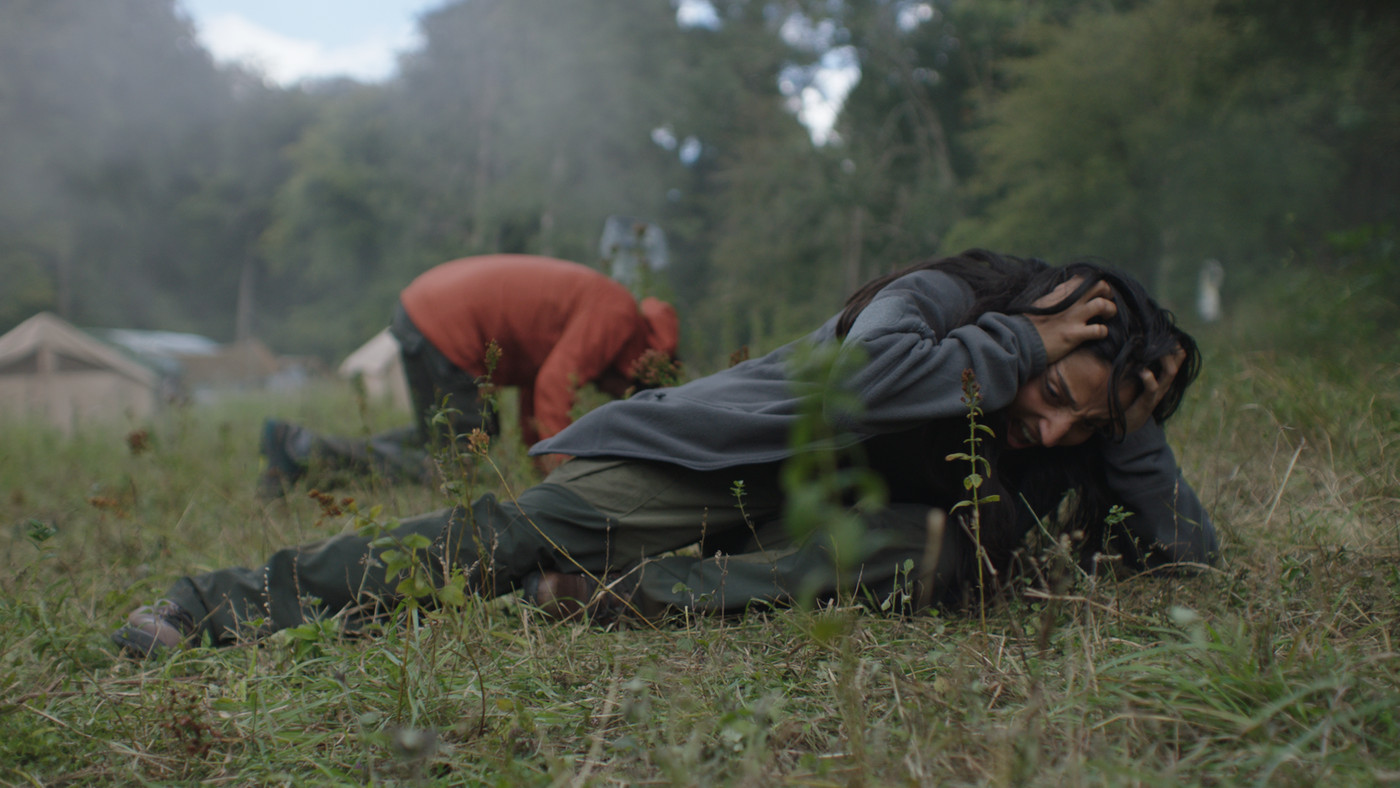
Martin, a young botanist, travels to a remote scientific station near a large wood in order to perform some checks in the forest. After a COVID-like series of health checks (there is a pandemic in the cities) he takes in some of the local folk art still evident in the ex-lodge and takes in some of the legends. All very colourful but he does have a job to do. He packs up with fellow scientist Alma and they set off into the woods on foot. Coming across an unoccupied tent, they note more examples of the local wood spirit seen in the art at the lodge. That night they are attacked in their own tents and wake to find their equipment trashed and their shoes stolen. City-bod Martin gashes his foot almost immediately and has to limp with a branch for a crutch through the bush until they both stop at the sight of the wild looking Zac whose tent is huge and houses enough room for them, some druggy fruit wine and shoes, glorious shoes. But if the relief of any of this is sending alarm bells it might already be too late to run.

There is so much spoilable plot after this that I'm going to stop it right here. There's still a fair bit to say despite that, though, and this new Ben Wheatley film is the kind that might take a few viewings to get quite right. This, will be a first impression.

Bearing immediate resemblance to earlier Wheatley films Kill List and A Field in England, In the Earth steers its own course towards an older tradition of sci-fi horror. Unlike the bait and switch of Kill List that goes from severe geezer gangster to folkhorror or Field that adds trippiness to its costume horror, In the Earth with its use of rainy day woods and the thing at their centre (a standing stone with an eye-like hole gouged from its head) plugging into something ancient and powerful, reminds anyone with a special interest or just memory of old BBC sci-horror like The Stone Tape or Children of the Stones. There are scenes where the expository dialogue approaches self awareness and it's a reminder of the days of Nigel Kneale and the need for clear statement of ideas driven by their density and weight. And there is the durable spookiness of those old shows that pervades here. Wherever you step, on the path or away from it, you are going to encounter something you hadn't bargained for.

But Wheatley is not playing a cover version. The pandemic surrounding the location like a force field is the reason for the scientists to be in the woods in the first place. The notion of the forest giving up a treasure of immunity is so close to pharmeceutical history as to be assumed by the viewer, but the link between asprin from bark and penecillin from mould and this complex living thing is well to the fore. But this is a horror tale and what starts as a simple expedition will have to become a nightmare trek as the science gets sidetracked and the anti-science plays for mystique and ritual. That's the thing that appeals to a world burdened by almost two years of pandemic, the craving for a treatment and the wildly ignorant myth creation on the fringes. This film was conceived and produced in time of COVID-19. Wheatley appears to have finally created an allegory that is almost indistinguishable from its model.

As I say, I probably need to see this again.


I missed it at the protean MIFF this year and it hasn't made it to cinemas so I rented it last night through Prime.

Sunday, November 14, 2021

DONNIE DARKO @ 20

One of the 2000's definitive films was a one hit wonder. Stepping up for the under-thirties, Richard Kelly gave us a film of strong ideas, great compassion, perfect casting, was easy on the eye, whose CGI effects still work effortlessly, broke a future A-lister and balanced on a tightrope of genre tropes that do not always knot easily: teen movies, psychiatric condition stories, Tim Burton style candy gothic, accents of sci-fi and more all form part of a smooth pattern that brings in a three act story on time and with great craft. Since then there have been a quirky epic that was universally reviled, and a retelling of an old Twilight Zone episode which was ok. Ok.

Then there was the director's cut, a bloated reprise that lengthened the screen time, messed with the sourced song list and all but fatally extracted the organ that made the original so robust: ambiguity. The swinging door that took the viewer from a time travel movie to a suburban gothic Beautiful Mind was barely noticeable the first time around. Kelly nailed it shut on the sci-fi side and made it feel ordinary. It left me and many others wondering if he knew what he'd done in the first place.

Teenaged Donnie Darko is woken by a weird voice that draws him into one of his sleepwalking episodes. The voice belongs to a human-sized rabbit with an evil grin, who tells him in precise language that Donnie's world will end in less than a month. Weird enough, but when he wakes on the golf course the next day he finds that his house took a hit from the falling engine of a jet airliner, his room is now several flavours of dust. When he tells his psychiatrist that he made a new friend she asks him if it's a real or imaginary one, he says flatly, "imaginary". At this point you know that you are in for a peculiar ride.

But it's peculiar in the best way. From the snapping table talk by the family at dinner to the conversation with Frank the Bunny, to the expansion and compression of time as the kids at school speed up or slow down in their movements, we are looking at a world through the eyes of someone whose every glance or stare is one of wonder. It's not all whimsy and fairy floss, though. Donnie knows that Frank drawing him out of the house that night saved his life. He finds it hard to connect to a world that feels like it's always going at the wrong speed and punishes any attempt to stop it (as his gym teacher does when he opposes the cringeworthy inspirational training she's brought in). If the surrealism of his dreams and day visions introduce a kind of epic beauty his encounter and courtship of Gretchen the new girl has all the awkwardness of genuine adolescent life. This and the stranger territories this film enters are navigated with such a confidently delicate helm that we really only notice after the credits that we've travelled so far.

And two decades have not wearied it. While in Australia it was a good performer for the art house circuit its true entry into the culture was on home video, particularly the then new and wondrous DVD which could offer alternative soundtracks (like a director's commentary), making-ofs or anything that could fit to give a feature film some extra context. An internet that had already fashioned meta-verses from tv shows (The X-Files had rewarded its Usenet fans by mentions or adoptions many times over) met the richness and promise of Donnie Darko with open arms and clinging embraces. This film is as much a part of the popular cinema canon as any classic you want to mention (I'm not going to as it will always leads to life-draining disputes) and will be there as long as we acknowledge the cinema of this century. The presentation I watched to write this article was the extended edition from Arrow in 4K, featuring both cuts and a host of swag. When it was announced I marked the calendar.

Watching it last night for the first time in many years I was again rivetted, watching it without interruption for the whole running time. The jokes work, the tragedy works, the performances impress and the movie bids me welcome the same way it did when I saw it at the Nova those decades ago (it wasn't released in Australia outside of Festivals until 2002, though). While I watched I couldn't help noticing something I didn't give much thought to at first watch. 

This film was made in 2001 but set in 1988. At the time I thought of this as a writer/director simply falling back on his own adolescence. Most of the post punk songs sourced as score extenders are from the other end of the decade (from memory only Under the Milky Way would have been recent) but good songs have a way of hanging around. Nevertheless, it comes across to me as more time stretching, not so alien to its setting as to be hauntological but still out of time. The contemporary presidential election between Dukakis and Bush has play in the family discourse and might serve as a reminder of more recent difficult elections like 2000's between the high profile Al Gore and Bush Jnr and how it was down to workers going cross-eyed to work out who the vote was for. It's release and conception put it way out of the loop of fictional commentaries on 911 but if it appeals to any era it's the close of the cacophanous '90s with its grunge and its Gulf War I and its Contragate and mass character assassination by internet post to a time when two rivals had to fall back on public discourse to run their campaigns. The aching wish for time travel to go back and stop it from going wrong was no less potent a thought then than it was when the towers fell and the wars were declared. No one who has lived on Earth for the past two and a bit years would need nudging on what they'd do if they could get in a Tardis.

And then there are the performances: Mary McDonnell brings a range from sharp intelligence, to pain to a crushing acceptance of what the world doles out as Donnie's mother Rose (she would be the centre of gravity in her every scene in the Battlestar Galactica reboot); Drew Barrymore brings the understanding that her acting royalty status and child stardom had given her to the teacher who might never make a difference to the minds she faces daily and the worse ones in school administration; Patrick Swayze's magnanimity in playing the glitzy lifestyle coach after a decade and a half of A-listing turned colourless is impressive; Maggie Gyllenhaal has fewer scenes than her screen and real life brother Jake but owns her young adulthood, holding it somewhere between diehard brattyness and  brash incipient growed-up-ness (it's her announcement that she'll vote for Dukakis that starts the family argument at the beginning). 

But, of course this film runs on its title character. This was not Jake Gyllenhall's screen debut but it was the role that broke his career so that he has not only never been out of work or the gossip magazines since but he's also a highly regarded member of the craft. He carries Donnie Darko because his intensity leads him to both inspiration and shattered communications and it feels authentic. The scene that really made me take note was Donnie's first real dialogue with Gretchen. He fights back his glee at getting the attention of a beautiful young girl but his enthusiasm keeps chest-bursting, the language variously rolls around his mouth or takes wing. He reminded me of Travis Bickle's early scenes with Betsy in Taxi Driver, the ones where he's too confident to notice how awkward he is being and the way this registers as a weird kind of charm in Betsy's eyes. Travis didn't have the benefit of psychiatry, though, and Donnie's dialogue's with Katherine Ross's Dr Thurman give him the opportunity to discuss the darkness that he fears is his fate. Ross's gentle gravitas contrasts with Gyllenhaal's unmasked pain and the scenes are electrified by the contrast between the pair. It's to Gyllenhaal's credit that lines that might have rested on the adequate shelf by a lesser player are elevated to unforgettable by his delivery and fluid physicality. His keynote is intensity and if  this means just plays himself each time it also has allowed him access to big mainstream Oscar bait like Brokeback Mountain, bizarro fable movies like Enemy, a Marvel Comic Universe character and the unforgettably creepy sociopathic human eel in Nightcrawler. All that started here.

So, did Richard Kelly just stumble on to a cult classic only to ruin it by changing his mind? That's a lot of confident and sensitive direction of actors and accomplished visual skill for a stumble. Maybe he just got sick of people coming up to him and telling him the "truth" of what his movie was about. His commentary on the director's cut includes a straight up claim that he only ever wanted to make a sci-fi movie. Maybe, but then why all the philosophy, why the real tragedy in the last act if you just want to do a time travel tale? Although I didn't rewatch the later cut for this article I wasn't inclined to as my memory of it was that the extra material either contributed nothing of genuine interest or only added more mysticism. What happens when you remove the ambiguity from a story like this is the removal of the audience's reason for staying. This happens too often with extended edits. Amadeus is rendered interminable with its extra scenes. Apocalypse Now Redux was worth seeing once (the "Final Cut" isn't much better). The 2000 cut of The Exorcist is still subtitled with "The Version You've Never Seen" even though it's practically the only version anyone can see now, despite the extra material making it drag and the added CGI just makes it look idiotic. 

But that's the thing, I guess. The best thing is to offer the choice. Almost every release of Donnie Darko since the Director's Cut has included both. For me this is just a reminder of a movie that was right the first time, one whose continued freshness and power make a new friend of its viewers every time. One hit wonder? So what? I don't have to be in the fan club to like Pop Muzik when I hear it. Same with this.

Tuesday, November 2, 2021

Review: ANTLERS

Twelve year old Lucas all but witnesses his father attacked by a wild animal in an abandoned mine. His teacher doesn't know this but picks up symptoms of abuse in the violent fairy tale Lucas presents as homework. It sounds less like a kid's story than a screen memory. A victim of her father's monstrous dominance she bristles and worries until she follows him from school one afternoon and, over a shouted ice cream learns the strange order the boy has made of his home life. We've already seen that there is a monster in the basement. Soon we are seeing Teacher Julia voice her concerns to her brother (town sherriff) and the school principal to little effect and we also see her fight her own stress by saying no to the alcohol at the local grocer. 

A few loaded guns right there and all this movie had to do was discharge them in act three as Uncle Anton commanded. But this Del Toro production of Scott Cooper's film (of Nick Antosca's story in the court of King Caracticus) has other plans. On the surface of it Antlers is the Stephen King style tale of a lonely outlier boy, bullied by a thickhead for his difference while monsters who might just bet on Lucas in a fight are roaming the Oregonian woods. We get the generic classroom lesson that makes the theme plain early on and we are apprised of how folklore however fantastic, has its origins in human misdeeds. 

Ok, all is well in horror movie land but Scott Cooper wants us to feel some of the humanity of the people he pushes into the room with us. Julia's PTSD is triggered but her strength is keeping it at bay for long enough to see it in reason. She knows she's one of the lucky ones as her brother Paul intimates later. Lucas is a believable twelve year old, meeting his extraordinary situation with a blend of fear and wonder, not entirely sure what he should be feeling at points of stress. And then you get the monster and the monster is not just a thing from the woods but has an origin and it's none too wholesome. A welling dread builds in the cold and dripping forests and mossy old houses and we know that when the action happens we will need to know that our tongues are tucked away form our incisors.

The very best horror is heavily flavoured with tragedy or at least sadness which can serve to stretch the violence and the mayhem into often unbearable extents. The mother/daughter bond is horribly racked in Dark Water. Even in 1941's The Wolf Man with its reluctant monster touches with melancholy. This is where Del Toro's influence is clearly felt. This is not to take away from Scott Cooper for fashioning a modern folkoric nightmare for these times of folklore in the breath of everyone outside. I put that bit in because I'm just back from seeing this at a morning session at Hoyts in Melbourne, the first real cinema screening since Supernova in April. It felt so calming and relieving being in a beautiful big movie palace with a massive screen and immersive sound. It's a testament to this film that my relaxation was shortlived. Perhaps it was this sense of relieving normality that influenced me away from some quite harsh review of this one but, dammit, I enjoyed it.

Saturday, October 30, 2021

PULSE@20


Computer wiz stares at his screen in his murky green Tokyo apartment. He gets up and exits, stage style, into another room. A group of twenty-something friends are talking about how they've lost contact with the computer wiz who has been doing some work for their startup business. Michi volunteers to pay him a visit and finds the apartment apparently empty until he appears, gives her the disc and goes into another room. She follows after an awkward pause to find him hanging by a noose against the wall. There had been a big oily stain there before. Now she knows it was shaped like his body. 

Across town young Kawashima, an ecomonics student, realises he has to learn to use computers to get through university unpacks and sets up his PC, clicking through the internet connection and huffing like a newbie at all the clicking and admin he has to do just to get started. He connects but the early 2000's OS does not look like Mac or Windows. On a black screen he sees the words emerge: "Would you like to meet a ghost?" What the hell, why not? It's probably the ISP doing some marketing. What he gets is a split screen of several web cams of people in blobby silhouette moving slowly around their apartments or just sitting at their computers staring at the screen.

Through a process of elimination the six degrees separating Michi from Kawashima vanish like all their friends and they find each other in a city turning into stains on walls, haunted rooms, driving through air that is filled with what look like uncrushed cremation ashes. To where? Wherever.

Kyoshi Kurosawa's apocalypse of loneliness (Kairo in the original Japanese which means circuit which is more appropriate) suggests a world to come will sound like the beeping and popping of billions of old modems as the people slowly harden on the walls and then dry to dust. Unlike other films from the '90s which showed the weaponising of the internet just as people were letting it into the lounge and bedrooms, the internet in Pulse has no malignance of its own, acting only as a conduit between worlds. There is no direct explanation for the ghostification of the world that appears to be coming through the screen, no imagined hyper-corporation or Bond villain, it's more of a phenomenon of a new nature.

Helpdesk woman Harue at the University cannot help newbie Kawashima very much but the computer lab she works in has a strange app running that models human connectedness. It was created by a grad student and she warns Kawashima not to look at it for too long. It looks like a screensaver of the night sky where the constellations move around in the dark. The lab, filled with students in an early scene gets progressively empty in later ones. The pair's own connection seems to be off to a great start until they both go to his apartment and she is compelled to climb the nearby stairs, returning to him minus a lot of her vitality. 

One of Michi's friends can't best his curiosity about seeing apartment doors sealed with red gaffer tape so he untapes one and explores the place. In one room there is a vague human shaped stain on the wall which on second look is a woman. As he begins to retreat she walks toward him in a slow but malevolent fashion. And then she stuimbles (but it could be a kind of dance) and keeps advancing. He is backed to the wall and crawls behind a couch but the thing keeps coming. He screams for us. 

This scene, often referred to as the stumbling ghost, makes it to a high spot on every scariest scene list that is made from the margins of the genre. It doesn't sound like much but the look, the operatic music and grimy hopelessness of it combine with the sheer lack of control over it we have as its viewers get into our spines. There are several more like it, each with their own special device of terror and they give this mostly quiet film a reputation for singular achievement. Nothing is like it, barring other films by the same director but even they don't approach it for the intensity of its dread. Michi's rescue of Junko actually feels demoralising.

What's the point? Well, as already argued, Kurosawa does not have a beef with information technology or even how it might be exploited by the usual suspects of government or capitalism. This apocalypse is about connection and its decay, the breaking of circuits. While there were forms of proto social media in 2001 like irc and usenet which were heavily populated and in constant use they had nothing of the cultural penetration found later in the decade and onward. But I doubt if Kurosawa has seen a great deal of social improvement from this thing that is so present with us now. 2021's Pulse would simply find the point of entry different only in appearance and more insidious. Then again, why bother when it was both the connection of it and the knowledge that everyone else was depending on it the same way as whole nations became shut-ins. Pulse in 2001 meant more. Kawashima in 2021 is too young to be anything but a native-born citizen of the internet and would never have gone through the frustrations that brought him to Harue. 

But that's not to say it doesn't work as well as it did. The notion of the teasing invitation to enter ghosts rooms and the energy draining webcam footage (in one a character starts to walk across a room but the image glitches and starts again creating a loop, it feels crushingly futile or even more crushingly might serve as the last evidence of the person who once was there. If anything, these moments look a lot like the kind of folklore that has grown around the notion itself of the dark web. Hell, why stop there? Youtube is bursting with channels passing home made horror as found footage. It's enough to make Pulse look tame. But it doesn't. Because Pulse is not about the computers but the people who use them and all else beyond whose connection to each other is being ironically deteriorated by communication.

The characters in Pulse are almost all young. The boss at the plant nursery, Michi's mother and the newsreader are the only prominent ones who come to mind and their presence is brief (the newsreader even gets glitched so that half his face is cut off by video noise. The youth of the principal characters is poignant as it is drawn from the hikkmori, the Japanese adolescents and young adults reported to whitdraw not just from the outside world but the space outside their rooms. Various causes have been suggested including a relation to autism spectrum disorder and PTSD but at the time the numbers of hikkimori were reportedly in the millions and looked to commentators like a social phenomenon. Kurosawa was imagining what an epidemic of it might look like. Any number of trival causes might add up to such a withdrawal without the person suffering noticing. Kurosawa adds the notion of ghosts escaping from their existential inertia into the living world as a kind of narrative diesel which he can use to avoid a lot of exposition. The inevitable U.S. remake has characters explain about the red tape as:"It just seems to work somehow." In Pulse someone imagines a situation where the tape used just happened to be a red the first time. The imagined scene suggests the colour took on a significance the same way that people wear lucky socks when they go to the pokies.

I said before that Pulse was unique but that's not quite true. It might seem extraordinary to suggest that the age range of its characters, its release date and location do not admit it into the canon of J-Horror but it really just doesn't behave like Ringu or One Missed Call. While there are three clearly discernable acts to the plot the tension is deliberately scrubbed bare to allow these people space and light enough to wonder at their continued life. One reviewer at the time memorably found it so difficult to describe the style of this film that he called it The Omega Man as directed by Andrei Tarkovsky. He was being funny but he meant it. The only films that this one resembles are its imitators. Those fail the same way that copies of Eraserhead or Possession fail as they don't come from the same compelled statement as the original. That's why Pulse still works, it's still there, sitting by itself, apparently the kind of horror movie ready to get up and dance like all the others but keeping quietly to itself until someone like you approaches it and an act of social charity becomes a meeting you will never forget.

Wednesday, October 27, 2021

Review: THE DARK AND THE WICKED

An elderly woman tends to her bedridden husband as she goes about the daily demands of farm life. Strange sounds at night as the wolf alarm (clinking things on a string) goes off in the barn containg the goat herd. Among the animals is a vaguely human shape with glowing green eyes. The woman isn't quite the same after investigating which brings her two grown up children back from their lives to help out. The woman cuts her own fingers off and wanders off into the night. She is found dead the next day. Then, in a series of horror effects setups the remainder of the household, some of their friends and the nurse tending the old man are beset by dark and violent forces ... for the next hour and a bit and then it ends.

High production values, good acting and some impressive effects and even a commitment to strong atmosphere cannot save this film from its own pointlessness. Why were the old couple targetted by the evil? It's made clear they weren't churchgoers which would point to the devil (whose warm embrace has chilled a little over the years) or god (who seems to have become even more of a bitch since he got away with his pranks on Job) but it doesn't really make much sense as it then attacks everyone who comes within a cooee of the farm. Is it like Hellraiser where you go to hell regardless of why you started playing with the Rubik's cube of the damned? Trying allegory, is it a grim statement on the withering fortunes of people on the land? I have to guess about all of these because all I get from the movie itself is that there's evil in the neighbourhood and ... don't step in it. There is an approach to a lot of the horror scenes that tie them that has to do with perception but nothing is made of that beyond the fact itself; it can't even say  beware of doing this thing because it feels written rather than thought about the thing to beware appears to have been assumed (beat the hell out of me, though).

I have long railed against the cattle prod approach to horror in films like Insidious or The Conjuring where 90% of all the horror scenes are unearned jump scares which work on surprise rather than suspense. There's not even a lot of suspense on show here: a bad thing is about to happen and it happens. Next!

I chose this as an expendable school night extended Halloween movie, thinking from the title and the tile art that it would be, at worst, a campy extension of The Exorcist. That it then goes on in an apparent campaign of letting its audience know that it's a serious horror movie only makes its lack of substance worse like a Shakespearean actor stage whispering with thunderous projection: "This is scary!"


Currently on Shudder.

Saturday, October 23, 2021

DRACULA @ 90

Last night I watched the 1931 Dracula. I can't recall how many times I've watched it and wouldn't ever try to number how often I've just seen the first half hour. I keep coming back to it and probably always will.

Why? Actually, yes, why, when I know that after Renfield comes crawling up the steps of the Vesta's hold with an insane grin and a honking laugh the movie changes gear, gets talky and then kind of ends. Would I be proud to serve this chicken to my family? 

Yes, yes I would. But with resevations. If you have no idea that there were films made before The Matrix you will not get why a rubber bat on wires representing a vampire could scare at least the characters on screen then you will never get this movie. If you think black and white movies are inferior to colour movies you will never get this movie. But if you care to bring your imagination to a viewing the same way you imagine the events of a story someone tells you from their life this movie will touch you.

Ok, so the villagers at the start seem to go into anaphylaxis at the mention of Castle Dracula. The bat that sometimes replaces the carriage driver never looks like more than a bat shaped puppet. Bela Lugosi's line delivery, stretching out the vowels as though he's trying to remember his lines is in every hokey old vampire movie. Same with the tux and the urbane manners. All done. Well, yes and no. Dracula was a tale well known to bothe readers and theatre goers for many decades before this film. This film wasn't the first horror film, the first sound horror film or even the first sound horror film made in Hollywood. But what you are watching when you see it is the forming of the code for Horror Cinema 2.0

Horror was a natural for moving pictures as was any imaginative genre. The first were little more than setups or brief spectacles a la Melies. When committed narrative was added they got stronger and then when sound promised the benefits of both cinema and theatre it was both an exciting and terrifying prospect. Dracula wasn't the first to try this but it was the first to start getting it right. If you want to see an extended nightmare parade of images you have to dig down and find something like Begotten. If you just want to go and watch a horror movie you will have something in mind that shares its essentials with Dracula. From medieval ruins to elegant drawing rooms, chemical smelling surgeries to the leafy grounds of mental hospitals, Dracula builds a world that its audiences could instantly recognise and still be surprised by. The two virginal young ladies at the centre of the second act are not corsetted Victorian vestals but jazz age flappers who playfully talk about Dracula's sexiness. The movie had all the mist and gothic decor of the Stoker novel but it felt like 1931.

Does Lugosi come across as a ham? Maybe. He had played the Count on the stage where his battles with English compelled him to use his physical presence more prominently than his lines. And there's another thing I haven't got to yet which really does make all the diference. The director Todd Browning was a carny; he came from the side shows and big tops where the allure could range from shows of great skill to the sight of disfigurement. He was a veteran filmmaker by the time he got to Dracula and had worked with the great Lon Chaney. If anyone knew how to build and sell the performance of an urbane vampire t'was he. And under his guidance Lugosi brought his best from the stage but pared down because the camera always spots bullshit if it's pushed and his Dracula was a man who could effortlessly charm one minute and go into spasms of self-restraint like an addict the next. Even the accent worked. It might sound goofy and cliche now but at that first cinematic outing it sounded other, alien, weary. When Bela says, "there are far worse things awaiting man than death" Dracula means every syllable.

By contrast the always welcome character maestro Dwight Frye brings an ethereal craziness to Renfield. At first he is a personable city slicker among the villagers but his transformation into servitude to Dracula renders him eerie, in pain from his devotion to the Count but possessed of knowledge beyond the ken of all the normal sluggards around him in the boring old world. His luminous grin is not just crazy it's knowing and what it knows is mystical, terrifying and forever. A late scene where he is crawling across the floor of Van Helsing's study has a genuine eerieness that calls across the near century of its first appearance. His performance is a feat and takes him to the level of Lugosi with all the others, however fine they can be, short of the competition.

Other characters get a more or less functional treatment. David Manners' Jonathon Harker is a '30s handsome lead but in a side role. Frances Dade as Lucy gives us a socialite of her time. Helen Chandler as Mina is a standout, showing us the pleasure and danger of being in thrall to the Count. Edward van Sloan is solid as Van Helsing. No one is bad but they have strong forces to beat. 

But I've put something important off here and it's a detail that cannot go unnoted. Dracula has no music score. There is a theme from Swan Lake over the titles but that became a generic mark. Other than that there is the diegetic music of the scenes at the opera. This is the thing more than rubber bats or cape flinging that gives the film what creakiness it has. While it is effective by its absence in the storm at sea, Renfield's crawling on the ship and then in the study and all of the vampiric scenes the silence under the Foley effects (done here, as it happens by the original Jack Foley) and dialogue renders exposition and action and philosophical exchanges uncomfortably equal. It was left out through budgetary squeezes, not artistic choice and the film does ultimately suffer for it. 

A score was prepared in the '90s by composer Phillip Glass. If you know his minimalist, repetitive style you can imagine this. It's all strings, subjects and strettos but for all that it does add atmosphere, if perhaps over applied. Universal (who have retained rights to this film since it was new) have put it into every release of Dracula in physical media from DVD onwards as an optional track. I would recommend against adding for a first viewing. Keep it simple and you'll do fine.

Last night's viewing was of the newly minted 4K presentation at HDR10 with a DTS doubled mono for the front speakers both of which are appropriate for a film of this vintage. The Glass score is presented in surround. As more picky reviewers have found the new UHD image restores the blacks and darker greys allowing for not just clarity of image but depth. This is the least flat this film has ever looked to me. The disc is one of four released in a box set that includes other high profile Universal horrors Frankenstein, The Invisible Man and the Wolf Man. For physical library nerds like me I opted for the UK release as I already have the very rich Blu-Ray box of the Universal horrors which is housed in a coffin shaped outer case. the US version of the 4K box has a book form with discs lodged into pockets that can be difficult to manage and the blu-rays I already have as well as artwork from the period. What I got was a smaller box with four 4K discs. The lack of waste appeals to me.

So, Dracula at 90, eh? Yes, the marriage of horror and Hollywood money that ushered in the genre in its conventional form and bears the traits of what we still consider horror movies. And these are not blown over hands of the walls of ancient caves as first signs of art, they arrive in a disciplined package of form and function, beauty and industruy. That's the version 2.0 of it, before Dracula there were horror movies. After it there was a horror movie industry, an entity that, as old as it has got, as different as the masks its worn, as reactionary or revolutionary, yet boasts the sinew of a young athlete and the wisdom of antiquity. I will always have a good copy of Dracula, a sdeathless film that utters this line of crushing futility that has been to the benefit of all cinephiles, fans or not:

"To die, to be really dead. That must be glorious."