Monday, April 4, 2011

SHADOWS AUTUMN Part 2: Asunderlands

The shadows lengthen as autumn creeps on. Come in from the chill and enjoy these six tales of breakdown and renewal by the fire. Stay to voice your thoughts with a glass of cheer and some nibbles.


Season trailer


THE SCREENINGS


April 15th 8pm

SANTA SANGRE
(Alejandro Jodorowsky Mexico 1989)
Fenix perches naked on a tree stump in his room at the local asylum and won't come down. When he is gently persuaded to eat some food by the doctor, and then dressed, he recalls what brought him there. The child of two circus performers, he grew up with a mix of wonder and worldliness, developing his own skills as a magician. One night ... Well the tattooed lady has a crush on his father which is seen at just the wrong time by his mother (leader of a cult of an armless local saint) who pursues immediate and certain revenge. As she reaps ... Fenix sees it all. Next stop a tree stump in a cell. And then more vengeance.

When Claudio Argento wanted his own slasher film, still popular in the 80s and long set in generic concrete by various franchises, he wanted it based on the hard reality of a true crime story from Mexico.  So he asked the director of two of the strangest films in history if he'd like a job.Well, if he'd really wanted it done more trad he'd have asked his brother Dario, wouldn't he?

Jodorowsky brings the same punchy mix of surrealism, melodrama and time honoured theatrical chops to the project and makes it pretty unmistakably his own. Even his DNA is on screen as his sons play Fenix as a boy and young man (powerful genes those, both look like younger clones of him). Santa Sangre is both his most operatic and narratively disciplined feature, allowing him, through more conventional methods than he'd used till then, to examine some of the deeper themes in the material. Sounds lofty but it actually just adds up to fun. Strange thing to say about what is after all a tragedy but if this filmmaker had pursued convention only boring things would be said of it.


April 29th 8pm
PUTNEY SWOPE
(Robert Downey Snr USA 1969)
A Brother takes over the ad agency. This happens at the start but I don't want to spoil how.

Madison Avenue, late 60s: Martin Luther King and Bobby Kennedy have both fallen to assassins and Vietnam looks like it's never going to end. I'd add Nixon's in the Whitehouse but he isn't. Instead there's a dwarf into bondage (so maybe Nixon is in the Whitehouse). Enter Putney Swope, token African American on the board of a big advertising firm.

First order of business, rename the agency to Truth and Soul. Second, fire the board of directors, keeping one token white guy. Third, make ads so out of whack with convention that they slaughter the competition. But Putney's astuteness and force have bigger troubles than business rivals as everyone from the Panthers to the President wants a piece of him.

Robert Downey Sr's broadside against the advertising industry is as angry and funny as Network is against television and rightly ought to be recalled in the same thought. With the kind of pace and constant invention that would render so much American satire of the coming 70s classic, Downey pumps it full of prickly one liners and shoots in a cool verite black and white. The ads themselves are in rich technicolor and while hilarious in context, reach beyond their era to today.

This is how Mad Men should finish when it gets to the end of the 60s. If George Romero hadn't succeeded in his advertising career he might have made something very like this.


Screens with The Deal.


 May 6th 8pm 
THE NIGHT PORTER
(Lilliana Cavani Italy 1974)
Max's nights at the Vienna hotel where he works are quiet and easy. One night a woman he recognises appears in the crowd in the foyer. He tries to avoid her but their eyes inevitably meet. She recognises him as well and her smile falls from her face.

The flashbacks dress Max in the black uniform of the S.S. and the woman, Lucia, in the stripes of a prisoner. The closer we get to both the harder it is to tell victor from victim. When Lucia's initial panic and anger bring a confrontation centre stage more than expected gets dredged from the nightmare of the past and aspects of the weird bond emerge as powerful as they had been. The gang of shadowy ex war criminals Max is reluctantly part of are going to have their own ideas about this.

Liliana Cavani's Night Porter is about an abuse of power and its troubling reception by the victim. It is in no way an attempt to explain the holocaust or exploit it (Lucia is pointedly not identified as Jewish, for example). It's far more like Stockholm Syndrome. The swastika here stands more as an instantly recognisable power that is seemingly absolute and invincible. Here is the power exchange in any relationship taken to an extreme. 


But none of this might have been apparent were it not for Cavani's steady vision of the costs in such a story, nor the power of the two leading performances by Dirk Bogarde and Charlotte Rampling. This story can be disturbing but is never a trail to watch. If you emerge from the experience troubled and thoughtful then you really have seen it. If this seems forbidding it shouldn't: The Night Porter is a transcendental film.


May 13th 8pm
CONFESSIONS  
(Tetsuya Nakashima Japan 2010)
Yuko quits her teaching job. She tells this to her cheering class and explains that after the death of her small child she cannot continue in the profession. She tells them that she knows it was a murder rather than an accident and that the murderers are in the room. When she then tells them that her revenge has already begun she is not being figurative. Chaos ensues.

Well it would except that, after the intial shock there is a knid of erosion to the bullish social order of the class. Who are the killers and who was the stoolie who told? The group is revealed to have always been a collection of vulnerablities and threats.

If you are thinking Heathers meets Battle Royale keep thinking it but go further. If you are lucky enough to have seen the breathtaking poetic epic of bullying All About Lily Chou Chou you could stir that in there, as well. This vengeance tale tells of a retribution by pervasion, attacking the weeds from the roots which is where we are invited to witness it. Through the confessions of key players we learn a lot about the ambitions of the kids but also the barriers that prevent them. Competition and failure reign supreme.And never has nascent criminality looked so seductively beautiful as here.


Radiohead and The XX provide a score that goes with the glassy rain and grey skies and opera blares with the sunshine.


May 20th 8pm
EL NORTE  
(Gregory Nava USA 1982)
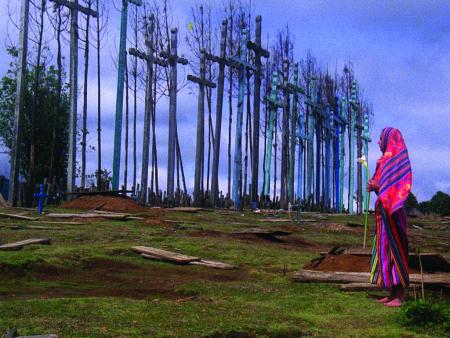
Brother and sister Enrique and Rosa are getting through their youth in their small farming village. Enrique knows only the life he has and Rosa is looking forward to what might come of her admirer's admiration. Around the dinner table they feast as well as they are able and talk of the wonders of the north, gringo land with its cars and money and real flushing toilets in every house.

You work the crop and come home to a happy family, dream a little and get up to do it all again. Simple. Well, no. This is Guatemala and they are Mayan descended natives. The U.S. backed dictatorship installed decades before is still in place and still muscling in on the land and freedom. Ricki and Rosita's father is about to do something about this when the meeting he goes to turns into a massacre.

After the would be insurgents the militia turn their attention to all the natives and cart them away somewhere other than good. Rosa and Enrique barely escape and now must flee. Where though? No one likes an indian here. El Norte, of course, where everyone can be rich and happy. Oh boy......

El Norte was called the first independent epic and seldom has a two word combination so aptly described a film from conception to reception. There might be a few clunkers in the dialogue and sourced soundtrack music but the scope of the vision with its clear, underlying themes of the trickle-down misery bestowed by the land of the free, allow this story both the simple lines of folk art and the breadth of a saga. Moments of Latin magical realism appear almost in ambush, adding to the riches. And the two leads, playing their own ethnicity, evoke an easy empathy. David Villalpando (Enrique) said of the film "El Norte became a powerful fighting element, grew an audience, searched audiences, and left the theatres to tell its truth."

He was right.


May 27th 8pm
CATCH 22   
(Mike Nichols USA 1970)
Yossarian flies in bombers. Bomber command keeps raising the bar on the number of missions he has to fly. He thinks of staging insanity to get sent home. But only a sane man would want to get out of extra duty. Catch 22.

And it's not just the war. Well, maybe it is as the business interests of the staff officers begin pervading all corners of life on the base and then beyond it, increasingly demanding loyalty above flag and nation. The war, borne of national and economic interest has created further interest. There is no such place as outside the system. Or is there?

Mike Nichols' punchy and funny interpretation of Joseph Heller's savage satire of warfare and duty keep the absurdity controlled to see it clearly enough to know it in the dark  before letting it out of the gate to run free. Alan Arkin veers between hysteria and grounded sanity as Yossarian who must keep his wits against the increasingly wayward reality around him picks off its victims one by one. Speaking of actors, you want a cast? Try this: Tony Perkins and Martin Balsam together again for the first time since Psycho, a creepily suave Richard Benjamin, contemporary comics Bob Newhart and Charles Grodin, the mighty Orson Welles, and Angelina Jolie's dad (some guy called Jon Voight).

The dialogue is kept tough but open to changes in texture. Glimpses of surrealism blend seamlessly with the kind of hard and important look that American cinema of the 1970s would command. And for each moment of whimsy there is a counterbalanced horror: there's cute Nately but sobering Snowden.

Friday, April 1, 2011

Rock on Film Part 14: Nowhere Boy

Always a risk, this retelling of the early life of John Lennon does something refreshing: it keeps focus on the central issue of the young Lennon's torn emotional life, being raised by his aunt and only finding out his mother lived locally when in his teens.

Aaron Johnson in the lead plays a young, cocky, charming and hot tempered teenager rather than a nascent rock star. His aunt Mimi runs her lower middle class home strictly but not coldly. Kristen Scott-Thomas presents a woman containing a tide of heartache and disappointment by providing her ward with a clean home that is welcoming if not always warm.

Anne Marie Duff plays Julia, Lennon's mother whom he hasn't seen since a traumatic day of his childhood. She's wild and warm and constant fun offering all the freedom in the world to her newly returned son as long as she doesn't have to take too much responsibility for him. Duff shows the danger in the fun, allowing a teetering instability into every scene she's in. And mention ought to be afforded David Morrisey for playing Julia's second husband, tolerant of the upheaval his young family suffers at the entrance of the intruder to the point of formlessness. His anger is palpable but so is his concern for her sanity. He's not soft, he's just good at walking on eggshells. It's a strong and thankless performance.

Just as the scouse accents are not overdone for these people between the proletariat and bourgeoisie who are attempting to step above mucky commonality, the Beatles content is so understated that when asked for a reminder of the group's name toward the end, John simply answers: "would you care?" No B word there. Similarly, there isn't a single instance of a title of a Beatle song nor any line from one inserted into the dialogue. Showing the gates of Strawberry Field or the Penny Lane street sign are blissfully permissable.

Lennon's epiphany on seeing Elvis on screen is believable, he doesn't explode but you can see he's riveted and calculating at the same time. When he gathers a gang of boys to light up in the loo at school, calling them to be his group, he's not so inspired as starting somewhere. The scene rings with schoolboy excitement and derision and, as with some later moments in the story illustrates something very accurate about bands forming and managing their membership: people are chosen by personality and fit over ability.

I've never been in a band nor ever observed one that recruited someone just because they played well. Come on, you're between 16 and about 25, you're playing some version of rock music; you are not going to get anyone who's too old or nerdy or straight or socially or culturally wrong, regardless of how well they play. There is nothing reprehensible about this, it's the way of the genre and it says less about rock being a musically clueless music but one that can easily be built from little: to this day I'd rather hear Jonathon Richman than Genesis for that very reason. When the significantly younger Paul McCartney plays a word and riff perfect version of 20 Flight Rock it's impressive but he's encouraged more for his pluck. He fits. It's a good scene as it goes against the grain of the rock bio without a breath of spite.

Scenes of the Quarrymen playing on stage are far slicker than they would have been but the point of them is to show Lennon's commitment and showmanship. Depicting the cold and uncomfortable reality of a rock gig at that level runs contrary to purpose of the film. The ones in Backbeat are a lot truer to experience (if heightened for fiction) because it *is* about the young Beatles. This is a film about a teenager fighting his way out of a damagingly confusing situation. One way he finds to do this is through a door he has little trouble opening.

You could say that this didn't have to be about Lennon at all but that it is is important. It has a curious effect of deconstructing the pop god. Soberingly it might remind viewer's of the turbulent mind that pointed a pistol at him in 1980 and squeezed its trigger.

Reccomended.

SHADOWS AUTUMN PART 2 PROGRAM HERE.

Thursday, March 31, 2011

Rock on Film Part 13 : Dogs in Space

Sam and Anna do it tough
Recently revisited this one on blu-ray. Seen it three times now. First at the cinema, cringed. Second, while sharing house with one of its participants, cooler. Last, soberest and strangest viewing of all. Here's what happened.

Back in 1986 I was hanging around with people who, like myself, were too young to have known the scene depicted in the film. All we had to go on was how embarrassed Michael Hutchence's performance made us feel. He lopes around the house dressed in a doona grunting like a farm animal, watching the tv from centimeters away as though he's metabolising the most incredible acid, and is otherwise as lively as a uncurled rollmop. It is a rock star who wants to show how actory he can be (see also David Bowie, Mick Jagger and Nick Cave) There are bits in his performance that do work: whenever he's declaiming into a mic: surprise surprise. The rest of the film, for us then, was looking around that selfconscious elephant and trying to see what else was going on. Didn't work. Whinged about it over goon and rollies afterwards.

Cut to 1990. Sharing a house with one of the people in the film but also one of the people responsible for the scene in the first place. It was on VHS and we were all in the lounge room, drinking and enjoying the proto-dvd commentary said participant was giving (not an entirely complimentary one, either). When I called this occasion cool, above, I didn't mean it was a desirable experience, I meant it was more aloof. The situation prevented both open derision and incautious praise. So, cool, not cool.

The most recent viewing came at the end of a long and tiring but productive day at work during which I'd picked up the blu-ray going cheap as I thought it might be worth a revisit and it included a documentary about the film and the times it depicted which I'd missed at the last MIFF (more of which in a minute).  I watched the docco first and then the feature. Tech reaction first: looks and sounds splendid on blu-ray.

As a narrative film, this thing has no act structure beyond a vague one but that feels intentional. The sagging chaos that the way of life depicted herein is served by this, going from claustrophobic kitchen-at-party scene to listless hungover evenings in front of Countdown to very authentic feeling gigs at pub venues.

The central romance between Sam and Anna is deflated from the word go as we never see them meet and spark. They're just together at the beginning and that's that. If the amusing role reversal bit of Anna fighting off the yobbos while our hero ogles the middle distance is meant as their intro it should be funnier than it is, at least. But nah, nothing. By the time the central tragedy takes place I cared no more for the fate of the character than any other in the film. Not one of these characters is given any life beyond their appearence in their frames. Instead we get a big bag of quirks.

I'd cry BULLSHIT here and now were it not for the realisation that I was actually watching something creepily authentic. It had nothing to do with the narrative of the film beyond lending a kind of monsterisation of the central character. He is a grunting, lumbering, gawp-eyed, self-worshipping monstrosity who is yet capable of controlling the outward signs of his seething mucoid tempests of anxiety that he might not be as loved as he deserves to be, in order to appear personally powerful. Inshort: a cool person.

Whatever its intentions, a chronicle of a time of great creativity, a lament for the lost of the era, Dogs in Space is a celebration of an experience that everyone between school and the assumption of becoming a responsible voter has gone through: the share house. There isn't a soul who has lived in a shared house who hasn't got a country swag bulging with tales o' kerazey flatmates or about that time when .... and .... got on the roof and .... with a bottle full of detergent ... and ...WITH A MALLET? Dogs in Space is a Fiction film so this is all writ large. All manner of industrial strength whackiness takes place in the Richmond residence and by cracky if it don't beat all. Except that it ... don't.

Sure, you can have people having scripted sounding political arguments in party hallways, and university lesbians on the prowl in the name of the reclaimed night, some old bloke delivering a lecture about the beauty of his chainsaw, or, indeed, Michael Hutchence acting like a medicated schizophrenic but it will only ever add up to a loss of conceptual control on the part of the filmmakers. Someone somewhere got drunk enough with some others and made a list of everything they could remember about the bad old days o' the share house and not only kept the crumpled list but suited it up in a word processor (this is an 80s film) and did all the maths to see it through the logicistics and budgeting so that every single exaggeration appeared on screen as though it were a natural phenomenon.

The end result looks so carefully contrived it almost asks it audience for permission to proceed. The problem is not that it goes too far but charges gormlessly into it in the hope that the bravado alone will win cheers to stifle the loudest of glaring gaffs. It simply doesn't go far or deeply enough into a more controllable sample of the thing it seeks to describe. As one who has served over two decades before the communal fridge I can say that I recognise much of what I see on the screen in Dogs in Space but never so twee and overfed. As such, it serves best as a record of the era of its production rather than one of the time it purports to celebrate, the big fat coked out 80s, not the lean, dogfood-nourished 1978.


Real Sam and Play Sam. Can you tell the difference?
Compare and contrast the feature-length docco We're Living on Dogfood in which the assembled veterans of those who fought the big one back in the late 70s recall the times. There might be embellishments and outright lies but I care not. Oral history is almost better when it includes disputes. What you get from this piece is something far more informative and certainly more entertaining than Dogs in Space. A mix of preserved video and super 8 vitamised in with a series of talking head interviews (including those with Sam Sejavka and the late Michael Hutchence) and about one and a half hours later you've been for a compelling and fun ride through the living memory of others that makes you wish you'd been there. Poignantly, as the credits roll and some extra snippets of interviews fade in and out the final one is of the late Rowland S. Howard who briefly gazes at his interviewer in silence before fading to black.

PS: Don Letts take note: you might well have been part of the scene you're documenting but you don't have to get your stars to fawn over your participation. Richard Lowenstein was confident that his viewers knew who made this one.

SHADOWS AUTUMN  PART 2 SCREENING PROGRAM HERE.

Monday, March 7, 2011

Mailing list

Yo, kinderoons. A word in my ear at the last screening illuminated the worth of a more formal mailing list than I have been using. If you would like to be on the SHADOWS mailing list to get updates and information about the screenings etc let me know at my hotmail address. It's there at the top of the page but it would be absurd to omit it from this post.

As the girls from Dessert sang in Suicide Circle: Mailme.

Monday, February 28, 2011

Review: Uncle Boonmee Who Can Recall His Past Lives

Boonmee is a tamarind farmer in rural Thailand. He is dying of a disease of his remaining kidney. His sister in law has joined him for company for what might be his last days. He has a male nurse to see to his medical needs and a probably illegal Laotian personal servant. Were it not for the closeness of death life in this balmy, insect chorusing agrarian idyll would be perfect.

But death is not such a conversation killer here. Boonmee is deeply Buddhist and thinks of himself less as dying than about to leave his present body.

Talk at the dinner table is about the future, life after Boonmee and it's practical, unsentimental. So matter of fact, in fact, that we hardly notice the ghost of his wife slowly materialising on one of the chairs at the table. I thought she was a reflection until she was unignorably there which is very similar to the reaction of the other characters. Once established, though, they variously take it in their stride or witness it as their worry slowly gives way to acceptance. They then converse as though she's just dropped in for a visit.

Not enough? Footfalls on the stairwell makes everyone's head turn to see the laser-eyed apelike creature from the opening sequence walking up the stairs. It pauses at the sight of all the attention its appearence has engendered but then enters the room and identifies itself as Boonmee's son, missing for decades. He'd become obsessed with a photograph of a strange simian figure, took up photography himself in order to capture another one on film in the forest, and then mated with one and joined them, even taking on their physical appearance. Boonmee's servant enters and is incredulous and fearful until assuaged by Boonmee and the others that it's just a member of the family. Boonmees's sister in law asks the ape why he let his hair grow so long.

Do you see the problem I'm having? I've just spent paragraphs describing events on screen rather than just summing up the plot the film and going on to tell you what I thought of it. Uncle Boonmee resists such treatment. You know what else does? Solaris, Eraserhead, El Topo, Valerie and Her Week of Wonders. What? Are you comparing this 16 mm movie to those classics? Yes, and I don't care if they're classics, they all stand outside of conventional narrative cinema and all carry themes or ideas that compel their existence and override observance of the convention. So does Boonmee.

So why don't I just pack it in and cry pretentious? Well, for the very reason that I don't understand it and that I care that I don't understand. Pretension is unfulfilled promise and I cannot say if this film fulfils its promise or fails it. I don't know what this film's promise is.

I do know that it has been made with precision and what appears for all the world to be love.

I know, as well, that for all the otherworldliness of this film there isn't a syllable of dialogue that isn't straighforward and suitable to its context (even when it occurs between a talking catfish and a disfigured princess). I do know that the fact that little or nothing of Boonmee's past lives appear on screen does not let the title down, as some commentators have claimed (it just says he can, it doesn't say he does ;) although how else to explain the scene with the princess from what looks like a medieval period?). I know, too, that for all its sudden bizarreness there is nothing that is intended to be adorably cute or quirky. This film leaves questions and mysteries that are questions and mysteries not the frays of lazy writing. This film is nothing if not intentionally made. I know that anyone who sticks so stubbornly to 16 mm to make his feature films (the sole detail in this review that I outsourced) and makes it look so beautiful deserves accolades for cheek as well as achievement.

I know, also, that this film, unlike most of the films I've ever seen, delivers on at least one promise to perfection. The first thing we see is a bullock in silhouette. The camera is motionless, taking in the slight movements of the animal, savouring the beauty of the curve of its head and horns against the light. It's restless and tugs itself free of the rope binding it to a tree, wandering into the forest nearby, strolling through the new terrain, looking around and emitting odd little glottal chirps as if to say: hmm, what's this? It stops deep in the forest, the camera again lingering studiously on its clean dark beauty. A farm worker with a sickle arrives and gently coaxes it back through the forest. Then we see that all this has been observed. A tall dark figure in the forest turns to reveal itself as a kind of lithe yeti with a pair of glowing red eyes, staring with a human fascination at what it is seeing. Title sequence.

We've been promised a ride both rich and strange. We get it.

Screens at ACMI  until March 14. Please go and see it.

SHADOWS starts up at ABC again this Friday. Here's the program with trailer and flier.

Friday, February 25, 2011

Blind Spots 4: Three cinematic phenomena that I don't care about

This is not a list of overrated titles. Whether something holds an eminent place in popular culture seldom affects my opinion of it. This series is simply things that have consistently failed to touch me. Partly, it's an exercise. I surprised myself when writing of the Coen brothers that I really liked very, very little of their output, having always assumed I liked about half. I started another about Terry Gilliam and ended up having to split it into three posts to cope with what I was finding out about my own opinions. This is another. I'm trying to avoid big targets like Stephen Spielberg who I think should make something he really wants to make or just stop altogether (but I think it would be unwatchably violent: I think he's John Wayne Gacy without the murder). And I'm not fond of targets that are too easy like Wes Anderson who I think should be placed in care if he ever tries to make another film. This particular post pretty much sins against those stipulations. Whaddayagunnado?

TERMINATOR
This one takes a couple of looks for me because on the surface of it this title shouldn't be here. I really enjoy the film. It's big and goofy with enough mid-80s earnestness and neon lighting to be both a perfect sample of its cinematic era and a neatly wrapped treat. The thing I don't like is one of the things that sells it for many (perhaps most) of its fans: Arnold Schwarzenegger. Ok so if you're into Arnie you're into irony. It's like a club token you can flash. See, it's Arny: irony and my good self, we're like that. And he's part of what makes it so big and 80s. 

So, if all that's true why do I shove it here? Because I made the mistake of watching a making of that revealed that the title role was initially designed for Lance Henrikson. He would have been an extremely low key figure, invisible in a crowd, unremarkable by design. The docco had storyboard art with Lance in the role, swinging off rails, falling through skylights etc. In that instant when I knew that, the big dumb 80s iconic hit movie became a sketch released in place of the real thing. The suits won and Arnie's career, instead of stiffing at Conan and body builder #1 roles became an action hero in a long rope of parts all called John something.  

Terminator went from being a fine piece of 80s'orama to a sellout to the suits, yet another indication in the post Blade Runner scene that big 'n' dumb was going to triumph over intense and clever. In this and other instances, the strong, socially committed cinema of the 70s was given last rites, embalmed and buried. Taxi Driver would have starred Arnie if made in 1986 instead of ten years before. So would Logan's Run, Rollerball and The Parallax View. Terminator was a film which I liked as an original and a sequel. Now I don't like any of them.

Wim Wenders
I know. Wim's a genuine indy, why kick him if he's already down? Well, this post is not about public visibility nor it is about things being overrated. It's simply about me not caring about things I've been told I ought to care about.

One of the essential films to add to your shopping list in the late 80s was Paris, Texas. Then Wings of Desire came along and joined it. A little before that, as a film student, I was strongly urged to see The American Friend and Kings of the Road. The only one I haven't seen of those is the last one. That's because I saw all the others.

He's made other films and I haven't bothered to give them a fighting chance as everything I hear about them makes them sound like the ones I have seen. I'd write this exact post (so far) about Wes Anderson except that rather than not give a toss I actively loathe his films; Wenders just leaves me cold. Before you start mentally defending Herr W. against the charge of pretension be advised that I'm not going to bring one. "Pretentious" is one of the most abused terms in all of cultural criticism and you'll witness my use of it very, very sparely.


I don't think Wim Wenders is claiming more than he delivers I just cannot care about what he does deliver. I would care that a gang of angels want to retrieve one of their own whose rebelled by staying on earth if the tale of it were not so meandering and loose-threaded. I find the monologues of the actor and the circus performer stiflingly unengaging. It is not enough for me that they are angels. It isn't enough that they are rendered in sumptuous black and white (not trying to be funny there, I love black and white). And it is too much to put that goof Nick Cave on screen as though his pointless, affected badboy songs were going to add anything useful.


Paris, Texas has the advantage of being attached to a real writer, Sam Shepard. Additionally, the cast is superb. There is also some fine music that not only carries the scenes it's in more than they deserve but became one of THE soundtrack albums to make conspicuous in your collection. And then, snatching defeat from the jaws of certain victory, comes our mate Wim to suck all the vim out of the proceedings as fully as possible. Harry Dean Stanton, already long a careerist character actor, made a big public entrance in his central role in this film. And boy, is he good. He doesn't say a word for the first three weeks of screen time and when he does it's something endearingly trivial which brings him further into our hearts than we'd thought possible ... assuming we're still awake.


The problem with Paris, Texas for me is that its themes of perdition and redemption are good ones. Seeing the hobo errant attempt to repair the disaster area of his life as a brother, husband and father should make us want to talk to people at tram stops or fulfil requests of $2.75 from junkies who need to visit their mothers dying on hospital beds. Well they would make us want those things if Wim Wenders' idea of auteurism didn't have an 'e' and a 'u' and an 'r' too many. In the hands of a genuine cinematic master this hands-off approach might result in subtlety or understatement. With Wim at the helm it translates as gormlessness.


I have heard many impassioned pleas for the quality of this and Wings of Desire and I don't think any of the pleaders are in error or have bought into hype. I just can't join in.


STAR WARS
I am indifferent to the entire saga even though I've only ever seen the first one in it's entirety and a few of the others in little grabs.

Late 1977. I went to see this at the twin cinemas in Townsville (it was one building with two cinemas which bore different names, Forum and Odeon: multiplexing was yet to be perfected) with friend Wayne. The preceding short (the economy of plugging so much advertising into the pre-feature time at cinemas had yet to be perfected) was called To Protect and Serve and was made about, for and by the Queensland Police who, even to my cosseted middle class white boy sensibilities, bore the reputation of being a corrupt and violent wing of the state government. The resulting propaganda outing was so hilarious it put everyone into the most receptive mood imaginable for this film that was already hyped to the galaxies. There were two girls sitting in the row in front of us and one of them for reasons unwitnessed darted Wayne a poison look. As was his custom at the time he responded with a protracted: "faaaark off!" She turned back around and that was that except that I joked that he should take that one and I'd go for her brunette friend. He whispered loudly that he'd seen them in the foyeur earlier and they'd both resembled human Mack trucks which put paid to that endeavour. Anyway, the film...

There it was, bigger than life, the rolling prologue about the long long time before in a galaxy far far away and I settled into the gentle but real thrill of being present at a new and significant world event. It began by winning me pretty thoroughly. The opening sequence of action and intrigue seemed to have more substance than the usual sci fi fare and soon enough, the establishment of Luke's world was a revelation. No Star Trek standard valleys of styrofoam here but pure desert that by virtue of its being littered with alien technology felt like another world.

And when I say littered, I mean littered. The first really important thing I noted about the movie was the scrap spaceships. All it had taken was someone modifying the image of a car scrapyard but how impressive it was to see it taken through to this extent. None of these convincing craft ("spaceships with rust!" I gasped at the time) were intended to fly across the screen at any point in the film. They were there to suggest the world beyond the frame of the story. And then the story proper kicked off and my interest drained steadily until the end credits allowed me to exit with honour.

First I hated the naming of things which seemed lazy. Tattooine? Skywalker? Chewbacca? They could convince me that I was beholding an alien world but it was one whose names came from the kind of five minute creative thinking exercise that office workers are serially condemned to every few years in training workshops that their HR departments are obliged to outsource. This alone unlocked the mystery of the Star Wars Universe. It felt like they stopped caring after finishing a few dazzling bits.

By the time I got to the cantina scene started mentally scoffing everything I saw. This was meant to be a bar in a port like the ones in ol' Marseilles or Casablanca so there was meant to be a great range of different types in there mixing it up. There was a great range but that's all. I don't remember any groups of aliens just a room full of completely different life forms with no suggestion that any commerce had brought them there. Compare and contrast the same film's munchkiny beings, the Ewoks. Desert scavengers dealing in scrap. A good idea convincingly borne. Nothing like it in the cantina which looked like an animation of those books done by fans of aliens that are so beautifully rendered the viewer almost forgets to notice that they wouldn't be able to move without hydraulic assistance in the third dimension.


And there was the cuteness. The duo of droids, the poncey one and the little smartarse one who emitted little bips and bleeps which were obviously meant to be sarcasm. Alright that last detail was clever (saved them writing any real funny dialogue for the movie's chief wit, after all) but it grew tiresome very soon (please note that I didn't say "it grew old", I'm trying to write in the idiom of the time ... kinda). Lucas and co liked this so much that they did exactly the same in the cantina scene and with Chewbacca. The occasional dryness delivered by Carrie Fisher and Harrison Ford provide the movie with its sole gravitas (Alec Guinness notwithstanding) and when you say that of a film you know it's in trouble.

The final thing that turned my smile upsidedown about Star Wars was something I was noticing in blockbuster cinema in general at the time and was turning me away from it title by title. The film seemed to be constructed by such a gigantic premise and teensy plot that it really felt like a rip off. See also Superman: The Movie (and anything from the time whose title was appended with "The Movie"). Yes, it was dawning on me that big cinema extravaganze were not necessarily being made for their contribution to cinematic progress. But there's something else.

Two other things happened in 1977. First, the rock music version of Star Wars had already appeared on screens in the form of Led Zeppelin's concert movie The Song Remains the Same. The boys' own version seemed insigificant after that. Also, Never Mind the Bollocks Here's the Sex Pistols was finally released which was hype come true and wiped the table of cultural significance for me that year (including the Led Zep movie which by then looked like a delfated velociraptor-shaped balloon) and served to keep slick big mainstream culture at a distance and lead to the discovery of all such things hitherto obscured.

When I got back home after the screening my Dad asked me what I thought of the film and my shrugged, "alright" was for once not necessarily an adolescent knee jerk.

The first sequel was supposed to be the best one of the bunch. I've seen about twenty minutes of it and have no interest in extending the experience. Ditto The Phantom Menace and the more recent ones.

I was informed in a recent conversation that my aversion to Star Wars put me in the early Gen X bracket as though I was to be sentenced to a life bound by a cultural cordon which kept me from the delights to Back to the Future, The Goonies and Ferris Bueller. Thanks all the same, but I'll take Never Mind the Bollocks over that, then as now.

Tuesday, February 22, 2011

Rock on Film Part 12: A pot pourri of punk

First, parameters. Long ago, I heard someone's opinion that there had only been three true punk songs. They were Anarchy in the UK, Helter Skelter and Rock Around the Clock. The opinion was reported rather than heard directly so I couldn't ask at the time what they'd meant by true punk. That kind of opinion was a typical pre dawn conversation topic when the party had dregged and nought but Fruity Lexia and Blackberry Nip were left to quaff: rhetoric, nectar and garbage all seem to find their own level. More recently there has been a trend to speak of punk rock as an American invention exported to a grateful UK. As to that I still like Lydon's comment about grunge: "Now they get it."

For purposes of this article my position is that punk was a British music that was born and died in the late 70s. Anything calling itself punk after that was nostalgia or laziness. I care not where or when or for whom the term was coined but as fine an album as it is Marquee Moon does not resemble Never Mind The Bollocks, Damned Damned Damned or The Clash in any useful way at all. Sorry, I'm old and that's my world.

The title of this post, by the way, is from a gig review in RAM magazine from the late 70s. I still find it funny.

Also, I'm omitting movies about the Sex Pistols as I've covered them here.

Punk in London
As flat a record of the good, the bad and the ugly of the scene in 1977 as you could hope to find. A few mumbled interviews and abortive manifestos pepper what is a series of live performances all done with a sole camera (probably a little Arriflex) from the audience. The image of a young (and still white toothed) Shane McGowan being a drunken bleached yobbo has become quite famous through its appearance in other documentaries. But, and you need to approach my vintage to care about this one, see if you can spot a very young Ian McCulloch later of Echo and the Bunnymen dancing in a crowd.

The real value of this footage, though, is precisely that it was taken at the time. All sorts of acts were included that wouldn't rate a mention in today's reminiscences not only appear but are highlighted. Slaughter and The Dogs, for example, look so try hard that it's hard to imagine what they had to do to share a stage with Siouxsie and the Banshees. Well, try-hard or not, they were part of the scene and muscled their way on to a stage or seven. This alone raises the archeological value of the piece. Of course it's great having the likes of Subway Sect and Chelsea playing through footage as untamed as the scene itself but the wannabes and neverwoulds complete the picture better than more extensive material from the major players might. All scenes have these fielders (I know, I was in a few of them in my own little corner of the Brisbane scene in the terrible winter of '82) and it is to Punk in London's inadvertent credit that it includes them.

As there is no commentary outside of the interviews this film's only essay comes from the rough cut footage itself. While this can get as tiresome as sitting through anyone's super 8 dreck from back in the day, the whole yet bears the weight of witness. As such it remains the truest of the accounts dealt with here. All the others are flavoured and spiced through hindsight.

Available as a twofer with the Clash-related Rude Boy on local DVD.

Punk:Attitude
All in the title. The idea is that punk is not a time bound phenomenon but a mode of expression. I shown this to people who have thought it a betrayal as it was made by a Brit who was there at the time but reaches back to US bands and scenes like the Stooges and the New York Dolls. I didn't get that from any of the viewings I've made. It's always seemed more a quest for chronological completeness.

The profound differences between the American and British scenes are made clear in the film. People who think as I do just tend to resent the American story being told on consecrated ground and I'll admit that it's easy to think that's what's happening in this film. The bigger problem in the presentation, for me, is that on the one hand Don Letts is saying here's a history of punk and on the other that punk doesn't have a history as it's an attitude that stands outside of time.


Outside of this Punk:Attitude is a strong quilt of accounts by players like Ari Up, Steve Jones, Siouxsie Sioux and Poly Styrene etc. Left as this and the video record the film is a delight. the problems start with the carriage of the attitude into the post punk era, the 80s, the 90s, the noughties and on where the examples get less and less convincing. As charming an interviewee as Henry Rollins is he cannot hide his ridicule of the more recent attempts on the American scene to keep the baton afoot. The scenes of sweaty cryptofascist gigs or the more mainstream versions like Blink 182 in front of massive outdoor crowds all just look like the kind of cutesy 50s revivalists of the 70s. The fact that their audiences manifestly clamour for this borrowed tradition (there, you go, "we're a trad punk band": I wonder if anyone has been funny enough to say that with a straight face) is a head shaking grimness.

So if the old stuff cannot be dressed up simply as the beginning of something that's good today why make a film like this? The real argument of this film comes late and briefly: if you've got the energy and the gear to get onstage and rant, don't: at best you'll be vacuumed up by a record company that no one buys from anymore and at worst you'll look like a busker from the 70s doing 60s protest songs. You got the 'tude get with the mude: Use the net, make a docco. The rock version is old (well, it was old in 1980 but let's not split hairs).


Punk:Attitude is a fine effort that makes the mistake of pandering to revisionists and irritating traditionalists and is not helped by the appalling attempt at suavely inserting its creator's role in the scene through interviews with the players (Letts was there and important but this is a sleazy way of making the point). See it for the great interview footage and ideas at the end.

Out locally.


Kill Your Idols
Self-threateningly uneven documentary about the nowave scene in New York in the late 70s and early 80s, useful for the reminiscences of highly articulate folk like Thurston Moore, Michael Gira, Lydia Lunch and Jim Thirlwell. And it's an interesting tale. After the storm of punk there seemed nothing left so that's where the artists that came after began. This and in the UK's post punk scene (to say nothing of a very rich vein right here in Australia which went even further by not giving itself a name) was where I see the real revolution, not in the charge of the light brigade of the terrible summer of '77. This was when the uniforms came off and the music mutinied.

The influence on later music was subtler but I think more profound and has more to inform today's highly affected indy scene than the last of the Mohawks. This is where Kill Your Idols both finally finds its argument and loses its power. About half way through the current New York band scene is examined. Everyone in it talks about how much they love the old stagers like Sonic Youth (the film's  title is from their album Evol) and Swans and then proceed to make babbling idiots of themselves every time they open their mouths (the A.R.E. Weapons spokesperson talks like a World Wrestling Federation contender).

This begins to look increasingly like agressive editing done once the Eureka moment had struck the filmmakers and they locked on to the kill. Now I hate bands like The Yeah Yeah Yeahs who sound like record company designed punk from the early 80s (youtube Transvision Vamp and try to spot the difference) but is Karen O really as stupid as she sounds here? Britney Spears comes across as a Rhodes Scholar by comparison. O's interviews really look like a film school assignment in misrepresentative editing. It's almost too obvious to opine that today's fringe music sounds like yesterday's mainstream but the point of that has long passed its shelf life. No one cares and maybe no one should. Still, it's fun to listen to Michael Gira or Lydia Lunch rant against it.

Initially I liked this docco but the more I thought of it the more I had to admit how indigestibly smug it is once it has found its point (which takes a lot of screen time to reach). If No-Wave didn't care then why should anyone, least of all the scenesters o' today who seem happier to receive its mantle than they should. 

I Swear I was There: The Gig that Changed the World
Hands down funniest title and freshest take on the history. This is the story of how two Mancunians got the Sex Pistols to play in their hometown and thus inadvertently ignited the fuse of the northern scene which informed the world of what would come after punk. The pair in question were Peter McNiesh and Howard Trafford who were far better known as Pete Shelley and Howard Devoto once their band The Buzzcocks emerged. They had dipped down to London, soaked in the scene there and saw the Pistols live and resolved to get them north.

This they did and the rest is hysteria. Through a quilt of interviews and contemporary footage the deals and logistics are revealed of a feat of epoch-making significance that, however plagued by turbulence, seems to have been achieved so simply.  Shelley and Devoto really just went to London, asked and received. The resulting gig at the Free Trade Hall was the stuff of legend, germinating an ethos still influential today in music and pop culture. The attendant tv appearance on Tony Wilson's show So it Goes only cemented this and to witness, as this docco allows, the act the preceeded the Pistols on the show is to witness the most important guard change in British music history. The other act (whose name has fled from me but it was something like Gentleman) are energetic and forceful, a kind of Roxy Music for accountants, They vanish from memory as soon as the Pistols appear. Seriously, watching it, you even stop laughing at them when the familiar lines and colours of the So it Goes Pistols clip commence.

Lydon, the funniest loudmouth in the history of rock music from his time to now (apart, perhaps from the Fall's Mark E. Smith) is absent from the direct interviews in this account which is appropriate as it is best told by the events' architects. We are witness to a good idea that made history. It feels like it but (this is a British documentary) you get all the minor annoyances, long held slights and grudges (the surviving Slaughter and the Dogs are unintentionally hilarious here) and throwaway humour. As such I Swear I was There is purely bloody wonderful.

Possibly available on import.

SHADOWS recommences March 4 at 8pm. Program here.