Friday, October 21, 2022

Review: BARBARIAN

Tess is in town for a job interview and finds that her AirBnb house has been double booked. Keith answers the door, sees her in the rain without the possibility of a hotel with a convention in town and asks her in to see if they can sort it out. While there's an edge to the situation he proves charming and self effacing enough to risk taking up his offer of the bedroom. There's a lock on the door and he seems pretty genuine. Strange disturbances during the night seem distant by the light of day and she rushes to her interview, smiling at Keith's note on the table saying he had a good night. Back from the appointment, she finds herself in a situation which compels her to search the house. Ending up in the basement she finds door after door to ever dingier rooms, including one which looks like it's housed torture. When Keith gets back she persuades him to check it which he reluctantly does. After too long waiting upstairs she goes after him, finding not only more dark rooms but a staircase that looks like it goes into the dark forever. Keith cries out. It sounds like he's faraway. Fight or flight?

It's fight, she, like Dante before her, follows on behind.

Barbarian is a crafty contemporary horror film with solid construction and clean lines. There are no arch nods to audiences that let them know that it's just a corny old movie and they are clever just being there getting all of it. It makes no claim to join the groanworthy nonsense of elevated horror. It's just a horror movie. It builds dread and earns its scares. There are references to a horrific crime from the past two decades and what seems a stab at cancel culture takes on more significance which resonates throughout the rest of the film. Two abrupt setting changes variously add backstory and deepen the narrative. There is also depth given to the monster but not at the cost of its threat.

This would just be an exercise if not for the warmth offered by Georgina Campbell as Tess who runs the gamut from personable through threatened, nervous, terrified and furious as the story throws ghastliness at her every few minutes. Bill Skarsgard comes out from behind his Pennywise makeup to reveal a kind of designer hunk with a disarming charm. Justin Long's sudden appearance as a heavily entitled Hollywood  hotshot facing cancellation and ruin, continues one of the most effective and thankless movie careers of recent decades. 

So, this is an accomplishment. I had actually toyed with catching up with the second of the recent rebooted Halloween and then going to see the next one in the cinemas but thought the better of  sitting through something I would most likely find tiresome. I chose this and was glad to sit in the cinema immersed in dread and care. A powerful electronic score comes in handy, there. 

Here's a point of frustration: there is a possible problem here of othering but it would involve too many spoilers to discuss. I'm still haunted by it but know that that doubt is balanced by the great threat that a character bears. It is a lot harder a case than the wincing depictions of baddies in Silence of the Lambs (an unfavourite of mine) or Incident in a Ghostland which as a very recent film ought to have known much better. There is also the counterbalance of the character A.J.'s comparable sins. Still don't know.

What I can say is how refreshed I felt that a current piece of horror cinema made it out of the gate without needing to be anything but itself. 

Monday, October 10, 2022

1982@40: POLTERGEIST

Young family in edge of town housing development is attacked by supernatural forces after strange phenomena appear and one of their own, five year old Carol Ann, is swallowed into the para-ether by the television. Experts are called and investigations made but it will be up to stronger bonds to vanquish the uncanny captors.

This film is among a very few of its vintage where the contemporary effects which it frequently depends on do not embarrass it. A fine cast of character actors perform a solid screenplay with high level lensing and a score by Jerry Goldsmith (no adjective needed there, considering greatness before and after). Poltergeist throws a lot of recognition humour about suburban family life, makes sharp points about greed-first business, and offers some respectable, if mild, scares and eeriness along the way. It was and is thoroughly enjoyable.

This high gloss entry into the horror of a new decade came at the end of a knotty string trailing back to 1973's The Exorcist whereby the horror is set in the normally comfortable suburban home. Neighbours fight over tv reception while the kids outside prank passersby. And then the horror. This time it was lifted into the influential dollar power of the father of the summer blockbuster, Stephen Spielberg, and the wielder of the Texas Chainsaw, Tobe Hooper. It's not the quality of the movie that gets questioned with this title, it's whodunnit.

The nitpicking on this topic can suck strong taxpayers into lightless rabbit holes but a shallow online investigation will reveal a workable solution. It was both and looks and plays like it. However, it is sorely tempting, given its gloss, pointedly every-family observations on life in the middle of the social strata, to leave it squarely at Spielberg's feet. Considering how all of Spielberg's productions of other directors' work ended up looking like his own, it's not so surprising, but here it looks like a hostile takeover. That is, until you start noticing things that he would never do if there was a choice. The mystic Tangina's stark Christian fundamentalism reeks of Hooper's southern upbringing and would return in later sequel to his own Texas Chainsaw Massacre. The face tearing scene is all Hooper. The use of the tv set as portal to a malevolant outer world, though, really could be either and possibly served as a starting point for the collaboration. The rest is probably just a history of compromises and/or personal politics. The more I see the film, though, the more firmly I think of it as a collaboration: Spielbergian themes and identikit look and sound (see also Gremlins, Back to the Future, or a host of others) but an undercurrent of darker and nastier thoughts from a Hooper who'd bargained with the mob to get his damn movie on screens.

I very happily watched this in 4K. The bizarre jump cut between the kitchen and neighbour's house scenes remains (look it up, there's a funny story to it) and the cover art throws decades of high recognition into the bin by putting a hard to visually read image on the cover instead of Carol Ann at the tv. Come on, folks, it's an iconic image for a film that was only ever intended to be mainstream; why the obscurity? Anyway....

Review: MY BEST FRIEND'S EXORCISM

Abby and Gretchen have been best friends since early childhood. They fit in fine at school, lunching with the alpha chick while maintaining their own bubble. So they're fine when the latter, Margaret, invites them out for a girls weekend at her family's lake house. Margaret's bf turns up with a page of lysergic acid stamps and they go tripping. Gretchen and Abby go investigating the ruined building they've just been told has a gruesome past and they reach it just as the acid kicks in and something weird and violent (and unclear) happens. After that, Gretchen is a social wreck, withdrawn and self-harming, claiming that an entity is trying to take control of her. At one point she freshens up and becomes the most sinister mean girl at school, humiliating friends and taking potentially lethal action against one of them. Abby, increasingly defeated by these things, keeps her resolve and fights to find the solution. It's going to get dark.

In this paragraph I'm going to try and suppress the fact that the source novel by Grady Hendrix is the most enjoyable book I've read in the last ten years. Just as a movie, MBFE struggles against its own awkward shifts in tone between satire, teen comedy and horror. And it loses the struggle. It's not the cast's fault as everyone on screen is doing fine work. It's stolid direction of a screenplay that doesn't know how bland it is. By the time you get to the heartfelt ending you wonder if you've got to know these friends in this story of tough friendship well enough to care.

The novel spans many decades, even though in concentrates on about two years. We meet Abby and Gretchen in childhood where a cultural touchstone endears them to each other and they become friends for life. Their shared culture and its history are essential to understanding their bond, down to their hilariously misheard song lyrics and views of the life around them. At the climax, when Abby calls on these resources in an epic tirade, all of this reaches its thrilling apex in a show both laugh out loud funny and solidly poignant. This book is of the kind that I'm thinking of giving it a regular re-reading, something I haven't done since I was at school.

While it is inevitable that a film adaptation of a good sized novel will need to cast off a lot of material so it can get to work on the main current of the narrative anyone, whether familiar with the book or not, is going to feel the lack of back story to the central relationship. Criticising movies for what they aren't is a futile exercise but, even I who can fill this in as the film starts, felt the assumption that the girls had a reason to be best friends was beyond question. See also, the missing bombardment of cultural touchpoints that the friends in the novel use to constantly pepper their communication. Every chapter of the book is the title of an oldie from the time of the setting (the '80s). When Abby comes to the scene where she must call upon this it feels like the adaptation threw up its hands and relied on another assumption that someone so young would naturally resort to this rather than it rising from a lifetime of shared experience. 

There is, in fact, almost no sense of lived experience in this version. There is almost none of the humour of the source. When the story must stand and take its position as a horror tale it cannot muster the energy to step across the line. Now I'm going to do something else i seldom need to do in a review: make comparisons. There are two films I can think of that touch the tension common to both comedy and horror and never ease the touch so that funny moments are memorably so and thriller or horror scenes play in their mode with no sense of contradiction: Heathers and Ginger Snaps which we remember as comedies until we watch them again. My Best Friend's Exorcism doesn't establish and then use its tension, it just applies tropes and, in doing so, fails its viewers and its own cast. The weirdest moment of this film is reading Grady Hendrix's name in the credits as a producer.

Sunday, October 9, 2022

THE LOST BOYS@35

A woman and her two sons move into a seaside Californian town whose welcome billboard is backed with graffiti describing it as the murder capital of the world. Well, it's where her dad lives and they can settle rent-free until she gets back on her feet and get started again after the divorce. Meantime, there's a boardwalk carnival at night and she goes around the shops asking about jobs while older boy loses himself in the crowd at a concert and younger boy meets the local comic shop brothers who send him off with a manual for fighting vampires done in panels. Older boy, let's call him Michael, sees the beautiful young Star in the crowd and pursues her through it, ending in the sight of the teen bike gang she's part of as she hops on the back of the leader's machine. They invite Michael to ride with them. He does and it's a fine ol' eighties pumpin' trip.

Joel Schumacher's take on the vampire sub genre has him setting it in the teen cinema of the era with an extra push. Just as Spielberg covered the under tens audience and dictated what such movies should look like, so John Hughes eightiesed up the teen saga, blending serious issues of the age group with a pastel toned finish and few exceptions took the adolescent experience outside of the program. While The Lost Boys didn't have the iconoclastic force of Heathers or the pre-Hughes oomph of Fast Times at Ridgemont High, it does use the cultural flow of the Hughes template to escape it. 

Keifer Sutherland's David could have been in the Breakfast Club but Judd Nelson couldn't have been in Lost Boys (thank Heaven and Hell!). Dianne Wiest and Barnard Hughes are written just short of Ferris Bueller caricatures but Jason Patric's persistent sadness would have been resolved in a sex scene with Hughes. The point of departure is in the genre and the vampires here are eighties rockstars (they even nest in a trashed hotel). If anything, the melancholy beneath the notion of eternal youth here comes from the implication that eternity will just be neverending hijinks of rapidly diminishing returns. Michael in his in between state takes on a kind of indy rock star shades in bed look but he seems treading fever rather than rising from it. For all the Hughesian epiphanies and pleas for young rockin' rebels to calm down and accept themselves there was never such a sobering portrait of wasted youth.

The Lost Boys not only knows it's a teen movie of its time but loves the fact. All the sax wielding, engine revving, rebel yelling pranks and the clothes and hair of a youth culture that got to punk so late that it looked like old glam, all of that is flashing like fireworks on screen. Even the joke of the final line puts it on the timeline. But this is a case where you're glad of the datedness of a film. As with an Easy Rider or a Hard Day's Night, you want it to sing the hits, however naff they would be out of context. Worth at least an annual revisit.

Friday, October 7, 2022

Review: DON'T WORRY DARLING

A '50s display house world set in the desert like a nuclear test site. Inside one of the houses an afternoon party has the catalogue perfect wives balancing filled whisky glasses on their heads as the husbands cheer them on. We widen out to see the rest of the lifestyle is the same: cold war bacon and eggs in the morning when the wives send their husbands off to work with kisses and last minute spruces or lunch boxes thrown in the passenger seats of cars that are all chrome and fins, dinner ready for the breadwinner's appearance at the door at COB. Above it all, Frank the charismatic salesman of lifestyle, has it all under control. 

It's not unnervingly perfect, there are rivalries, boredom alcohol and bitchiness buzzing at every turn, but it all smooths out to a postcard perfect vista. But Alice, like her namesake through the looking glass, starts noticing the flaws: cartons of empty eggshells, mirrors that aren't like real mirrors, planes that seem to crash but can't be found after checking. Detail after detail comes up for test-flunking scrutiny, not least being Alice's precursor in discovery removes herself from the picture in a way that is completely refabricated by the authority figures. Things are not good but there seems no way to fight them.

Oliva Wilde's second feature tackles the dystopia scenario with great force on the beauty of the lifestyle but less oomph on the weirdness of the tale. Apart from a few impossible plot holes the overall scheme works but, given the strength of the performances, there is a curious constant downturn in traction, like a slowly leaking tyre. Florence Pugh is typically magnetic, Chris Pine is just as typically unnervingly urbane, Wilde herself is a hoot as Bunny and even popster Harry Styles fronts up with a credible turn and they are surrounded by a palpable world of gleaming golden day lifestyle fashion.

I noted at the action packed climax that I'd been missing all sense of pushback which had taken so long in coming from the thinning veneer of civilised discourse in the second act. I wonder if I just wanted more violence to go with the anger. While we are bombarded with a program of visual motifs that increasingly bring home something we already know, we get a lot less of the very canny Alice working out how to break the oppression. Sometimes, she steps back to blend in, regrouping to work out the next move, but the other characters seem less convinced than we are about her sincerity. It feels like a level or two of the realm at the base of this rabbit hole might have been dispensed with to push the well established and strongly delivered themes of conformity, identity and the fragility of the culture. There are many really well turned moments here but the big messaging just works to push them back down again.

There's a none too subtle hint in the greater culture that the character Frank is a take on reactionary postulator Jordan Peterson. Wilde and Pine steer the role away from this, however, to present an entity much more like a Fox News pundit. Of course it wouldn't work well dramatically (or even comically) if they'd let the character ramble until everyone else threw up their hands (like the real thing) but the character as given offers a lot less to rail against, he just doesn't have the same brittle arrogance and Pine is too effortlessly charming. You might want to sock Frank on the jaw but you never get to the point where you'd happily wish you had a flamethrower.

There was a small group of dickheads in the back row at my screening who were talking incessantly and often laughing at whatever was going on in their own conversation. At one point I heard their chatter (mostly under the film's soundtrack) cease, footfalls and looked around to see them leaving. Really? They paid twenty-four bucks for that? This film does have merit and if I rant against it it's more from letdown than contempt, but never was I so gladdened to imagine the sense of ripoff that those honking cretins must have felt on their way out. It almost felt meta.

Saturday, September 24, 2022

Review: BODIES BODIES BODIES

Bee and Sophie kiss slowly and happily. Cut to the pair in Sophie's car tapping manically at their phones. They drive out to a country mansion where some of Sophie's rich cronies are hosting a small party to weather a coming hurricane. The crew, caught in mid underwater meditation, are less than excited to see Sophie and meet Bee but things get kind of smoothed out. As evening comes with the storm someone suggests the detective game of the title which goes well until a slight spat breaks the fun into small pieces as old wounds are poked at. A little after that, the host staggers outside in the rain until he collapses from the great blade gash in his throat. The game got real.

This film is being sold as a black or horror comedy or a comic slasher and if that worries you then all you need to know is that while none of those descriptions quite lands it is a difficult one to encapsulate. That's a good thing. If I tried I'd call it a Tic Tok whodunnit. Instead of a self-appointed detective intoning, "you were the only one who had the key to the gun cabinet!" we get a group confrontation scene where the accusations fly and peeves hurl things off the rails while the killer's identity takes second place to the social media psychobabble that is fired in screams and taunts that ricochet around the room. The scene (which might even be in a library) is glorious and makes way for a busy third act that is variously funny and tense. 

My memory of the movie starts there and I recall the opening intimacy but then I also remember how plodding and repetitive the transition from the first to second acts is and wonder if I shouldn't highlight that as when it's happening it starts dragging the whole film out of the shape that had taken all that work to fashion. Then again, maybe I should just relax and remember how the wall to wall electronic score worked so well, that the performances were uniformly strong and how this story of identity and self (by which I don't mean narcissism) occurs between characters that are crafted to resemble each other so firmly that it takes that twist on the classic library scene with its firefight of bitchiness for us to start distinguishing one from the next. And what that adds up to for me is a film made with comedy that seldom makes us laugh in preference for amused recognition. This is a comedy of contemporary manners and aims to reveal how dark that notion is. It's all fine as long as the booze flows, the drugs work and the seamless hostility of the gleaming hip hop continues. Once the power goes out which is something that hurricanes are good at doing, the dark comes up through the floorboards in search of blood and there is always blood to be found. Maybe I should just throw my hands up and declare it: an A24 whodunnit. Yeah, I know, but it's still more accurate than horror comedy.

Monday, September 19, 2022

Review: MOONAGE DAYDREAM

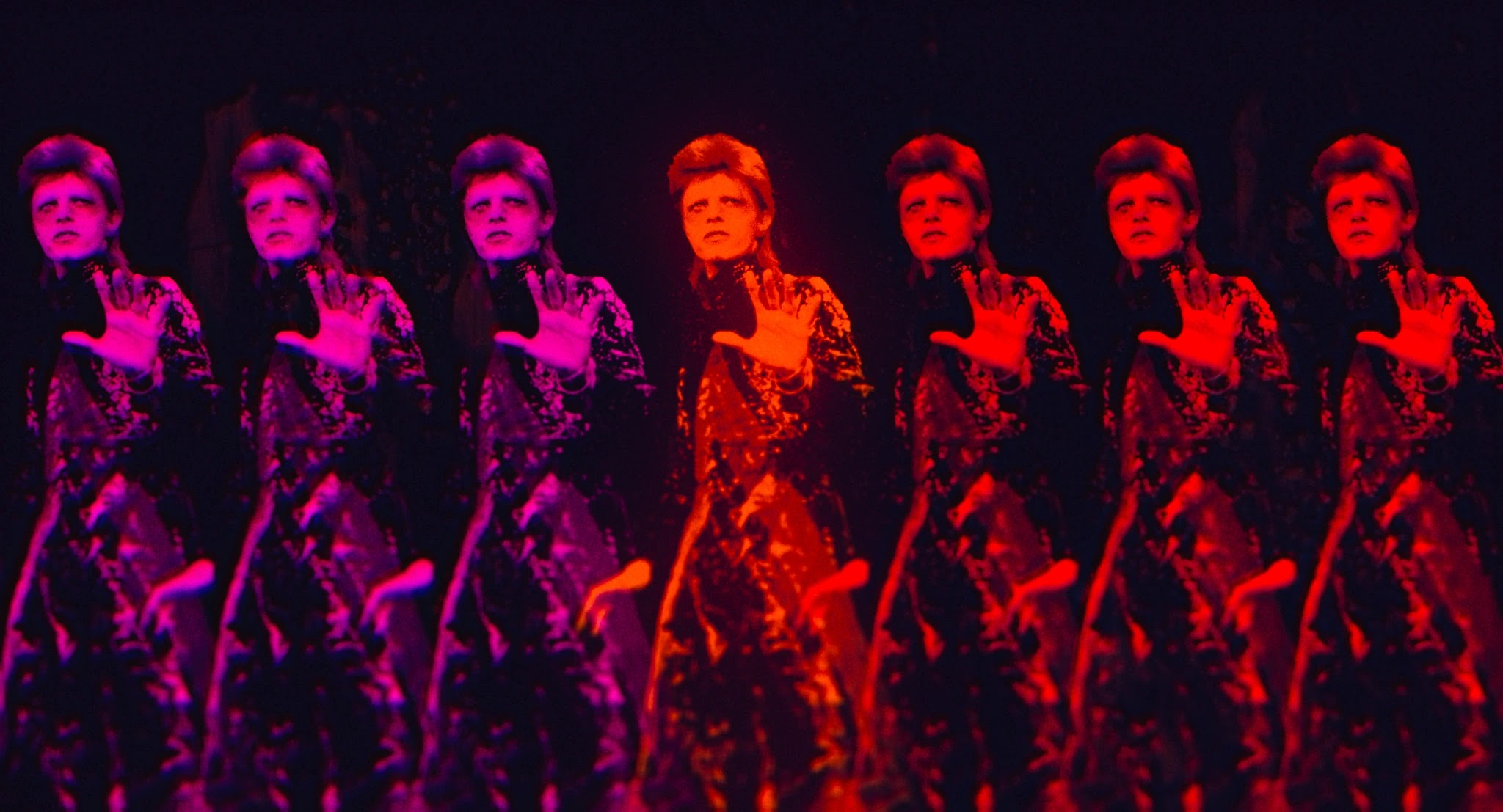
While this film follows a timeline of its subject's career it is so vaguely that it cannot bear the name documentary with any faith. It is, on the contrary, an immersion. From the ominous opening moments where the name Bowie is spelled out similarly to the title in Alien where each letter appears without obvious order until its complete. In Alien this cleverly suggests an unearthly alphabet but in this film it foreshadows the form we are about to sit through: a bit from the end, some middle, there's the O, more middle etc. And then we plunge into deafening concert footage and liquid colour as stage lighting seems to soak into everything it touches and the sound of the magnetic voice at its centre holds the chaos in. We see him preparing for his early '70s video for Life on Mars, impossibly whitefaced with candy toned makeup, and in equally gaudy costume, fending off the smarmy questions of Russell Harty until the latter seems to swallow every question he utters. A couple of quotes encapsulate the way Bowie might have looked back on his ridiculed 1980s by showing him ecstatic at the stadium sized popularity and then, jaded, preferring the creative freedom of the margins. This is David Bowie in high career from the end of the '60s to the end of his life, singing, noodling, opining, stumbling through cokey interviews here, effortlessly intimidating with quiet confidence there, very often very funny, and pretty much always dazzling.

Brett Morgen who directed, compiled and edited the footage as well as inserting some of his own imagery, also mixed and shaped the music track which, apart from the concert footage, is an epic of reimagined familiarity. Like the more conventional Finding Fame documentary from 2019, Morgen worked from recording stems so he could lay down a groove from Young Americans and feed some Low on top or some plaintive isolated vocals from Cygnet Committee between the jags and wires of Heroes. Add a mass of costuming over decades, eye popping stage setups, more than a few extended live takes that might make you well up, with garnishes of antique cinema and vintage media and you have this, an experience rather than a documentary, an experience more than a film.

To be able to do this convincingly you do need a Bowie or someone whose protean faces on parade frequently brought him to the question of who he really was and how close that might be in relation to the personae he pushed on to the stage. Taken that way, this is an immersion into intoxicating fame. We don't need to see fans distraught at missing out on a sight of Ziggy or ogling upward in Speilbergian wonder. This glancing blow of what it might be like to be so beloved but also where you might have left yourself before the first word you uttered into the microphone. This is what saves this film from hagiography, while it does leave some elements out it also deals plainly by describing itself as a celebration: we really aren't seeing a saint of modern showbiz but we are seeing someone who sought to create as much as he could before his light went out. Does that mean he really did that every day? Everyone has hangovers. It might well mean that he damn near got close. If you fall a little short of Bowie fandom this film will be an assault. If you're in, you won't know where the time went.