Showing posts with label 1982@40. Show all posts

Tuesday, December 20, 2022

1982@40: BLADE RUNNER (spoilers)

"Lemme tell you about my mother." Kowalski murmurs that before he blasts Agent Holden into the next room. That's at the end of a tense interrogation meant to test Kowalski's humanity. He knows he's flunking and the mother question shoves him in a corner. Across town retired Blade Runner Deckard gets hauled away from his dumplings and noodles for a re-hiring chat with his old boss at headquarters. A small group of lethal replicants have illegally re-entered the atmosphere and need dispatching. Deckard finds himself at the source point of androids, meeting the great Mr Tyrell himself and does the Voigt Komp routine with Tyrell's niece. She's a clanker. As these threads approach each other, winding and weaving, Deckard won't just be hunting down bad robots, he'll be wondering about his own nature, if that's what it's called.

Ridley Scott's classic neo-noir sci-fi set the pallet and the design for the genre to come for over a decade, building a splashy neon city whose vintage grandeur is loosening brick by brick from the endless rain of climate change and whose people seem to swarm like insects. He could have died with that achievement but then he'd already made Lucas' dirty space grittier with workaday talk and penalty rates in Alien. Blade Runner is a marvel of world building.

Well, the screen life is set at a near future far short of the setting (2019), where an imagined interface of mumbled commands gets results that a few mouse clicks or wheels still get faster. It's not that bad a job, though, considering how they scaled the devices down and integrated them into the domestic decor when the computers that aided the production still filled rooms. Also, if you think of how advanced the computers in the original Star Trek look by comparison with the ones from the '60s you're seeing a wilful leap from the old tape spool, valves and incandescent lights. They even got the floppy disc kind of right. In 1982, Ridley Scott was reeling all that back into the kind of machines we'd have to use, unglamourous, daily, functional. It's a similar feat of the imagination it just looks a little more like the office than we feel comfortable with. 

It's the city at large that impresses, here. It spreads beyond the screen, as weathered as an old cliff face, with the teeming futility that any alpha replicant would wince at as soon as see. There are no attack ships on fire here, just cops and little people. But their purpose is not to move into a flat, they want to leap out of the four year constraint given them by factory workers as dull as anyone around them. Even the designer at the centre suffers from a formless ennui. Even here, at the centre of their genesis where a kindly and prematurely aged loner wastes his genius on physically making his own friends. There is a lot more depth to the meeting that Pris stages between herself and J.F. Sebastian; her own programming recognises vulnerabilities within him to manipulate his pain. She even seems to know that his recognition of this will not create resistance. Darryl Hannah glows as the standard pleasure model grown well more self aware and nuanced than her designers allowed for. We know she's a replicant but her ingenue facade is so charming we prefer to believe it.

Rutger Hauer's Roy Batty feels more like the cinema that was presenting Conan the Barbarian until the sadism that his own self-development has made comes out. He's as much a pragmatic torturer as Wagnerian hero which only makes him scarier. His lengthy showdown with Deckard takes the deluxe sci-fi tale here into the epic, to a point where Deckard cannot help but be haunted forever by it. Hauer famously suggested the last line of his dying monologue. It resonates with all of us. The closing line from the detective takes further down: "Too bad she won't live but then again who does?"

This is where my experiences bifurcate. In 1982, Blade Runner was a cuter film with a hard boiled narration and a nice ending with a glider and big open scenery. Since then the film has undergone a number of different cuts, all purporting to be definitive. For this article I watched the currently available Final Cut version on 4K. The practice of directors returning to their canonical works and bloating them out with cutting room goodness that would have better life as home video extras has been one of the trials of the technology and the market. In the main they end up like the longer cuts of Amadeus (purpose defeating), Apocalypse Now (boring) The Exorcist (failed grab at later currency). In the case of Blade Runner I prefer this one. Nothing drags, nothing cloys, it's just a deathless epic.

I've gone all this way with almost no mention of Harrison Ford at the centre of the narrative. Is there much to say? He is poised between finding such depth as he was able in the Star Wars cycle and then reducing himself to an action figure as Indy Jones and he was soon to take pride of place in the cinematic trophy room as a steroidal dad for us all. Here, at least, he was given a shot at a character penned by a visionary whose cinema had to be conjured by a reader. It is to Ford's, Scott's and the movie's once and future pride that Phillip K. Dick saw Ford as Deckard and recognised him:

"He has been more Deckard than I had imagined. It has been incredible. Deckard exists!"


Wednesday, November 16, 2022

1982 @ 40: TENEBRAE

Bestselling whodunnit writer Peter Neal travels to Rome for a promotional tour of his latest thriller, Tenebrae. It's not just interviews and signings, though. He's barely landed before a series of murders starts in which the killer leaves notes for him, quoting his work, effectively calling him the inspiration for the killings. Detectives is on the case but Peter, himself, has his own ideas and quietly begins his own investigation. Is it the weirdly bent journalist, his frenzied fiancĂ©, a member of the  of the LGBTQ+ community in Rome making a point? All shall be revealed (but not in this post).

While the first twenty minutes of this entry into Argento's giallo cinema can feel a little cramped and awkward, once it gets into second and hits the road it's one of his tightest and effective thrillers. There are plenty of stunning camera moves like the survey around the house that is part stalker and part supernaturally powered killer or some of the breathtaking murder scenes. Goblin's score veers between ethereality and the nasty end of prog and is always welcome in an Argento joint.

International stars Anthony Franciosa as the urbane, ratpack style author works a treat as does John Saxon, playing against his B-movie action single-cell dimensions to comic effect. Argento's partner in life and writing Daria Nicolodi, so welcome on screen in Deep Red, provides most of the ethical gravitas to proceedings. My favourite of the cast has to be Guiliano Gemma as Detective Germani who reads libraries of thrillers but never guesses the killer. He is the end of a long line of Argento cops who steal all their scenes from Crystal Plumage on.

I always forget the strange, dreamlike sequences of the woman on the beach with the teen boys. There is a creeping unease beneath its beauty that recalls filmmakers far further to the margins than Argento, like Zulawski, Pasolini or even Jodorowsky. There are two of them, both mixing a brooding sexuality with sudden violence, and their appearance is always arresting by both their progress and the interruption to the more muscular giallo style of the rest of the film. They are centrally relevant to the plot but it won't be apparent as to why until the end and it is so difficult to attribute them to a character that they become more compelling than the murder mystery. It's as thought the film itself is daydreaming a kind of pleasant version of the movie until brought back by violence it cannot mask.

Another aspect that strikes me about this one is that the sensationalism in the treatment of LGBTQ+ people is kept to the novel of the title and the mind of one of the characters. It is not normalised; the jealousy mind games between the lesbian couple are not played for laughs and their sexuality is only the cause of their slaying by a figure whose savagery prevents empathy. This is not unusual in Argento's work but the beige naturalism of the depiction feels pleasant from an era where even edgy comedy played on stereotypes.

Dario Argento was still on a career high at the beginning of the '80s and it would continue for years more before the following decade's patchiness threatened to soften his name (see also John Carpenter and George Romero, just quietly).  While Suspiria before it and Opera after featured more eyepopping violence the kills here are in character with a murderer making statements. The double murder of the two women and then the startling noonday sun in the piazza slaying are as crafty as anything he has done.

If Argento has muddied his own waters with later works, to my mind we can still keep the room we've made for him on reservation for all the stunners he brought to the genre which levitated its bar and kept the genre in the realm of great style. If I chose this film for a rewatch it's always as a casual pick but it always ends up reminding me of how compelling it gets, how soon and with what mastery. It wasn't the last time Argento made all of this work so fluently but it's still one of the best.

Monday, October 10, 2022

1982@40: POLTERGEIST

Young family in edge of town housing development is attacked by supernatural forces after strange phenomena appear and one of their own, five year old Carol Ann, is swallowed into the para-ether by the television. Experts are called and investigations made but it will be up to stronger bonds to vanquish the uncanny captors.

This film is among a very few of its vintage where the contemporary effects which it frequently depends on do not embarrass it. A fine cast of character actors perform a solid screenplay with high level lensing and a score by Jerry Goldsmith (no adjective needed there, considering greatness before and after). Poltergeist throws a lot of recognition humour about suburban family life, makes sharp points about greed-first business, and offers some respectable, if mild, scares and eeriness along the way. It was and is thoroughly enjoyable.

This high gloss entry into the horror of a new decade came at the end of a knotty string trailing back to 1973's The Exorcist whereby the horror is set in the normally comfortable suburban home. Neighbours fight over tv reception while the kids outside prank passersby. And then the horror. This time it was lifted into the influential dollar power of the father of the summer blockbuster, Stephen Spielberg, and the wielder of the Texas Chainsaw, Tobe Hooper. It's not the quality of the movie that gets questioned with this title, it's whodunnit.

The nitpicking on this topic can suck strong taxpayers into lightless rabbit holes but a shallow online investigation will reveal a workable solution. It was both and looks and plays like it. However, it is sorely tempting, given its gloss, pointedly every-family observations on life in the middle of the social strata, to leave it squarely at Spielberg's feet. Considering how all of Spielberg's productions of other directors' work ended up looking like his own, it's not so surprising, but here it looks like a hostile takeover. That is, until you start noticing things that he would never do if there was a choice. The mystic Tangina's stark Christian fundamentalism reeks of Hooper's southern upbringing and would return in later sequel to his own Texas Chainsaw Massacre. The face tearing scene is all Hooper. The use of the tv set as portal to a malevolant outer world, though, really could be either and possibly served as a starting point for the collaboration. The rest is probably just a history of compromises and/or personal politics. The more I see the film, though, the more firmly I think of it as a collaboration: Spielbergian themes and identikit look and sound (see also Gremlins, Back to the Future, or a host of others) but an undercurrent of darker and nastier thoughts from a Hooper who'd bargained with the mob to get his damn movie on screens.

I very happily watched this in 4K. The bizarre jump cut between the kitchen and neighbour's house scenes remains (look it up, there's a funny story to it) and the cover art throws decades of high recognition into the bin by putting a hard to visually read image on the cover instead of Carol Ann at the tv. Come on, folks, it's an iconic image for a film that was only ever intended to be mainstream; why the obscurity? Anyway....

Sunday, July 17, 2022

1982 @ 40: THE THING

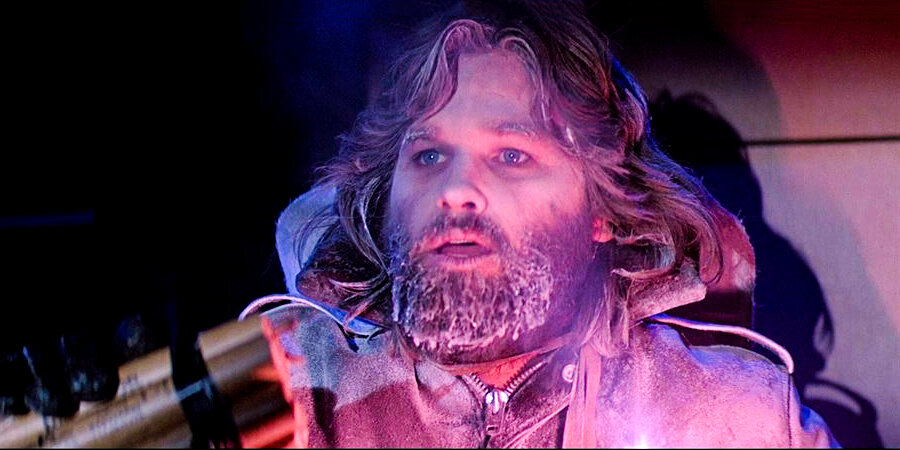
A flying saucer grazes the Earth's atmosphere as it zooms by. We don't see it fall in but as it disappears into the dark it looks red hot. Credits, a low brooding drone given form by a thumping bass guitar. Antarctic Mountains. A helicopter is chasing a husky who evades bullets and grenades until reach an American outpost. The dog runs to his new best friends as the chopper crew manage to blow themselves to barbeque. The dog gets the run of the station until he bites one of the men and is sent to be with the other dogs who snarl at him until he turns into a tentacled monstrosity and starts absorbing them. Hearing the yelps the station crew run to the kennels with flamethrowers. Dammit, they thought the South Pole gig was gonna be a doddle.

The cast present a good range of masculinity from Kurt Russell's frontier machismo to Richard Masur's strong silent type to T.K. Carter's funky urban to Donald Moffat's military ruthlessness to Wilford Brimley's civil, grey haired science, and more. It is easy to see this as being film about male competitiveness and develop a commentary on the extremity that forces cooperation. The fear of penetration by a colonising other is there on screen all the time. While I doubt that considerations like this were too far away from Carpenter's thinking as he put this one together it strikes me that they were subtexts he used for the drama, not the other way around. They're still there, just not doing the job they usually do.

The body horror of the mutative fusions, the sudden extremity of the violence responding to the appearance of alienness and the great featureless white of the world around them make for a sobering meditation on the isolation, the shared loneliness of despair. If anything felt like the nuclear threat back in the early '80s it was this. Carpenter's action is dependably compelling and here, with the best practical effects he ever worked with, his weird scenes push so hard against what his viewers might have feared (at least the ones in the early '80s) that he had one character watching a severed head sprout spider legs and walk away say what the audience was thinking: "You gotta be fucking kidding."

John Carpenter's Thing ditched the carrot suit of the '50s version, went back to the source and amped up the paranoia of an alien that could adopt any appearance and intelligence it needed. Just enough backstory is delivered through action and reasoning and the rest of the tale is about fear of the familiar. Is that thing he said the truth or what the Thing needs us to believe? Characters that, through elegant writing economy are rendered potentially terrifying simply for acting like themselves. The worse this gets the more it points to a scorched earth solution. Is that what it will take?

Carpenter had begun his feature film career less than a decade prior to this. It was also science fiction (Dark Star) but its alien character was a barely disguised beach ball. With scant means but great style he fashioned the action classic Assault on Precinct 13 and the and the immortal slasher Halloween. By the time The Thing came up he was dealing a big studio budget that included a massive allocation for practical effects. Other directors climbing from cash-strapped indy to the major label clubhouse can fall on their faces just in the execution let alone the success of their mainstream works. Carpenter, gave us a magnificent imaginative movie  with a score by Morricone (who did a kind of cover version of Carpenter's own film music) where the scariest notions were extended into advanced level practical effects and the scope felt as big as the continent it was set on. And then it fell on its face.

Common wisdom puts the blame for The Thing's failure in cinemas on Carpenter reading the room all wrong. Alien was a few years back. This was the year of E.T., the loveable off-worlder that everyone wanted to cuddle. Carpenter had already added scenes to The Fog to bring them up to 1980 and, armed to the teeth with money for everything and a big warm go ahead to helm a project that had been left a long time in turnaround, he threw everything he could at the project and emerged with a bona fide genre classic. But the problem was that everything else was getting warm 'n' fuzzy endings. Even Poltergeist with Tobe Texas Chainsaw Hooper in the chair felt like a Spielberg movie (some accounts say it was one) I don't even have to spoil the ending to write that the course of events in The Thing at the halfway mark prevent the question of the situation reversing into happyland. The question of how much worse is a better one. To a culture in the scariest phase of the Cold War yet, the notion of mutually assured destruction was not the stuff of cuteness. 

John Carpenter has enjoyed a rich career making genre films that stand up to time and continue to be justly celebrated. There are enough and there is distinction enough to pick and choose, to be a Halloweenite or an Escape From New Yorker (I'm increasingly a Prince of Darkness-zen) but his own stated favourite is this one. Like many things that didn't blow up the box office The Thing rose to furtive life and perennialism on the then new home video market and remains one of the essential spines on the shelves of any physical media collector.

And for its grimness it is still a welcome watch forty years later. If the mutations look increasingly plasticky the higher your resolution (I saw it in 4K for this) the brooding silence and the humming spaces of the station still generate a fight or flight in us. But the more I see it the more I understand how wearying it felt to people living under the ICBM flightpaths with a cowboy in the Whitehouse and a Cossack in the Kremlin. The negotiations that will lead to the worst mutuality didn't even have the relief of a wisecracking Arnold Schwarzenegger. For all the snappiness of the dialogue and the engaging procedural language I'm just brought back to the threats: Trumpism, climate change, pandemic, anti-vaxxers and conspiracy cookers on parade and I think as the credits roll that I just had fun watching a great movie but I also feel exhausted. Not exhausted as after the catharsis of a well told tale but from one that refused to sing a sad song to make it better. It's Throbbing Gristle not Joy Division. It's Threads not The Day After. It's Come and See not Saving Private Ryan. It's The Thing not E.T. And it's completely bloody wonderful. Pass me some of that whiskey, now.

Saturday, July 2, 2022

1982@40: TURKEY SHOOT

A credit sequence montage of civil unrest being quashed leads us into scenes of the arrests of dissidents or those standing next to dissidents. The prisoners are clapped in yellow overalls and shipped out to a jungle prison camp run by sadistic guards and controlled by a sinister grey eminence. The latter invites the idle rich to the prison for human hunts which variously serve as capital executions or true life adventures. That's the movie.

Well, not quite. That describes most of the action for most of the running time but there's more on and through the screen going on. This is considered an Ozploitation classic along with the likes of Mad Max or Stone but, while it has the sleaze and action of those, there is an extra factor at work: Brian Trenchard-Smith. Trenchard-Smith's rap sheet makes him look like a lifelong jobber with a trove of tv credits alongside a good line-up of cinema and straight to vhs exploitation. But those latter titles were made with a lot more social commentary than they needed and by themselves make a good case against judging their maker too easily.

Whether it's this dystopian violence daydream or Frog Dreaming's uneasy mix of serious first nations mythologising and crass (if authentic) contemporary racial terms which would not get within a cooee of a screenplay now. The sadistic commandant Thatcher's name was borrowed from the then reigning British P.M. Margaret Thatcher without the slightest coincidence. The blending of accents from Australian to British to American transcends the charge of widening the potential box office, the suggestion that this oppression is effectively everywhere is clear. The jet fighters at the end bear RAAF insignia (would have been effectively impossible to have changed that) but the radio communications all sound American. For my part, I saw this as a fanciful expansion of the truncheon legislation of the Queensland state government I was subject to. It still feels politically and emotionally true.

What of Carmen Duncan's psycho aristocratic hunter who reveals her lesbianism suddenly when moving into her quarry like a python? Lesbianism goes hand in hand with exploitation cinema and will appear faster than you can say prison or vampire. It's a short cut to home video credentials because, more then than now, it has the appeal of instant othering. A year later Paul Cox depicted a lesbian initiation with candour and humour in Man of Flowers until it felt like an eiderdown. Duncan's lip licking predation here just joins the other blood-crazed monsters like the gun happy and sharply-names Tito, Noel Ferrier's queasy urbane depravity or Thatcher's cold process. We don't see the rape or murder of Lynda Stoner's character but we get a pan over her corpse afterwards with a bloodied body, torn clothes and more arrows than a damned soul in a Bosch painting. We are forced to fill the act in ourselves and it is ugly but the only people who aren't ugly here are the victims.

For the past decade or so the notion of a resurgence of Australian cinema has been couched in the plea to make more genre films. Ozploitation is the example trotted out time and again for its robust long term success in home media despite box office disappointment (as in the case of Turkey Shoot). The secondary plea is that of the entertainment-first drive of this kind of movie. For all the sensitive summers that changed lives to rawly adapted novels, the action-heavy gore fests rise easily to the top of the retrospective surface. 

While I have no problem with the idea I get the feeling, hearing the case being made again and again, that rather than Turkey Shoot which, for all its violence and sleaze, does have a point to make and is far from the kind of Ikea pack of joined thrills or othering being alluded to. The problem of ridiculing overstated performances is not that the joker doesn't get it it's that they ridicule the very values they would celebrate in more mainstream fare: showbiz and subtext. It is the awkwardness of a Turkey Shoot that calls to us across the decades in megaphone tones that oppression is bad because, however more smoothly we can put it, however more archly we can say it, oppression is bloody well bad.

Saturday, June 4, 2022

1982 @40: HALLOWEEN III: SEASON OF THE WITCH

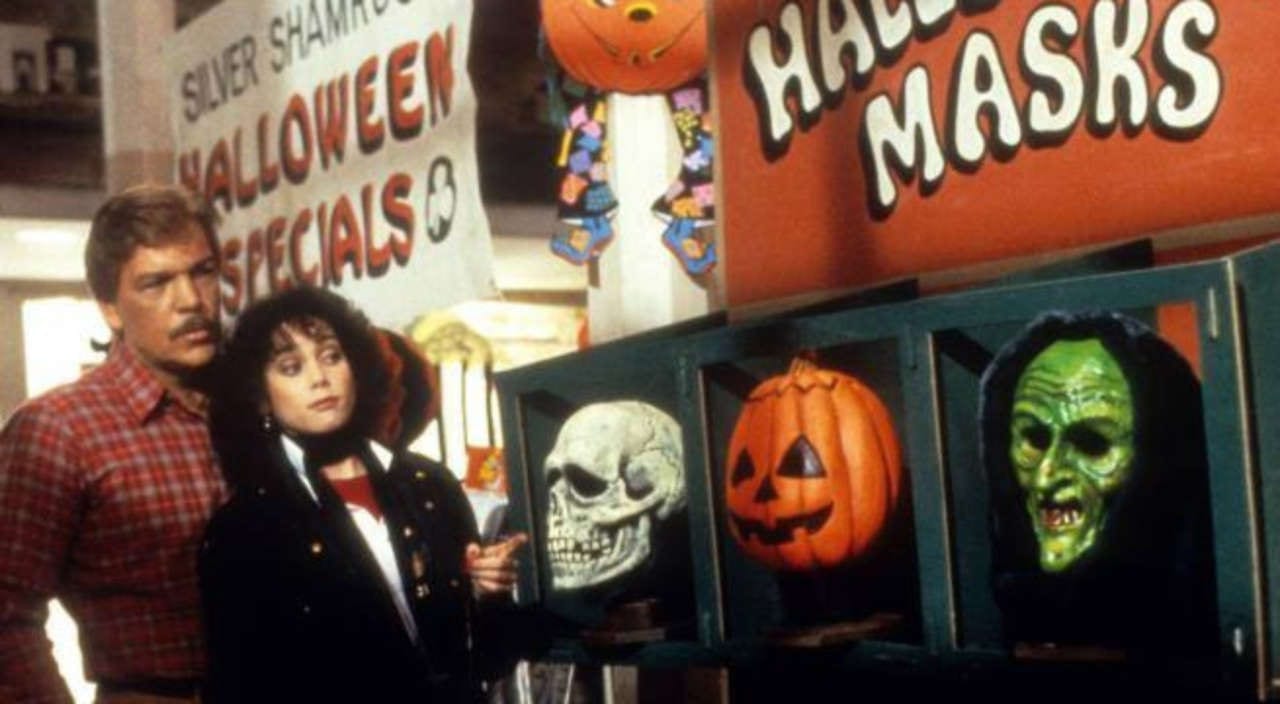
A man flees pursuers, clutching a halloween mask. He lures them into an obstacle strewn yard and escapes. He takes refuge in a petrol station nearby but collapses, muttering about doom, and is ambulances off to hospital. While there, he is visited by one of the creepy men in suits who have tracked him down. The baddie gouges out his eyes and, chased through the hospital by the horrified staff, gets into his car, douses himself in petrol and lights up. BAM! 

The doctor treating him is aghast at this and can't shake it. He has an errand, delivering presents to his kids and estranged wife before he can get on the trail. The ex is never impressed with him but the kids twist that knife even more when the halloween masks he bought them aren't the cool tie-in merchandise that Silver Shamrock has already peddled to them. They sit at the tv in the masks and watch the grating commercial once again. Countdown to Halloween, mere days.

The man from the beginning has a daughter who turns up to id the dad and, incidentally, fill Dr Challis in on how her father came to be hounded by the weirdo suit squad. All this leads to the Doc taking the gal off to Santa Mira California to the factory that makes these, the most popular halloween masks in the whole dang world. And things just get stranger and darker from there.

This is far more plot than I usually supply but there's a reason for that. Let me ask you, are you familiar with the name Nigel Kneale? Sigh, ok. Briefly, Nigel Kneale was a British writer who came into writing for the fledgling television fiction strand of the aby BBC, producing some of the most extraordinary science fiction that has, to this day, been committed to production. His character Quatermass alone and the many stories he wrote for him warrant serious pursuit for the mass of ideas each story bears. To watch an old monochrome Kneale production and feel the concepts streaming out toward you is to experience a modest but genuine revelation. Look him up and follow through. 

John Carpenter, co-chef of the mighty 1978 classic Halloween and Debra Hill proved that they weren't just Americans when they commissioned Kneale to write this screenplay. Halloween II had been a success but it was in danger of imitating the film that imitated it, Friday the 13th, by becoming a string of teenage-murdering monster flicks. Carpenter and Hill wanted something more like an expanded anthology collection where the notion of halloween might bear a multitude of tales. This one, linking the popular suburban rite to its ancient roots was perfect for the visionary British writer. But it went sour quickly.

Kneale's tale had as much folklore, technology and psychology as horror but the bossboy De Laurentis wanted blood and guts and Kneale took his name off. Carpenter, who wasn't directing, kept on with it and the result was a shonky blend of the Kneale slowburn and early '80s genre, including more than one diegetic insertions of the 1978 Halloween on tvs in scenes. Carpenter and Alan Howarth provided another electronic score of great merit and the title sequence which shows '80s computer graphics move in time with the music to create an Atari-ish jack o' lantern is superb. But that's where the real greatness and this film part ways.

Halloween III is a plod and it's often a grating plod. Does anyone, now or then, easily allow a fiery sexual connection between the earnestly unbonkable Tom Aitken and the decades-younger porcelain wonder that is Stacey Nelkin? Well, they go at it like teenagers at a high school formal and it still rings with profound unpleasance. This feature of the tale would not cut it in a remake (unless Rob Zombie was interested). 

Dan O'Herilhy is the silver eminence at the center of the big nasty that will attack the world through one of its fun holidays (even though most of the world doesn't do much at all for Halloween outside the USA) and he's more than suited to the role of the edgy urbane paternal terrorist. The sadly underused Nancy Kyes (veteran, as Nancy Loomis, of Halloween I, II, and The Fog) gets one scene before being squeezed into angry high pitched squawk on the other end of the phone. And the range of plastic faced automatons perform as their robotic roles demand.

Too many idiotic coincidences later, we get a very masterful and solid final act which says everything the long previous two couldn't quite articulate. This film goes from dull to wow in a very short time before the credits roll. And there's the pity of it. Because this film only works for its post hoc admirers it flopped for anyone expecting the next slasher movie, which was everyone. Michael Myers' only appearances were on tv screens within scenes. What might have become an ever expanding idea of where cinema might take the popular festival just shut back down to an increasingly uninteresting series of masked stabber flicks. I like stabber flicks but will have to admit that, for all their goofiness, the Friday the 13th sequels take more chances and manage to please both connoisseurs and casual popcorn gorgers. This was the first and last chance for the Halloween franchise and it was blown.

All was not lost, however. Carpenter wrote, directed and scored a film a few years later which paid clear tribute to Nigel Kneale and credibly honour his tradition of ideas-based sci-horror. Prince of Darkness, a movie I can watch at least in part, several times a year. I wonder, if the energy and creative will that made such a marvel of marginal cinema had risen for Halloween III, would we have a genre tradition knocked off course in the best way? Probably not without a renaming and a lower starting rung. But it was obviously really worth a try at one point. 

Sunday, May 1, 2022

1982@40: THE HOUSE ON SORORITY ROW

After an ominous monochrome prologue involving a doctor, new mother and the fate of her baby we zip forward to the early '80s which was in colour and meet a group of uni students who are getting ready for an end of term party against the proclamation of the house mother, Mrs Slater. As the future matrons of those United States, they prank the old gal and inadvertently kill her. With bon ton finesse the kids get their stories straight and wrap the body in a carpet and heave it into the disused pool. Not everyone's happy about it but PARTAY! So, they pile back into the house and get ready for a night of tertiary level boogie. The sun goes down and the boys arrive, the bottles flick open and it's on. But is Mrs Slater still in the pool?

While this might describe every second teen slasher you've ever seen. Depending on what you've seen of certain Canadian/US and older French thrillers you can pick two main elements that drive the plot. I'm not naming them here as the titles alone could conceivably be spoilers. So, if you're expecting a parade of fatalities at the hand of a mysterious (but is it?) killer and then maybe a few twists along the way, then this is the movie for you. 

By 1982 the teen slasher was established. Final girls, and masked othered killers converged upon each other as the body count ticked by. Because the audience and the onscreen targets were indistinguishable, the market was, for the time being, guaranteed. So, why bother doing anything differently? Well, there's always the possibility that something special about yours might help you break into the emergent market of  Michael Keaton vehicles just in time for the Tom Hanks explosion. If that happens here, that strive for respectability, it has to do with writer/director Mark Rosman's apprenticeship on the sets of '70s name director Brian de Palma. 

De Palma had established a profile reviving Hitchcockian suspense (to the point of outright lifting whole scenes) and while you might not be able to instantly declare something as one of his you wouldn't be surprised to learn of it afterwards. His most divergent from the Hitchcock template was Carrie which remains a legit horror classic. Outside of that, with de Palma you got gloss with everything looking Hollywood rather than gritty. If you know Hitch's '50s and '60s colour films, imagine them updated by ten years. Well, that's what Sorority Row looks and feels like: soft golden '80s light, youth culture about five years out of date (dig that The Cars with Tom Petty party band), and a few twists you don't care about but at least move the plot along. Oh, forgot, and a final scene that screams sequel (just not loudly enough in this case, though there was a remake decades later just to use the title). 

If you were to program a Halloween marathon of '80s slashers, this would serve as a pallet cleanser between stone cold Carpenter or F13 entries or as a companion to other twisty turny ones like Happy Birthday to Me or April Fool's Day. Ands that's the problem. Seeing it again, I registered it as ok but could stretch that no further. Among the sub generic fare there are the screamingly gory, the outright disturbing, the trove of checklist-ticking assembly line pieces and a few outliers like My Bloody Valentine or Slumber Party Massacre. Some can still turn my stomach and others feel like favourite albums and then there are Sorority Rows which play like a stretch of hits and memories radio that you don't mind at all.


The House on Sorotity Row is available on Tubi

Sunday, April 17, 2022

1982@40: THE WALL

A rock star sits in his hotel room as his grim past visits. Losing his father while young, a brutal education system, a scarring marriage and much more that his success cannot obscure. By the time his entourage come to collect him he is virtually comatose from depression and self-horror. This turns him to visions of fascism which then bring him to a break. He imagines being put on trial with everyone who tormented him in some way as the witnesses and a giant worm for a judge who orders that the wall the rock star has built between himself and the wall be torn down. We end with hopeful images of children cleaning up the debris.

The story behind the production of this film is complicated and dramatic and is worth your pursuit. I won't cover it here, concentrating on what Alan Parker did with it. The source album of the same name was one of the band's milestones and causes of its disintegration. But it was massively successful, played as a rock opera with a more coherent narrative line than something like Tommy and criticised its society with a grim determination. Perfect for a downer film at a time when even the newer pop music was also on a years long downer. What Parker had to do was as much logistics as cinematic style. He used the by then advanced state of Gerald Scarfe's animation (an extension of his cover art for the record, used by the band's shows for the tour) and added as much British dourness as he could muster.

The main character Pink was played by rock star Bob Geldof whose lanky frame and intensity came prefabricated from his punk days. This is not a film where many characters crack a smile so Geldof's jaded pallor or dirstorted screams blend well with the hysterical animation style of Scarfe. The major point of contrast lies in Kevin McKeon's performance of Pink as a boy. His seriousness feels wrong on such a young child but that is the intended effect; he's had to grow up young. A scene in which he tries to attach himself to a stranger's father is so worrying we don't have time to feel sadness. Then, later, during the album's great classic Comfortably Numb his act of compassion for a sick animal and then his own illness is as haunting as it is heartrending. The rest of the film is more violent in its imagery of factory processing children, hands reaching from death camp trains, an animation of Pink's marriage running from a beautiful dance of flowers to mental cruetly and violence and far too much more to detail from this many layered movie.

Is it just an extended rock video? No, but you could play extracts that way. Mainly Parker has kept his focus on the narrative that was already there and stitched together a rich quilt of emotive visuals, wisely trusting the music to do much of the work.

The Wall was one of the very few old guard rock albums that broke through to teenagers more inclined to the alternative of punk. The Punk Rock Board of Review, cleared the record for use by persons under twenty and we got into it without the help of midnight headphones. It was a wrenching experience, alleviated here and there by some magnificent music and it had the all important critique of institutions that any teenager felt. It felt weird to be buying it back in 1979 from the same shop I'd bought Never Mind the Bollocks two years earlier but there it was, its perfect playing, arrangements and clean production blaring out: "Hey, teacher leave those kids alone!" 

When the movie was announced years later, we lifted our heads, noted it, and stood in the queue at the cinema. In the very last year of my teens I watched with joy and admiration as the adolescent images of relentless cruelty and unfairness rolled out and nodded approval as one of my own generation's heroes played the boomer rock star turned teen Hitler and tiny screaming victim. Parker had marshalled his pieces perfectly. It was cleanly drawn but as emotive as a school kid and, because of that, it felt more complete than the record. The boomer rock epic of alienation and terror really did have a heart. A warm one. That was so good to know.

Sunday, April 3, 2022

1982@40: HEATWAVE

A gang of land developer thugs move in on a row of old terrace houses in inner Sydney just in time for Christmas. The residents have mostly had their home sold from underneath them but a defiant group of them squat in protest. One, seeing the news cameras, gets up on the roof to yell and is chased by a stooge with a hammer. Across town, the rags to riches Cockney larrikin is loudly seducing his company into the rewards of the apartment megolith he's putting where the houses are. The architect, up and coming and still young and ambitious is in the crowd, likes his job but hates the spin.  Guess which two characters are going to get involved.

Well, it's not that simple. There are a lot of threads here and they are served well by the interception of Kate and Stephen as they bring information and power from their initially opposite sides of the conflict. There's a high profile crime figure who runs the Cross with adult clubs who wants some of the respectability pie and a stripper of his employ who learns of a particularly personal connection that gives her a potentially deadly motivation. There are the increasingly dodgy deals that change Stephen's architectural vision from an urban paradise (it's called Eden) to a compromised edifice that looks increasingly like an overcrowded prison. And at the centre is the chief organiser of the tenants/squatters who poses a swelling threat to the suits to the extent that she vanishes.

And, something that I remembered clearly from my only other viewing back in 1982 (at, I think, the New Farm Valhalla), Cameron Allan's ethereal and moody score or synthesised drones and a phased guitar playing a series of unresolved minor thirds to 9ths. One of the reasons I noted that at the time is that it was totally unlike most Australian movies' music, its shining spookiness hovering over the mystery like a raincloud. No joy on finding it anywhere now but I'd buy it if I could.

Noyce continues his filmmaking prowess here  by giving us a Sydney of contrasts between ostentatiously wealthy and condensed milk poverty, a pallett that doesn't just change for social stratification but from the oppressive humidity working in the title to torrents of rain. This movie really feels like Sydney. And moving through it his large cast mixes old and new with John Mellion as an veteran newshound, the coplike Graham Rouse and Paul Chubb as cops, Chris Heywood as the kind of blustering populist tycoon who's all spin and bounty until you scratch him (and then only slightly), and new kids on the block Richard Moir and Judy Davis.

I recall thinking Moir was a liability to the film as his flat delivery and facial expression made him come across as a clothes horse feeding Stephen's lines to the rest of the cast. He lacked presence beyond his looks in In Search of Anna but had distinguished himself in a tv mini series Players to the Gallery. While he brings none of the passion of his character in that to Heatwave I found myself far more forgiving this time as what disappointed me as woodenness struck me now as restraint. This is not to say that he doesn't underplay the detriment of his role here and there but scenes in which he must stop himself from speaking destructively are clearer now.

As for presence, though, it's Judy Davis who sends beams of burning magnetism out through the screen. Already celebrated by this time for her breakthrough in My Brilliant Career (and, for those who saw it, Winter of Our Dreams) Her Kate is from the developer's side of the tracks and, whether slumming it among the worthy poor or not, transforms from a young firebrand who's found a cause to someone with genuine empathy for it. Noyce clearly recognised this power that allowed Moir to boil off most of his performance but her turn never comes across as overcooked. If you are a fan of the actor this is worth the fairly difficult tracking job you'll have to do to find it.

And then there is the undeclared star that is Australia at this time. Chris Heywood's Houseman is exactly the kind of figure we would not only be seeing more of in the ensuing decade but celebrating. Whatever healthy disrespect for position and wealth was supposed as part of the Australian character was crushed beneath the glossy pages of gossip rags and soft news. The bastard boss had become the idol in the age of the yuppie. The Bonds, the Elliots and any other corporate raider who could string a coherent sentence was afforded celebrity more typically given to rock stars. Heywood plays this perfectly as a dangerously wound double thinker: he is aware of the garbage that comes out of his mouth when he's pitching his vainglory (e.g. singing a corporate jingle in his limo to a recorded backing) but can keep that up as long as it works at seducing the eager and repelling the hostile. I don't remember much of the culture of magnate worship in 1982 but by mid decade Heywood's turn at it felt completely void of irony and worked as straight reportage.

We can't leave until we acknowledge the inspiration for Heatwave lies in the case of Juanita Nielsen whose activism against organised crime in Sydney in the mid-'70s is thought to have led to her disappearance. Nielsen had a varied career but the circumstances of her vanishing are most closely linked to her high profile advocacy against the development of heritage listed Sydney housing and by extension the kind of figures playing parts in Heatwave. As a figure she was closer to Judy Davis' well-born and glamorous character than Carole Skinner's more homely Mary Ford but that is all to the betterment of the fiction. This is not the Juanita Nielsen case, it just treads the same path to the same ends.

I loved seeing this in a cinema at the time. It seemed part of a push by local cinema to stop congratulating itself over period dramas and hit the streets of our cities. Monkey Grip, Starstruck, Winter of Our Dreams, Mouth to Mouth and Puberty Blues etc. gave us a look at where we were and what that meant without the aid of crinolines. The push, if it had ever been that, didn't sustain and the output grew frayed and infrequent. Not dead nor even sleeping, just less cohesive. Until then we had moments like this and the minties to meet them.

Saturday, April 2, 2022

1982@40: CLASS OF 1984

Slick young music teacher Andrew starts work at a school where the kids have to go through airport security to get in. There is a principal but the halls and classes are run by the gang of punques led by the fiery Stegman. These things come together in the first music class where the band, when the gang allows them to play, sucks. Andrew clears the room of thugs and sets to work, having made Stegman an enemy for life. So, what happens then? What do you think?

The pattern set by Blackboard Jungle was not changed by To Sir With Love and that wasn't changed by this. The sole differences between these three (and scores of others) is the wardrobe and the extremity. So if a teacher's rare record collection is trashed in Blackboard Jungle the biology teacher's lab animals have to be skinned and skewered. Andrew's wife isn't just threatened, she's raped in her own house and then kidnapped. The rest is what mainstream USA thought punks were.

There was an episode of the para-detective show Quincy where the punks looked like Alice Cooper clones and their bands sang songs with lyrics like: saw a beggar the other day, stole his pencils and ran away... Among other such nihilistic warcries. Then Phil Donahue had some examples of punk on his talk show but that was after this movie and they looked like Alice Cooper was going for a Siouxsie/Robert Smith look. To his credit Donahue sought to neutralise the threat felt by the straighter of his crowd but while that might be comendable it just don't sell movie tickets. The punks in Class of 1984 are a bunch of violent petty criminals of the kind that would have been ordered to smarten up if they were anywhere near genuine organised crime. But they have spiky hair and were made bad.

Andrew played  by Perry King, who is so 1974 in 1982 he has a tightly groomed beard, is a kind of bipedal cardboard cutout of concern until the bad kids drive him to being a cardboard cutout of rage. The always welcome Roddy McDowall is the cynical biology teacher with a "victimise here" tattoo on his forehead and pressure valve ready to ping. Stegman, punk in chief who would never be seen at a CND rally (like a real punk) is an identikit bad guy. A young 'n' chubby Michael J Fox is one of the kids who really only wants to be good. And so on. 

There is a lot of violence in this film which you are told about in a pre-title card that includes some figures that look like stats about violence in schools. There is a title card at the end which carries an exoneration that would make Donald Trump blush. Between those two points there are a lot of overcooked scenes involving slam dancing punks at a club, a canteen diversion riot to cover a knifing and a third act that is little more than catalogue of vengeance stunts. If you were lulled at all by the apparent concern in the opening card the effect would have worn to tissue by the opening scenes. Apart from the rape of Diane (Andrew's wife) which is disturbingly rompy (and not in a Clockwork Orange intentional way) most of the violence is unremarkable by the standards of even a few years after the release date of this film. Is any of it mitigated by the scene in which Stegman reveals himself to be an accomplished classical pianist? No, but the way that scene plays out, well against expectations, should tell you a thing or two about what you are watching.

There is a point beyond which an attempt at ridiculing this movie is futile and that is an admission that it in no way claims to be anything other than an exploitation flick. To its credit, it does shape up towards the end as a muscular action thriller but, really, it's abouyt goodies and baddies and the baddies look like punks on Donahue. Writer/director Mark Lester, who has a long rap sheet of perfectly respectable genre films lays this one out like an updated Sam Fuller or even Roger Corman without the commentary of the first or the style of the second.

And it's not just those title cards that anchor this (intentionally) back to Blackboard Jungle (or its era at least) but the choice of the song as the title cut. It's a kiiiiind of synthpop punk thing called I am the Future, sung by Alice Cooper. Though I am from the generation who found its depiction of punk culture laughable, I see no more harm in it than in Corman's biker gangs: both serve a fiction in costumes. It's not the Quincy punks as much as the vileness of the heroism that gets me. This film fulfils its claims to the last. Maybe I'm not fond of the claims.


Oh, just so you know, no, this film's title does not mean that it makes any allusions to George Orwell's novel Nineteen Eighty-Four. The year of the same name was only two years after the release date of this one and is only in the title to evoke bad stuff, the society depicted in it looks as much like 1982 as anything else made then.


Saturday, March 12, 2022

1982@40: NIGHT SHIFT

Chuck is so intimidated by life that he quit his whitecollar job in investment broking to work in a morgue among the silent dead. His timidity has developed so far that he is bullied by everyone he encounters. That is until, bullied off the day shift so the boss's nephew can take the job, he meets his new assistant Bill. Bill is constantly engaged with the life (and non-life) around him to such a degree that when he's not talking or riffing he's dictating new ideas into a Walkman. And then, through a series of domino effect events from the crime movie prologue to a victim identification scene in the morgue, he meets Belinda, a sex worker whose pimp is on the slab. She's also his neighbour in the apartment down the hall from him. She's also in straits now that the management has gone, turning up one night injured by an aggressive client.

Putting two and three together, the trio come up with a scheme to organise the sex workers more corporately with job tracing, much better percentages and maybe even dental plans. You know how plots like this go and so does this movie. The point is in the people. Of course the relationships between them will turn inside out, break and be mended, this is a comedy, the fun is in how. And that is supplied by casting.

And what casting! Ponder this: Fonzie as a nebbish, Diane form Cheers as a worldly sex worker, and Micheal Keaton as a proto Beetlejuice (he was about to have a busy decade on screen). Against type, development of type and type in progress all in one movie. And it is in the writing and performances here that we get a comedy significantly against type for its time.

Henry Winkler is beaten by life, accepting the ugliness that acts on recognising his vulnerability. Intelligent and sober he is yet not written as a straight man of foil for Keaton's mania. The times would typically have him an exaggeration, a walking anxiety machine. Winkler, though, gives us something far more real, a person on the verge of implosion. In a way this is exaggeration, though: if the public wanted another Fonzie they didn't get the one who selected songs in the drugstore by punching the jukebox, they got the one who broke his hand trying. The tension between Bill and Chuck is not the clown vs the jumpy guy but a hyperactive toddler whose japes and turns are absorbed by an unimpressed void. What happens when it fills and pushes back? It robs the film of easy comedy but gives it durability. Also, it allows us time to suspect the sadness beneath Bill's mania, the terror that if he isn't making noise that there will only be the silence of space. Between these two comes Shelly Long's sobriety. Breaking the unironic privilege she brought so effectively to Diane, she gives us someone aware of the ugliness of her profession and respect for it. Like Winklers, her performance's power lies in its restraint.

The trailer for this movie at the time (not the one on IMDB) played up the comedic tells, Chuck getting bullied, Bill being crazy and Belinda being sassy. It looked like an m-rated sex romp like Porkies. The only reason I went to see it at the cinema was the recommendation of a fellow student who said the trailer was completely misleading. It is. There is sex in this film but it is shown by aspects. It's Chuck's ritualised coupling with his self-obsessed fiance as well as a service for sale on a shifting scale from exploitation to a more protected systematisation, a function of  consumerism either way. The only leering here is diegetic, of Johns and authority figures, the film itself refuses to snigger.

This is down to the hand of Ron Howard (Winkler's cast mate in Happy Days). This is not his cinematic feature debut but it's a very early one and already shows his willingness to go against type within the bounds of industry standards. The opening pastiche of Taxi Driver is not a send up but a use of an iconic streetscape. It's not meant to be clever, just effective. The interplay of the central trio  is kept delicate until it can finally break into broader comedy by which time it's much more than slapstick. How intentional this was I don't know but the same quality led Howard from this through things like Splash, Cocoon and Backdraft from comedy through to a highly respected and oscar winning allrounder status. Perhaps it was just something that happened from job to job but the refusual of Night Shift to play to the norm and dish up a saucy satire and concentrate instead on its characters and their complexity gives it a lasting strength. Maybe fewer laughs than Bachelor Party but it still feels good after the credits. 

Saturday, February 19, 2022

1982@40: THE KING OF COMEDY

Obssessed fan Rupert Pupkin wrests an opportunity to talk directly with his idol, chatshow host Jerry Langford and the contact turns an already unhinged fandom into denialism. Rupert's fandom works in tandem with his self-belief in his powers as a comedian and fantasises constantly of the two strands of his life twining into an unbreakable weave. 

It's not just the daydream scenarios where he and Jerry are showbiz friends, it's also the basement of his home which is decorated as a mockup of a talk show set, complete with canned applause and laughter and cardboard cutouts of Jerry and other celebrities. And it's also how Rupert keeps turning up to Jerry's offices with audition tapes and waits despite industry standard hints that his quest is futile. He teams up with equally deranged Langford fan Masha for a practical solution involving kidnapping. Will he get his routine to the show?

Undersung in the canon of the Scorsese/De Niro partnership to the point where it is frequently forgotten, The King of Comedy is as energetic and intensely cinematic as any of the others. It's just that it's difficult to reconcile its strange comedy with grave megaliths like Taxi Driver or Raging Bull before and Goodfellas after. Like David Cronenberg's The Dead Zone, fans will on being reminded of it say something like: "of COURSE, completely slipped my mind." But when King is revisited and again proves itself more than worthy and it is because of the comedy.

Comedy? It's about a psycho fan teetering on the edge of ultraviolence. Well, yes, but to get why it is a comedy can take a little switch of focus. There are moments in this film that play more conventionally as comedy but all of them fail, feeling try hard or cute. Mostly, this is a comedy of cringe. Rupert doesn't know that he isn't funny. He has the conviction of a self-help book and the consequent unnerving confidence of the wrong person making up their mind about something for the remainder of their life. 

Rupert's socially disastrous behaviour, his incapability to recognise embarrasment in others or feel it himself, and his impulsiveness give him the feel of a Dostoyevsky character, the underground man or Mr Godyalkin from The Double. De Niro's performance shows an unexpected commitment to a character pushing a fantasy version of himself so far forward that his natural self is annihilated. Mr Godyalkin while on one of his self-destructive shopping sprees makes eye contact with his boss as their carriages pass in the street. Godyalkin says words to the effect of: "It's not me. It's someone strikingly like me." If anyone had been hanging out for Scorsese to make an official adaptation of Crime and Punishment or The Gambler they only need to watch King of Comedy for the closest they'll ever get. The comedy is cringe. It is white knuckle and almost entirely unrelieved. When he is making a tape for Jerry in the basement studio his mother, offscreen, yells out for him to be quiet and in the second or two when he has to deal with it the viewer might well let out a loud laugh. Mostly, though, they would be more inclined to watch through their fingers.

Counterbalancing De Niro's force are the dual opposites of Masha the crazy fan (a snakey and effective Sandra Bernhardt) and the post comedy career Jerry Lewis as Langford. Only two years prior to this Lewis had tried to resurrect his gawky clown persona in the repellent, like-punk-never-happened Hardly Working (find the trailer on YouTube and see if you can make it all the way through). While Lewis persisted with similar attempts these eventually faded and he turned his skills to whimsical cinematic landfill like Funny Bones and Arizona Dream. 

In the middle of that was King of Comedy is which he plays a man whose tv persona is constantly confused with his offscreen demeanour so much that all he seems left with when encountering his public is anger. A very funny moment in which a fan who pushes her luck in getting an autograph and is refused a further favour turns instantly vitriolic puts Langford's position in a clear capsule. Lewis brings an intensity unknown in any role prior to this and never reprised. As a public figure who hates his public and recognises that his fame forces an endless repetition of the cycle of adoration and hatred, he is a celebrity who has come to understand his own futility. In his one shot, he took the face of the mugging clown with the cartoon voice and showed us the grimace beneath. His every appearance in the film carries tension which was a revelation then and now.

Sandra Bernhardt's Masha is an edgy variable and demonstrates that to take an already volatile film further she needs to be even more unpredictable. This is not in a cute or goofy way but one that grinds up against violence that could take any form. That it's indistinguishable from her sexualised adoration gives it further power and in the two hander scenes with Lewis she suggests the kind of Manhattanite horror figure to be seen later in Wall Street or American Psycho. It was her first screen role with dialogue.

At Griffith Uni in the early '80s, if you took as many cinema courses as they'd let you, you could like any filmmakers you wanted but you had to have an opinion on Godard and Scorsese. Godard's heyday or the years that could be written as seminar papers or assignments were long gone but Scorsese still had decades of forceful auteurism. We happy few who had watched Taxi Driver for the first time on a Steenbeck editing desk (all of us too young to have seen it at a cinema) and Raging Bull on a U-Matic video tape saw The King of Comedy as the next chapter in the canon. We would have been blitzed by the sheer virtuosity of Goodfellas or the depth of feeling in Last Temptation of Christ. Until then, we had some mighty movies from Marty. We couldn't know that his future would be solidly mainstream and have decreasingly sharp edges, that he would become scholarly, respected and dull. 

The King of Comedy, meanwhile, did not play like Tootsie or Night Shift (both probably future parts of this series), it played Taxi Driver in pastels and was all the punchier for it. It just wasn't friendly enough to be invited in to the 1982 movie experience, even languishing on the shelves of video shops. I wonder what fans of 2019's Joker would make of a first viewing of King which forms part of the blend used in the later film. Joker's mash of Taxi Driver's proto-incel nightmare and King of Comedy's dangerous delusional fan removed the depth of those and replaced it (knowingly, deliberately) with super villain blockiness. Has that further obscured the source films from contemporary audiences? My hope is that those fans I was just imagining could see King of Comedy just once, knowing when it was made, they might at least admit that it gives Joker some needed context. But I have no idea about that. I can just go back to a banger from an old master and settle in again. Maybe it doesn't matter. No .. it has to. 


Saturday, February 12, 2022

1982@40: TRON

Three people variously cast out or blocked by computing giant ENCOM band together to bring the corporation. The corporation head has been acquiring his way to the top, hiring and firing wizkids by the dozen and reaping the profits. What Mr Big doesn't quite grasp is that his central digital entity is not only learning fast but is becoming a bigger, badder paranoid control freak than he his, out gaming him to the point where he has the boss over a barrel of blackmail.

While all this is going on we see the world of a video game from the inside and at the level where those little 8 bit figures look like real people in active wear who talk to each other off script and are aware that they are units in a game, referring to the people who control them as their users. Their world is a combination of a police state and a wonderland under an intense neon glow which renders everything both brighter and darker than it should be. Their faces and hands are in black and white.

During a raid that the trio makes on the ENCOM building, the lead hacker falls victim to the experimental laser that the aforesaid A.I. (called the Master Control Program or MCP which used to stand for Male Chauvinist Pig and would stand for Microsoft Certified Professional) uses to render him into a digital entity and drops him into the game as a unit.

There is a mass more of plot. There has to be: the pile on of concepts forms a complex meta world that is left for later entertainment as the story flashes along at a blur. The notion of artificial intelligence has been a sci fi plot since Frankenstein. Its chief descendant, machine learning was routine in tv shows like The Twilight Zone, Outer Limits and Star Trek. What Tron did was to take the threat of it and merge it with the theme of megalomania as corporate greed and plug that into a neato tale set in one of the new video games. 

Those are just the basic building blocks of what's happening here but they'll do for a start. What's more compelling to me is where the merger puts this film in its time. There is a notion that Star Wars brought sci-fi into the A-Movie realm, made it respectable and popular. But the success of Star Wars really only popularised action adventure in space, engendered non-sci-fi clones of itself and drove the darker, more troubling material undergorund. For every Videodrome or Liquid Sky there were a dozen Battle Beyond the Stars. But now and then there were anomalies, mainstream flicks that stuck to their concepts and dressed them up like jumbo popcorn buckets. For all the space opera blaring out of the screens and speakers there was the occasional Blade Runner, Brainstorm and Tron.

Tron doesn't just apply a Wizard of Oz template to its two worlds and make the jargoned speech of the software engineers sound like '40s noir characters, it places itself between the big strong money of the information industry to come and the youngest kid in the house who, plugging away with an Atari in their room, had the house's best if not only computer and was already treating it like culture. When Flynn says, "let's use the wayback machine," he's quoting Mr Peabody and, unknowingly, giving a future Brewster Kahle and Bruce Gilliat the name of their web archiving retrieval system. That prety much sums up a good deal of what Tron has to say: whether you know you're in a game or not, whether you're the boss or a unit, the competition you are part of simply by existing is without date. That's more poignant now than in 1982 as the mix of antique digital graphics and hard sets might have been cutting edge technology then but would be a cultural cutting edge now as retro future. And money grubbing empire building is with us forever and ever. And it plays like a great adventure movie, anyway.

The cast is perfectly adequate but any performances necessarily remain under the veil of the warpo look of the game world and action. That said, the central counterparts of Jeff Bridges as Flynn and the dependable David Warner in his usual ice cold authority figure role ground everything. I noted that South Park had lifted the image of the stylised David Warner as the MCP and used it for the manifestation of Moses in the Jewbilee episode.

All that and you get one of Wendy Carlos' best scores, appropriately old and new in its mix of synthesis and orchestra. On that and the audio mix I'll note here that I watched this through Disney Plus and it had been upgraded to a very busy and boomy 5.1 which made me kill a lot of the bass as it was making my subwoofer rattle louder than the music and effects.

Tron flopped at the cinema. Then again, so did Blade Runner. Both, appropriately, found their fan bases in the emergent home video market that allowed a generation an undeclared film scholarship. But there's something else, going on with Tron's audience that wasn't quite expected. While grown ups found it hard to follow the game levels which can make the plot seem episodic, the kids who knew their Pac Man and Donkey Kong had less trouble. The teens and tertiary students into their online games, MUDs, MUCKs and MOOs, that required the direct injection of player creativity, also got it. The game in Tron doesn't look like Pac Man but what it does look like fired the imaginations of anyone thinking beyond the arcades and consoles and would soon be demanding more from their screen lives.

What Tron didn't anticipate is how movies in the future based on games behaved less like games than movies with three act structures rather than levels. This is not so bad (it's what still happens to novels) but it's interesting when you consider that Predator, made only a few years later, behaved much more like a video game than a sci-fi film which had less influence on game to movie adaptations than perhaps it should. Tron's themes of computer hacking and the figurative digitisation of a game player were solid refinements rather than innovations but the MCP's threat of extending its control and the reasons it gives presages cyber terrorism and probably for the first time. These now routine exploits cause terror at the level of personal identity on a mass scale. What might have been a spoken whim in the writer's room became a future modus operandi. Tron is like that, though, it's creaky and vintage but it can still drive. So, watch it.