Monday, December 24, 2012

Catchup Review: COSMOPOLIS

A fable of the 1%. Eric Packer, citizen of the oxygenated bubble of the billionaires club, wants a haircut. His security man reasonably suggests he spend some of his unimaginable wealth calling a hairdresser into the office. Eric wants the mirrors and smell of pomades, soap and the sound of clippers. It's a rootsy thing. So he gets in the limo and heads across town. Traffic's slow. The president's in town and creating traffic jams. Eric's favourite rapper whose beats supply the sound of one of his elevators is also going across town but in an open casket, slowly, mourned by thousands. There are anarchist riots. There are sexual opportunities and places to lunch and dine. It takes a long time to get across town. Eric, in the capsule of the limo with his data screens in the armrests, vodka and ablutionary facilities, is about to watch his life change from the root upwards. Oh, there's also a threat on his life.

This might be thriller territory except that the interest is far more in the examination of the pieces of his lifestyle, his power, health and business methods. If you thought the description in my crammed opening par made for action be warned that this is one of the coldest, most inert, most talkative examinations of a character you are likely to see outside of experimental cinema (and by experimental I mean lab conditions).

But it does play fair with this. Once in the limousine we see the impeccably groomed and smooth faced Robert Pattinson in the car and the back projection of the city behind him and for the first few shots it looks fake. If your tv has a high frequency setting like 100 Hz try it and see how that organic look of film with its grain and colour richness suddenly looks like cheap home video. That's what this looks like.

It's not a mistake. If you don't much about David Cronenberg then wiki or imdb are your friends but for now you do need to know that he is an extremely deliberate filmmaker. After Videodrome when his budgets started improving and his skill grew ever finer there is nothing that happens on screen or comes through the speakers that he hasn't intended. No awkwardly stumbled line or inappropriate facial expression is chance or lack of skill. In any way at all. So when we see our protagonist looking like the groom in a wedding video we are being clued in to the idea that we are going to see a lot of surface, a lot of skin and no heart, and it will be our job to find whatever's beneath. If we don't want to do that work we shouldn't be watching this movie.

This movie is talk. It's so much talk that it can be easy to miss the action and the visual feast going on. The talk is often abstruse but it's not hard to get the gist without feeling left out (indeed, if you were to try and follow it all the first time around you will be left behind very quickly). Keep your focus on how Packer's character changes throughout and you'll be ok. This is not an easy thing though. The verbal delivery is so dry to create distance between these people and the rest of humanity that you might want to pack a jogger's bottle before you sit down in front of it.

Since The Dead Zone (a Cronenberg film that even fans forget to count because it is so early and conventional)  David Cronenberg has split his jobs into increasingly mainstream fare like The Fly, Eastern Promises or A Dangerous Method and the products of his own personal laboratory like Spider, Crash or this one. While all of them look like his work and he's never softened into unrecognisable normality like Scorsese did, the gap between these approaches is wider than that of Guillermo Del Toro who jobs in action sequels in English to fund his singular masterpieces in Spanish. Maybe Cronenberg has just been doing that, playing the game here and reinventing it there on smaller budgets with the idea that his peaks will appear to history from among the innovative pieces. Well, history will take its pick.

Meantime we have Samuel Beckett in New York. People delivering lines rich in information but low on emotion. The great Samantha Morton's near monologue is like something out of a Matthew Barney video it is so poised and creepily monotonous. Juliet Binoche's turn is unsettlingly sexy. Sarah Gadon as Packer's wife is so sexlessly groomed and prepped she might be from the cast of Mad Men. Paul Giamatti is a real treat. His is the final line. It makes sense of a lot of the preceeding and it kills.

I don't know more about Don De Lillo who wrote the novel pon which this is based than my failing to enjoy an earlier book his lent me by a friend. I considered that to be a kind of lo-cal Anthony Burgess meets John Irving, all quirk and scholarship but no substance. Remembering that made me wonder what Cosmopolis could be like on the page as one thing Cronenberg has shown a genuinely astouding talent for in the past in his knack at imaginative literary adaptation. Crash and Naked Lunch, for example, play like companion pieces to their novels rather than rote visualisations of them, they extend the source material into cinema; you can enjoy both without one experience threatening the other. Now it looks like I'll be breaking my vow of non readership of De Lillo just to find out.

Even if I hate the book it will have been worth it.


Sunday, December 23, 2012

My bottom five for 2012

As I tend to accurately pick what I think I will like my worst list for any year will always fall short of the best list. MIFF also throws this off considerably even though I'm far more haphazard in my choices from that program. Then again, a broken leg will knock a great swathe of cinemagoing out of the schedule. Anyway...


The Rum Diary: Johnny Depp aided and abetted by Bruce Robinson make the thoughts of the pre-Gonzo Hunter S. Thompson into Animal House. No thanks. It's rubbish.


The Woman in Black: Renders a good solid novel and chilling sparse tv adaptation (by the late great Nigel Kneale) into a fun park ride with a lot of boo moments that wouldn't stop a ten year old. Also, if you're going to add elements that aren't in any previous versions (including the source novel) try and give them something new. Every original-version-warping addition made to this travesty was straight out of the cliche chest. When Kneale wrote his adaptation for the small screen he knew it would have a tiny budget and so scrapped any special effect that would jeopardise the gloom, dread and sadness that the story needs. His additions involved very clever use of contemporary technology and poignant mementos of the story-recent First World War. The 2012 version just adds cheese. Complete bullshit.


Prometheus: The good thing about Alien was the near total lack of back story. The characters talk shop, union regulations and salvage rates before getting torn apart by the alien. This is all backstory and one of the most hamfisted attempts at creating depth by adding religion. If you're not remotely religious (and I'm not) it comes across as a massive waste.


Damsels in Distress: Whit Stillman considers himself arch and sophisticated but if he weren't so intent on letting us know he thinks this we might enjoy his films more. But he continually demolishes all chance of that happening. It ends up looking like the most contrived garbage outside of the blast radius of a Wes Anderson stinker. Argh!


Dark Knight Rises: EEEEHHH? Dark Knight Rises? Worst? Don't you know it's Christopher Nolan, the man who gave brains to blockbusters? Yes, I know and there they are splattered all over the screen. Look, it is better than most of the others and superior to any of the Tim Burton attempts by going deep into the central conflict and imbuing every main thread with colour and depth. That's the problem, though, because in the end it is really just a big action movie as it should be but bloated out by increasingly lunking pointers to just how clever and deep it is. The effect is to make the conflicts and subtleties and darkness that are part of every major big action piece blaring and obvious. Take those out or allow them to appear to the audience who then can choose to get them (they probably will) or let them slide so the explosions can be enjoyed. Nolans brainy blockbusters remind me of prog rock. Nice playing lads but rock needs to have something primal and joyfully cretinous dominating and driving it. Slamming some Tchaikovsky into Get Off Of My Cloud makes utter faeces of both. Stop it!

Review: THE MASTER

First we see the subject. Not just the topic but the character about to be subjugated. Freddie Quell is all deconstructed animal, bleeding the alcohol from torpedoes  humping the prone sandwoman on the beach and then finishing himself off in the shallows, giving only sexual answers to a Rorschach test, fashioning booze in the cleaning closet of the department store where he works as a photographer and sharing it with the store model he's just picked up, provoking and then fighting with a customer before storming out and dragging the model with him like a coat he's just remembered. He could be a caveman with a club from a fifties Playboy cartoon, dragging a woman by the hair.

He is not alone in this. He's just been demobilised from the US Navy at the end of WWII and has, along with his fellow servicemen been lectured about the struggle they will face in getting back to civilian life after what they've been through. He's the same as them but perhaps pushed a little further in certain areas. He's not Everyman but Damagedman.

So when he flees the scene of a possible manslaughter he jumps dock on to a lavish looking yacht party and stows away. He's discovered and taken to the commander of the ship, the self possessed Lancaster Dodd who effortlessly takes control over Freddie, recognising him as the perfect guinea pig for his ideas on human existence and its cure, a body of supposition he calls The Cause.

Freddie is taken into the well-funded looking cult but I wouldn't say absorbed. He is subject to some experimental processing by Dodd which involves answering some penetrating questions, many repeated until the answer changes. The processing is a means of identifying vulnerability in the subject and is the only thing short of physical violence that has got through to Freddie and his violent narcissism. This scene shows a clear case of alter ego between the two men: one controlled and controlling and the other wildly rapacious. This, folks is not how you start a cult but how you perpetuate one; a market of human parasitic commensalism.

PT Anderson has played down the similarities between his Cause and Scientology and rightly so. His brief here has more to do with the motion of a fabricated alternate reality than a particular instance of it. Dodd does come across like an L Ron Hubbard but also like an a-religious David Koresh or Jim Jones.

A beautifully eerie scene plays this out as Dodd sings a bawdy Irish folk song to one of  his gatherings. We see Freddie gazing at it with pleasure and then in the next shot and for the duration of the number all the women in the room are naked. At first this seems like more of Freddie's galloping libido but soon enough it's clear that he is recognising how Dodd is experiencing the occasion; the adoration of available women and docile men. Roll on, ye Joneses, Koreshes and Mansons, here is the bounty of your pluck.

Also absent is any concreteness to the details of The Cause. Beside notions of humans being not of this earth there is little to attach this fabrication to those of Scientology. The scenes of physical and mental processing carry the same kind of hypnotic/entrancing/brainwashing manner as any indoctrination. The scene of Freddie's enforced pacing and continual redefinition of what he is touching is interminable and exhausting. The physically gentler intercuts of Peggy Dodd and her exercises in doublethink are chilling but seem all too brief.

The question of whether Freddies evil ways can be fully subjugated to the Master's plan is the question of whether Freddie and Dodd can fuse together. What at first might seem a good proposition for a bit of Jack Sprat compliments of the reason eventually develops to reveal conflicts. A telling moment when Dodd bursts into puerile fury at the persistent questioning of a journalist about the claims of The Cause strikes him off the roll call of the self-controlled. Dodd's violence is altogether more disturbing than Freddie's ready fists.

But there's a clear limit to how profoundly the master can penetrate Freddie's being when Freddie's self interest is so essential. The sequential question is then how much need has he or any of us for a master of any kind? What does that make any member of the cults that have existed and those countless that shall? Weak-willed? Maybe. But maybe, just maybe, a touch too civilised or socialised ... or processed.

I find an interesting comparison between this and Martha Marcy May Marlene rather than PT Anderson's other films. In Martha ... there is no need to inject obvious religion into a cult that clearly already has a charismatic leader. The offer of a kind of alternative life consolidation seems key to both the fantasy history of The Cause and the unnamed family of Martha ... and in both cases it can only mean subjection. The scary part is the apparent will towards subjection, the guilty victims that cults create.

I'm a critical fan of PT Anderson but I will say this of his work: I seldom feel the need to revisit it because it stays with me. It's very hard to forget Boogie Nights, Punch Drunk Love or There Will Be Blood. And though I find this one harder to connect with than any of the others I'm left haunted by it.

Anderson's visual strength remains intact. He is like Kubrick in the deliberateness of his images but not as winceable as Wes Anderson. His use of music has been improving steadily since he gave up on the jukebox approach. And his casting is again central to his films' integrity.

Hoffman brings his industrial strength presence to Lancaster Dodd. He is intimidatingly present in his scenes and his few sudden flashes of anger reveal a terrifying narcissism.

Phoenix takes a rather strange path in creating Freddie but it's worth it as it allows for both the vulnerability and visceral force elemental to his character. We know more about him than any of the others but he keeps a lot of himself in shade to the end.

Last and best, IMHO, Amy Adams. Peggy Dodd is the cold and deadly brains behind the man. Whether falcon-eyed in a crowd, servicing her husband with such matter of factness that it is both disturbing and arousing, or staring straight into Freddie's point of view and persuading him and us that her eyes are changing colour, or reciting pornography in a voice as cold as a catheter, her performance is like watching a cyclone without a soundtrack; her violence will always look like beauty but will also look like death.

I saw this at the Astor in its 70 mm presentation and was glad of it. The sound cut out about a third of the way through and we missed a little dialogue but quite pleasantly I don't think we missed a single point made in those few minutes, even though there was clearly dialogue being spoken. There's Hitch's requirement seen to and not even intentionally ;)

Saturday, December 22, 2012

Catchup review: Martha Marcy May Marlene

Marcy May flees the weird cultish commune where she's been living and the pursuit of her by the others ends with a brief ineffectual confrontation in a diner. Free, she's on the payphone outside reversing the charges to her sister who turns up and collects her, carrying her back to a splendid huge lakeside house in the country. Marcy May is really Martha. She's in good hands now.

Martha doesn't tell her sister Lucy anything of the cult she was in, being persistently vague about where she has spent the previous two years. But we see and as we do we quickly get a sense of the structure of this film as it phases between the present life in Lucy's house and the previous one at the cult's farmhouse.

Her life there included constant degradation as the women were subject to the leader Patrick's charismatic divide and rule policy, an initiation involving rape which the women facilitate, some cruel mind games and finally home invasions and worse. They refer to themselves as a family to which anyone with a passing knowledge of the 60s will mentally add the name Manson.

So, good thing she's out. Well, although she began well by appearing chatty and involved in the life of her sister's house and marriage. Soon enough it becomes clear that whatever social skills she had before the cult she now has nothing but a series of guesses and they are all wrong. Her damage is profound, beyond the scope of the care of her increasingly alienated sister. Through a moment of weakness Martha betrays her new position to the cult.

That's as far as I'll go with the plot as, even though it's a slow boiler, there are no go areas for a reviewer beyond this point. But as well drawn as the plot is the worth of this film lies more in the constant psychological commerce taking place between characters in the new life and the past. Martha was so soured by her life in the cult and events they have engineered that she must flee but the normal world beyond the woods has become alien to her, a world of threats and filled shadows.

This is the creepiest film I've seen since Last year's Kill List but without need of the genre jumping virtuosity. Martha... presents one thing only but with such cold deliberation and a surprising grip on the elements of cinema and how they will serve that deliberation that it is unthinkable that, once accepting the premise and its initial development the viewer will not be shaken by the closing moments. This is a horror film, an undeclared horror film as it looks like it's going to be another severe indy piece like Winter's Bone. It starts there but then turns to its own course, going somewhere old by a completely new route. I have seldom witnessed such a sustained exercise of sheer unease, such constant dread as here. The house invasion scene and Marcy May's preparation of the new girl are lighted like Rembrandt paintings but play like real nightmares.

Elizabeth Olsen shows in this piece the sheer power and control that would make her complex turn in Liberal Arts so compelling. Here, her gentle beauty is a curtain of hell. As such she will continue to bear close watching.


PS - I saw this on dvd even though I'd wanted to see it at the cinema on release earlier this year. It came out before my injury but I just didn't get there. Now I wish I had seen it with an audience. I'm definitely getting my own copy.

Review: THE PERKS OF BEING A WALLFLOWER

What Americans like the ones in this movie call high school is different from what we call it here. Here it starts after primary and the average kid is thirteen, going from being what feels like world monarch in grade seven to untouchable leper in grade eight. The temporal distance between your first day at high and finishing senior appears to the kid on the first day as an interminable Sysiphusian penal code.

Here the ignorable dickheads of primary school are goon squads of blinkered conformity. There are genetic monsters who take P.E. and grown up gamma minuses who take Tech Drawing. Embittered harridans of History and Economics whose talons and villanous laughter press home the grinding truth that there is no fair combat. But worst of all there are the popular teachers. These bearded or beaded (this was the seventies) narcissists were experts in using the social weight at the top of the pyramid to press down on the lower orders until everyone is word perfect in the pledges of local allegiance and pecking order. In the midst of this are teachers who carry their vocation like an old valise, comfortingly outmoded and dependable, and seem as easy dealing with sociopathy as perceived talent in their charges. I treasure their memory today, even though it can be obscured by the maelstrom of hatred and special pleading of most of the other memories.

I shouldn't complain. Things really improved for me after the first two years (which weren't that bad anyway, to tell you the truth) and I didn't mind the flack when I felt it as I was the offcentre type to begin with, only feeling the need to belong when ... well, that's kind of what this story is so I'll get back to it.

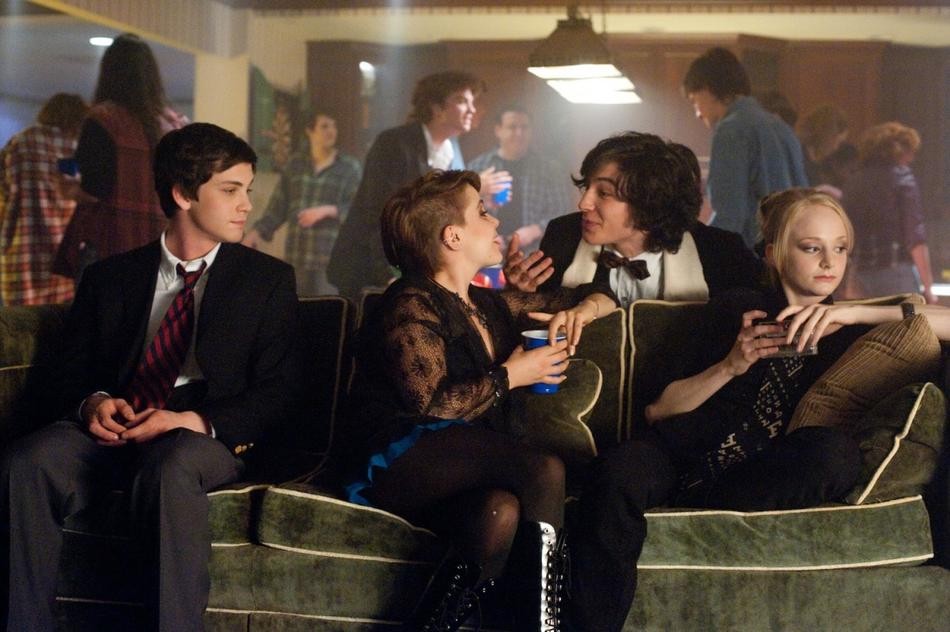
Charlie writes a letter to himself, saying that he will begin dealing what high school will be like by imagining his last day. He walks in slow motion through the corridor scale ticker tape parade. You, I and Charlie already know that his first day will be a flop. No spoilers possible there. But there's something that feels very wrong for the first good while of this film and it was making me uneasy in my seat.

After his first day when he makes no friends beyond the benign attention of his new English teacher (a pleasantly subdued Paul Rudd) in a few believable circumstances he is in with the quirky crowd, completely and utterly accepted with no faux pas nor overplayed hands. When the moment comes when he is toasted by the effusive Patrick (a post-Kevin Ezra Miller) his response:"I didn't think anyone noticed me." Comes after a lot of shared experiences including what will be this movie's iconic moment, a ride through a tunnel to the strains of David Bowie's Heroes. After all that he whispers something so self-effacing it sounds disingenuous. But it's meant to sound modest and poignant. Everything feels floppy here and doesn't feel like it's going to gel and take wing but will slop down to a Wes Anderson-like cute fest.

It doesn't, though. Charlie's personal issues with his family develop (yes develop, not turn into narrative ambushes) and take root, giving even the timidity of his personality more cause than it began with. This material also allows some real gravitas to the rest of it and soon enough the whole cutsey avalanche of novelist phrases - "Welcome to the island of misfit toys" - is placed within the naivete of adolesence. When the twist arrives (and we have indeed been expecting it, thanks be for decent writing and pacing: novelist adapted and directed) its effect is profound and flows understandably from the preceeding mood. And Charlie (Logan Lerman) gets a chance to do more than emote as a wisp o' the will. His performance at this point is impressive and informs the rest of the film.

So, while there aren't the kind of storms and occasional cornucopiae o' bliss that I remember, this is a gentle tale of big dark things that, once it hits its stride eradicates the indulgent cuteness that many lesser films focussing on the same area too easily give in to. Also, one particularly big moment involving a fight concludes in a way that I, curiously, imagined as a written scene from a novel. Odd thing is that it works a treat.

Something for summer about a time of personal change that everyone has lived through or soon will? It's not The Tin Drum but it's better than it promises to be.

PS - While I don't have the same problem some others have about these kids who can name songs by the Smiths and Cocteau Twins but don't recognise Heroes when they hear it, I still say humph and happily show my age by declaring that Heroes was one of the big anthemic songs when I was at high school. Like Pretty Vacant it managed to be quite culty and erase the sounds of Hotel California with a terrible might.

Wednesday, December 19, 2012

Review: LIBERAL ARTS

When you're young ridiculing older people isn't just fun it's necessary. Youth has nothing but itself for its own defence. The Rimbauds and twenty-something Orson Welles's are statistical anomalies. Mostly it's bravado and a bubble of self advertising, the louder and further fetched the better. So when oldies with their threatening experience, judgement and culture appear at the gates it's time to render all that into shiftless bigoted conservatism, goofy music and culture that wouldn't shock a rabbit and senility. From the other side (where I now am) there's no comeback; if you lampoon the young as a senior you just look like a dick.

But it's not all extremes. There's a whole tribe of folk who, while ageing, still live young and charge the silver backs of others only a handful of years older as generationally distant and of quaint living archaeology. It is easily forgotten that three years equals a chasm when it's 18 and 15. But 47 and 50 .... Sorry.

The cruelty of all of this, of course, is that the only group to whom age becomes a sheddable skin is that which, having passed the big zeros has relaxed about it. The rest is hysteria.

Liberal Arts is a delicate essay on this. If at times it shows its didacticism too easily the sheer continuous appeal of its cast and their performances do much to soothe. In fact, walking away from the cinema it struck me that every single cast member, even the ones playing cranky seemed to have come fresh from the best sauna and massage of their lives. There is conflict in this story but it's played so smoothly there's never a chance of the slightest furrow. That's not faint praise as I'll get to.

Jesse has found himself nowhere at 35. Having enjoyed his uni years, he took his unmarketable degree on a drift that led him to working in admissions, facilitating increasingly younger people's passage to the salad days of campus life. He gets a call from a much loved professor from his old uni inviting him to the older man's retirement dinner. What else is he going to do? He accepts and jumps in a rental and gets there. In the course of the multi-car logistics of setting up a lunch date with colleagues he is struck dumb by the radiance of their daughter Zibby. Over lunch and the digestive afterglow he fills to the brim with love for her. She's pretty keen on him. She's 19. He makes his excuses and leaves. A sullen evening walk later Jesse is accosted by a harlequin-like stranger (a deliriously funny Zac Efron) who persuades him to crash a nearby campus party. Guess who's there. So, should they start something up? If so, what? Etc.

What ensues is a far more credible cultivation of a relationship than I was expecting from a writer/director/star driven film. Woody Allen didn't have to be that advanced in years before his on screen romances started to look high fantastical. Here, it is kept to a credible early spring/mid summer pairing who are close enough in vintage to work but distant enough to allow conflict. Meantime, there's Jesse's old Professor who panics over his retirement and near debases himself trying to get his job back, Jesse's old romantic poets tutor whose ageing has left her insolubly embittered, and Zibby is coursing toward a decision that will bring her relationship with Jesse to an ethical brink.

All of this is handled so smoothly it should just drip from the screen and evaporate on the cinema carpet but it doesn't. The central pair of Josh Radnor and Elizabeth Olsen work and the tension between them due to the age gap is constantly on screen despite the warming harmony we mostly see. Radnor is constant self-doubt. Olsen is a 19 year old reaching beyond her years but still constrained by the vulnerability her inexperience gives her. The more I think of it the more extraordinary her performance appears. The reconciliation of this situation happens not just from its confronting moment of truth but through a separate thread you can discover for yourself which, while it feels a little too tidy, provides a glimpse of Jesse as a self accepting thirty something. Zibby has more to go through.

But if it weren't for the seriousness and import of the issues of letting go of false ideals and grasping the realities of ageing and that seriousness given such generous air to speak, this film might just be a rehash of the  jaded square rejuvenated by a sparking young thing so enamoured of the late 60s that it might well form its own genre. Harold and Maude reversed the casting and kept the memento mori centre screen and created something new. Liberal Arts doesn't but doesn't have to. It's like morning tea with a friend who has stumbled upon a revelation about themselves that is potentially life changing but so well articulated and good natured that it's a pleasure to hear rather than a grating indulgence. One and a half hours of a conversation you'll be glad you overheard.

Monday, December 17, 2012

Review: SEARCHING FOR SUGAR MAN


In the late seventies I remember seeing ads in the local music press (Juke and RAM) for what I took to be promotions of current singer songwriter types. I clearly remember a series of display ads for Nick Drake's albums. I never heard them then so they never took with me. Rodriguez was given the same treatment. Quite big ads for his two albums issue after issue. I thought no more of them at the time until the name started filtering through in the community out under the smoking trees at lunch and then, which gave it real heft, the university parties I started going to when I was sixteen. But there was something in the way of all this.

By the late seventies the singer songwriter type of artist was in the panelling. What I heard of Rodriguez' albums was acoustic guitar and whining voice. Right, I thought, it's 1978 and someone's cashing in on Bob Dylan. That's timely.

Also, when I was swept up by punk from 1976 onwards everything had to be as good as that. Well, everything had to be that. So in the year I decamped for Brisbane and kept up a lot of letter writing with some of the ol' crew from Townsville, Fiona, fellow travelling punque, told me about how good she thought this new stuff by Rodriguez was, quoting the lyric to I Wonder. I didn't give up on her but I did feel like it.

Searching for Sugar Man does this kind of thing. The first scene and narration are that of a shop owner from Cape Town talking about himself and then edging toward the subject of this film. And then you get a lot of other people from the same town doing the same. In the midst of this are some talking head interviews with people in America recollecting seeing Rodriguez in the bars he played, signing him up and recording the two albums. And one thing comes through like a big blue wave: Rodriguez' story is that of his fans. 

See also Nick Drake. There is a poignant and delicate film about Drake called A Skin Too Few. So very little is known about him intimately that the screentime seems held together with a system of spider webs. In this realm of fame or near fame the testimony of a Paul Weller feels as weighty as that of a Joe Boyd who knew and nurtured Drake's work. The overall effect of this is respectful but barely contained commemoration, its brevity seeming to emphasise the fragility of the emotional response to such a heart rending tale as Drake's. 

That's what I thought I was in for when I saw Searching for Sugar Man and indeed that's how it begins. Rodriguez through the same kind of social currency as I experienced put the hook in the Afrikaner youth who were culturally malnourished but ready to rumble. It was these two sets of whining singer songwriter strumming that fuelled a generation into something anthemic and mighty. The cultural and social movement that led to the southern Perestroika in the hated Republic of South Africa rioted to the thump twang and wheedle of a singer unknown in his own land and in his own town known only as a demolition worker.

Rodriguez' two LPs sank without a trace on their release in the early seventies. After that so little is known of him that the arguments were not over what might have been but if he'd killed himself by gun or petrol at his final live performance. This is where this film gets interesting, knows it and starts luxuriating. 

With no effective biographical material there is nothing to talk about but the effect the music had on its listeners. They don't just talk, they bear witness to social upheaval and healing. There isn't a musician alive who wouldn't find this and this alone to be a kind of neurological miracle drug. Such works as I have given, shall cleanse nations..... Especially if he flopped and settled down to his old job and did like everyone else. Or ... if he'd lit a match to his petrol-doused body and farewelled the nerveless cruelty of the world forever.

Anyone with Google can end the story told here and I'll keep the heart-gladdening twist of it for the viewer but there is something this film brings out that has intrigued me for a while and it has to do with an error of perception on my part that I can scarcely forgive in myself.

Where grief is concerned I'm mostly an ice cube. It takes a lot to affect me simply with the news of a death. I'm just not very good at it. But when Syd Barrett's death came through I wept. I could think of nothing more than that beauteous creature with the fiery imagination walking away from his fame into decades of shuddering lonely insanity. Then I read an interview with David Gilmour who said that the rest of Pink Floyd made sure that Syd's contributions were kept in good profile and that he received every penny of his royalties. His death came at the end of decades of pottering creative restlessness, creating weird furniture, painting, naming the pebbles on the path between his house and the chemist and somewhere way back there a little music as well. Everything I'd thought about him was guided by the shallow assumption that he had wanted the kind of fame he had early on but just couldn't connect with it. We assume this about our rockstars as the supporting evidence is so cringingly strong. But sometimes....

Rodriguez makes a couple of albums that fail so rudely he gets the message and picks up his tools and goes back to work. An ocean away the sounds and words are fuelling a revolution. But there's a fridge that has to come down from a second floor apartment and there are only the stairs to get it there. And now, I'm going to go looking for some Rodriguez CDs.