Tuesday, December 6, 2022

CASABLANCA @ 80

A montage lets us know that it's 1941 and the Nazis are getting crazy again but no one wants to play so they run in all directions except the bad one. Some of them find a place and settle but most end up somewhere like this place, remote, venal, politically uncertain, all those things that a refugee could really want. We open in a marketplace dominated by the newcomers who try to buy their passage to America and, guess what, it's a seller's world. Losing count of the deals and many faces of human aspiration, we are taken as rapidly through this undeclared Hunger Games of manners.

The opening of Casablanca is a wonder of choreography, so perfectly judged and finely crafted that even detail hound cinema students like me when I first saw it - who could confidently name the lens types Gregg Toland used for any given setup in Citizen Kane - let all that fall to the floor and just watched. 

There's plenty of expository dialogue but it's couched in the barb and the wink of the deal. All of life, such as it has become for these stateless people, is here in the noise of raw retail. We are not surprised when the earnest local warns the soft British tourists of the dangers of the locals as he picks their pockets. Then in a different location we witness the amiable reception of a visiting Nazi by the local police chief who makes it plain that local law and order is a process of pragmatism served up for the wit of the gendarmerie.

That night everyone goes to Rick's. The whimper-voiced Ugarte takes to Rick himself. Ugarte has things more valuable than money for Rick to caretake for a take while the deal matures. Goes bad. Around them a superficially more refined version of the stinky marketplace rolls on with ever more folly observed with wisecracks. We first think the worst and then the best of Rick by a deed following a lack of deed. Life in Casablanca suits him. It's everyone's problems not his.

And then she turns up. From a long delayed tale of a past that the war interrupted, she too has fled like everybody else and, of all the gin joints in all the towns in all the world, she has walked into his. Ilsa, who is instantly recognised by Sam the piano man and who instantly recognises him and asks him to play that song about time going by. Time stops, just for a little, as the suave melody rises though the cigarette haze and into the ears of Rick who gets up to rage at Sam until he gets there and sees her. The world stops. It's really her. Married, actually. To the famous fugitive freedom fighter. Everything feels too strong and the night is still blushingly young.

Michael Curtiz' movie has come down the decades more beloved than Kane, more grown up than Wonderful Life, easier on the attention span than Potemkin. An oldie that the youngest love, enamoured of both cynics and romantics ... its really easy to do this. But it's also easy to see why this one draws its masses of platitudes and it has less to do with expert or virtuous film making. There are creaks here and corndogs there all over the shop that wouldn't pass the cut in noirs made for half the cost but the point is not in the lap dissolves or the often forced goodness of the messianic Lazlo who seems essential for the whole world's sake to clear it of nazis.

It is in the central love story between Rick and Ilsa and it is in the complications that make that story impossible or at the worst, defeatingly cruel. For the audiences of 1942 the high stakes would put the prospect of a show of humaneness at some distance behind the satisfaction of a tight struggle and punishing blow to the black hats. But we just don't feel that as we watch, we want the goodness more than anything and we want, having become acquainted with their vulnerability, all the refugees to rest in real homes. And when the barking nazi anthem gets drowned out by the rest of the world singing La Marsellaise we struggle to breathe for the intensity of it. And we see the kind of nobility that we never expect of our politics rise to triumph. And by all the circles of hell we wish we lived in such a world ourselves.

If only a Rick made of a Humphrey Bogart at his hard boiled peak could stand amongst us. If we had the example of the insanely photogenic Ingrid Bergman to show us that the toughest intellect can be no match for the heart's tug o' war. Well, we've all already met the Chief Louis Renault, whose way with a silky barb would stay with us after we shot him for his eelish self-service. But that's the thing, the most romantic terms fall off these characters as, for all the romance of their situations, they do act as they might if real, or at least how we wish we ourselves would act.

The quote section for this one over at the IMDB goes for screens, including almost all the dialogue. It's a talky film. But as witty as it gets (very) the wit itself is measured and appropriately assigned. Rick's deadpan wisecracks are rougher than Louis' Wildean bon mots. Isla's earnestness forbids jokes but her warmth comes through and in the midst of her gravity she manages the genuine eroticism of: "Kiss me as if it were for the last time."

It works because it takes no imagination to link the hill of beans problems Rick mentions and those of the wider world racked by a Hitler to the issues of any time since its release deep in the middle of the war years. It works because it makes us feel as good as we do when we understand that the grownups recognise the crap we're going through and manage to croak out something perfectly formed and healing. When I first saw it, in the days of old movies on prime time on the commercial channels and themed movie marathons that went from midnight to dawn, offering an education supplement I will never cease to be thankful for, in a Brisbane pressed down by a party political police force as much as it was by the humidity. And I thrilled and understood. The next morning brought the same Bjelke Brisbane in through the windows but I had a new song to whistle on the way to the busstop.


Friday, December 2, 2022

Review: BONES AND ALL

Young Maren is starting to fit into the new high school enough to get invited to a sleepover. She begs off, saying her father, saying that he has issues with that kind of stuff. Issues: when she goes to bed she sneaks a screwdriver into her room and her dad latches her in. She gets out, goes to the sleepover and commits an atrocity which she flees. Dad's seen this before, so when Maren bangs on the door with a bloody mouth Dad angrily shouts that they have three minutes. At the next town, Maren wakes alone with a cassette and a wad of bills, the world waits to use or be used by her. What she finds, without significant spoilage, is that there are more people like her who go by smell to tell each other apart from the normals. And this is how Maren finds love.

Luca Guadagnino has a lot to make up for with me after his pointless remake of Suspiria (twice as long and half as good as the original) but the originality of this one drew me to it. And I was neither disappointed nor smitten with it. Though, from the Suspiria debacle, I already knew that the director seemed to think that horror meant excessive gore and would happily set it up without the understanding that shock and horror are distinct and not mutually dependent. So, I went in with the trepidation that he would try so hard that he would achieve disgust without dread or fear, to play it too hard. When I bought my ticket at the Nova, the woman who sold it to me pointed to a card stand which bore a warning about the violence and we had a brief conversation about being wary of the gore. Like her, I had dithered over seeing it.

After I got home from the screening I checked to see if the Australian release was cut but apparently not. It has been released as an MA 15+ here where it's 18 or R in the UK and US. Same running time and, reading the content advisory notes at IMDB, I can safely say I saw everything described. And yet reviewers I trust (at least to their response to issues like gore) were really gunning it about the gore and disturbing moments.

There is gore and plenty of worrisome passages between characters but I've seen far more intensity in those areas in many other films. Maybe I'm just jaded but, if you were tempted by this one yet worried about the nasty stuff, it's really not all that. You'll see far worse in an old Fulci film.

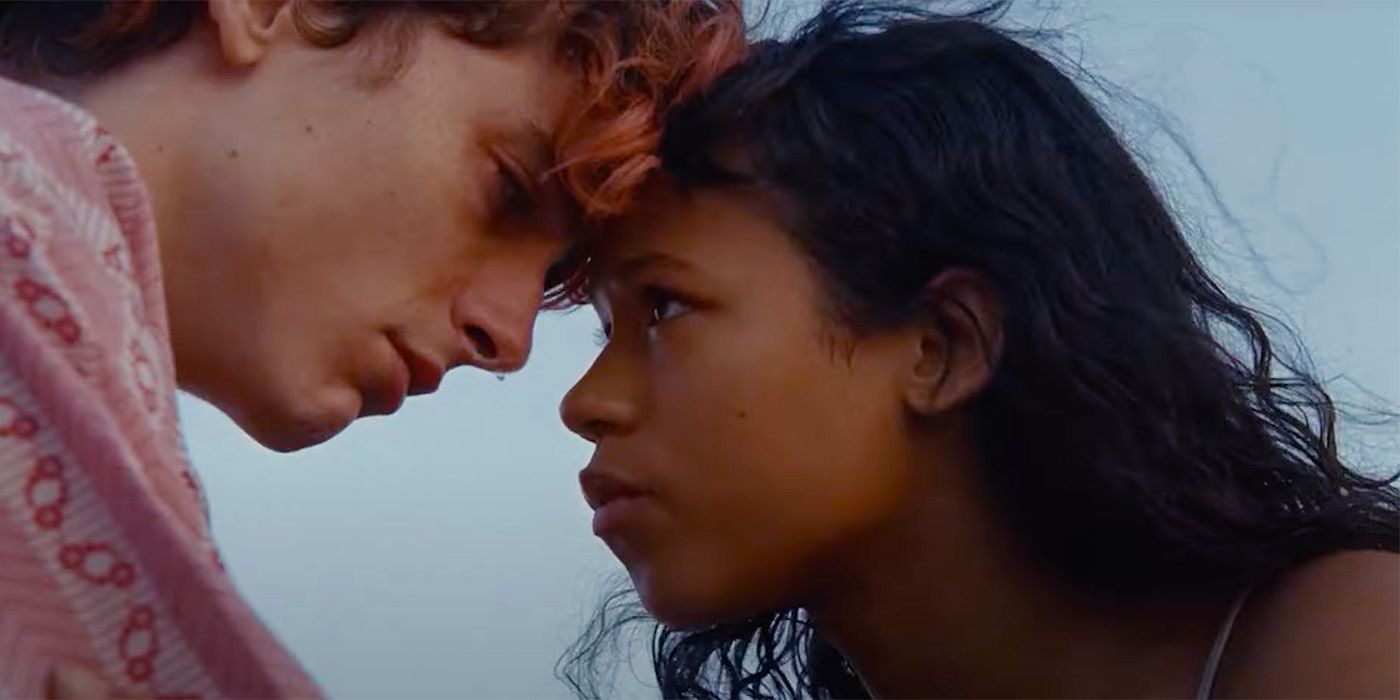
The gore, however, is not the point or, more accurately, not the real focus here. That is taken by the development and growing depth of the central duo. Maren and Lee are served by writing that feels observant and restrained. I was reminded, in a positive way, of Sissy Spacek and Martin Sheen in Badlands, a film that this strongly resembles for its light touch and patient craft in the examination of attraction. On that notion, the casting is a dream for this effect as Taylor Russell delivers a flawed and confused young woman gripping anything that might add meaning to her condition and a world that doesn't declare rules for anyone of her needs to live within it. Young adult of the times, Timothee Chalamet uses his effortless beauty to endear us to his rough southern boy who is surprised to draw tenderness from his attraction to Maren. These are a pair of violent cannibals but damn me if I don't love them as they go.

Zen master of cinematic restraint, Mark Rylance, excels in the role of the veteran "eater" who develops an unhealthy lust for Maren (even within this context). He displays the motions of charm but his dead-eyed hunger gives us the creeps at sight of him. It's possibly Rylance's most powerful movie role and puts him beside other whackos like Blue Velvet's Frank, Wild at Heart's Bobby Peru and Hannibal Lecter (my god would he make a good Hannibal!). When he shows up, we squirm and that's the way the nature of this film intended it. He is the one who enlightens Maren and us of the ways of the eaters in tones avuncular and terrifying.

In addition to the sourced British post punk and popcorn rock of the '80s we are treated to a subtly constructed acoustic and synthesised wash which glues it together and gives voice to the beauty of the landscapes (of which many and lush) and leaves us helpless for the violence when it approaches.

While there are some directors I think I'll never reconcile with (hi, Wes Anderson) I will admit defeat against the surprising charms of Luca Guadagnino for this outing. He really didn't go the Gaspar Noe route and beat us senseless with gore. He added to the classic Badlands without trying to hijack it for his own purposes (Suspiria). And he ended up making a substantial and enjoyable film.

Saturday, November 26, 2022

Review: SKINAMARINK

A series of mostly static shots of a house at night. The light is either referred or flooding from tv screens or torches. The image is murky with noisy grain preventing clarity. Soon we hear the voices of children, Kaylee and Kevin, sometimes so muffled they need subtitles, sometimes clear and close. They are trying to make sense of waking up in this house where there are no doors to the outside and no windows. The sense that something grave and very wrong has taken place is all we have and it swells.

This film plays on fear of the dark, the physical darkness of a house at night and the dark of unknowing. It is compounded by the point of view of the two children as they are variously static with fear or follow the instructions they can hear that might be parental or something more forbidding. 

That's what you get for one hundred minutes. There are some moments of relief when we catch a glimpse of the children's faces or watch the antique cartoons on screen but the message on the tin is clear from the first few minutes of static shot after static shot of different rooms.

This is a difficult film to describe. It made me think immediately of why The Forbidden Files or The Blair Witch Project were so effective when new as they presented scenarios without apparent manipulation. The found footage subgenre of horror that slowly rose from the latter example built, at its best, on the principle of limited exposure. What the committed viewer of any good found footage film will know is that their own imaginative completion of what they cannot see is worse than the most sophisticated digital effects. I find it oddly gratifying that the advent of avenues like YouTube have provided such a welcoming home to this approach.

Skinamarink does not play like a found footage movie, though. To reinforce the base dread of the point of view of scared children the film takes on more of a VR walk-through. A few years back, as part of a pre-order deal, I received a scaled down version of an Occulus headset and grabbed a few affordable horror VRs. As a vulnerably empathic person I couldn't make my way through the terrifying Afflicted: The Manor (a friend of mine didn't skip a pulse beat when he tried it) and the heavily uneasy Asian Horror style School. The latter was more of a game where the player had to perform tasks and progress through a scenario but the atmosphere alone and the immersion had me tearing the headset off. If Skinamarink was a VR game rather than a movie it would have the same effect.

That is why a cinema viewing is preferable to a playthrough in the home. Even at night, alone, with the lights out, the deliberate pace and vagueness of the images would not have the same effect when a pause button was to hand. The reason the film is not kept to a short but extended beyond its apparent material is precisely because it needs to immerse each member of even the fullest house alone into its breathless and weird world.

If the notion of providing your own reason to this lengthy block of experience is oppressive or too demanding then pass it by. If, on the other hand, you delight in projecting your own creativity on to the basic materials (like the regularly depicted messes of lego bricks on the floor) this is for you, even if only as a one and done viewing. I've often said that well crafted atmosphere alone will do more for me than a well wrought conventional horror plot. Well, this was my test. I only needed to see it once but as with the likes of Martyrs, Irreversible or Salo, it's a big once.


PS - I have heard a convincing theory about this film which I'll happily discuss with anyone who sees it but will not disclose as it would only guide new viewers to a particular reading which would go against the point of the film. I encountered the notion of it after watching it.


Skinamarink is currently available on Shudder.

Sunday, November 20, 2022

CRASH @ 25

Successful yuppies in Toronto, Katherine and James, take their sex lives beyond their marriage by mutual consent. With all their needs won or catered, they seem well on the path to rendering even sex as beige and designer bland as their decor and day to day lives. One night, James, distracted at the wheel reels off the freeway, rolls on to the lower level and crashes head on to the car of Dr. Helen Remington whose husband has gone through the windscreen and into James's passenger seat. In hospital, both with corrective scaffolding on their limbs, they meet Vaughan, a medical imager who seems to be taking more than a professional interest in his photographs of the wounds. Later, James and Helen meet when they inspect the mangled remains of their vehicles. They sense an immediate attraction to each other and a fascination for Vaughan. Vaughan runs sporting recreations of famous car accidents in front of mesmerised audiences on bleachers. When James and Helen go to one, their curiosity is replaced by compulsion and then transformation. No U-turns permitted.

David Cronenberg was a perfect match for J.G. Ballard's novel. Ballard himself described the book as a psychopathic hymn but one with a point. Vaughan's noodlings on the psychosociosexual implications of car violence on the human form and mind variously float on the surface of his obsession or drift away, leaving only the image of his compulsion to damage. 

Cronenberg's lifelong fascination with automotive culture mixed with his own tales of science-led body horror put him and only him in the director's chair. If you ever considered The Dead Zone an anomalous afterthought in compiling favourite Cronenberg movies, it's probably because you've never seen Fast Company. The action adventure made between Rabid and The Brood, which does involve a taste of Cronenbergian machine fetishism but that is rapidly absorbed by the TV movie standard plot. By the time Crash came up, Cronenberg had a little over twenty years experience of honing his ever more nuanced imaginings of the mesh of science and the body.

In Crash the significant dichotomy is between the control of the affluent home with the scarred and stained realm of the car cult. James Spader and Debra Cara Unger are exact fits for their roles as the bored yuppies at the centre of the story. They are so cleanly surfaced they seem varnished, addressing each other in whispers which have the reverence of devotees, compounded when, during a designer sex scene, Katherine speaks in a near hypnotic voice while imagining Vaughan's genitalia, anus and how he and James might have sex themselves. Holly Hunter brings her Texan managerial toughness to a character who, trying to find a way out of grief, has chosen confrontation with the most violating of its opposites. But it is Elias Koteas who steals everything as Vaughan, scarred and smelling of sex and petrol, growing increasingly drawn to the oblivion at the end of his obsession.

With such fiery issues on show you might expect Crash to be thrill a minute but Cronenberg has got there before everyone and turned everything down. It opens with three sex scenes that have neither animal lust nor sensual eroticism. They are functional and mechanical, the antithesis of the interminable passionate first scene of a Betty Blue. At the stress point of the first car crash we start feeling something for these societal phantoms until we see them resettle into blandness. Even when Vaughan stirs them from their cultural torpor with real violence it is to keep them as tethered as junkies. The only warmth we feel in this disturbingly humourless film is in the final act but even then it is a nightmare reading of warmth. Crash works as an entire text. You might well remember specific scenes (there are plenty) but it wants to get into your head in its entire fogging whole.

Aiding and abetting Cronenberg in his anti-fun pursuit is one of Howard Shore's most severe scores. Three harps and six electric guitars (recorded clean, not even with the lightest rock distortion) are sparely augmented by woodwinds. What is absent from the music is that most cinematic of groups, the bowed strings. The effect is spiky here and cooling there, never quite friendly. I watched the extra where Shore is interviewed about the score and it's worth it if you get the chance. Apart from the inspired arrangement choices he describes is his own memory of growing up in the same neighbourhood as David Cronenberg who was sufficiently older to appear as a kind of local god in leather on a motorbike. From there to the sound of Crash there is a long and rich trail.

It's hard to know how effectively this film would be to younger audiences now. Like the deliberate alienating chill of other later films like Cosmopolis or Spider but entirely unlike the more conventional Eastern Promises or A History of Violence, Crash doesn't welcome anyone who isn't there for the whole running time and with minds open enough to admit characters whose lines of thinking can turn repugnant in a second. I wonder, has the car lost enough of its sex cache in this age of global alarm. Is there at least the knowledge of its history as a Western essential object? Will audiences foreseeably to come understand the allure? Perhaps, beyond it they will feel the horror of it all the more.


Viewing notes: I saw this on Arrow's 4K. Done perhaps before their routine upgrade to Dolby Vision but the HDR 10 is pretty stunning. The audio is a DTS HD Master which you might want to ride as the massive dynamic range will have you turning up the whispers and clamouring for the volume button for the crashes. A superb disc. This was only my third viewing of the film since seeing it at the still missed Lumiere back in early 1997.

Friday, November 18, 2022

Review: THE WONDER

We open not on the mud and turf of rural Ireland but a soundstage where the rear of box like sets are held in place by scaffolding. A woman's voice greets us and tells us we are about to see a film called The Wonder, sets the scene as Ireland within memory of the great famine, and bids us believe in the tale as the characters within it believe. Without a cut but a smooth track we glide into the first scene on a ship with a few drips coming through the slats and we softly forget that we are watching artifice.

Lib Wright, an English nurse, is travelling to Ireland to tend to a nine year old girl in a country house who has not eaten for months, claiming that she has been fed by manna from Heaven. While there is some skepticism in the community, her family and the local powers of medicine, church and state support the family's claim that the child is a wonder and on the tough avenue to sainthood. Lib hides her horror to tend to young Anna and explores means of getting to the truth, suspecting she might not like the look of what she finds.

This tale of troubled faith and frustrated rationalism does something interesting: bidding you join a dark and tirelessly solemn situation that seems progressively more hopeless and bringing you out the other end feeling that you've experienced more than a film. A beautifully rendered electronic score goes against any expectations that it might feel anachronistic by providing an emotive bed from the violent to the ethereal and eerie. Art direction and cinematography pluck every single scene from the canvases of 19th century paintings, some details like window frames actually do appear painted by masters. Details of reality to seal the period setting often othered by tidiness reminds us that the hems of ankle-length crinolines got muddy. More than authenticity, the interiors and landscapes transport us to the same conviction as the toy given to Anna by which a spinning disc creates the illusion of a bird being in or out of a cage. We choose to stay in, aiding and /or abetting the film itself.

But without good writing and casting this might collapse as a series of handsome tableaux. In the lead is Florence Pugh who gets cast for intelligence, bringing the years of military nursing to her character's young face, choosing when to show strength, when to mask it and when her sense of justice break through from sheer compulsion. Mother and daughter in real and screen life, Elaine Cassidy and Kila Lord Cassidy impress; the first burdened by the situation and the second creepily confident of its sanctity. Auld stagers Toby Jones, Ciaran Hinds deliver authority that we know is capable of injustice. Tom Burke's initial menace gives way to depth where we aren't expecting it. Everyone looks at home in a home that is less than a home.

While some might find it too slow, long or heavy, I'll recommend this as one to persist with. It won't get you laughing like your uncle at Christmas lunch but you might well end up rising from the table sated rather than bloated. 

Wednesday, November 16, 2022

1982 @ 40: TENEBRAE

Bestselling whodunnit writer Peter Neal travels to Rome for a promotional tour of his latest thriller, Tenebrae. It's not just interviews and signings, though. He's barely landed before a series of murders starts in which the killer leaves notes for him, quoting his work, effectively calling him the inspiration for the killings. Detectives is on the case but Peter, himself, has his own ideas and quietly begins his own investigation. Is it the weirdly bent journalist, his frenzied fiancé, a member of the  of the LGBTQ+ community in Rome making a point? All shall be revealed (but not in this post).

While the first twenty minutes of this entry into Argento's giallo cinema can feel a little cramped and awkward, once it gets into second and hits the road it's one of his tightest and effective thrillers. There are plenty of stunning camera moves like the survey around the house that is part stalker and part supernaturally powered killer or some of the breathtaking murder scenes. Goblin's score veers between ethereality and the nasty end of prog and is always welcome in an Argento joint.

International stars Anthony Franciosa as the urbane, ratpack style author works a treat as does John Saxon, playing against his B-movie action single-cell dimensions to comic effect. Argento's partner in life and writing Daria Nicolodi, so welcome on screen in Deep Red, provides most of the ethical gravitas to proceedings. My favourite of the cast has to be Guiliano Gemma as Detective Germani who reads libraries of thrillers but never guesses the killer. He is the end of a long line of Argento cops who steal all their scenes from Crystal Plumage on.

I always forget the strange, dreamlike sequences of the woman on the beach with the teen boys. There is a creeping unease beneath its beauty that recalls filmmakers far further to the margins than Argento, like Zulawski, Pasolini or even Jodorowsky. There are two of them, both mixing a brooding sexuality with sudden violence, and their appearance is always arresting by both their progress and the interruption to the more muscular giallo style of the rest of the film. They are centrally relevant to the plot but it won't be apparent as to why until the end and it is so difficult to attribute them to a character that they become more compelling than the murder mystery. It's as thought the film itself is daydreaming a kind of pleasant version of the movie until brought back by violence it cannot mask.

Another aspect that strikes me about this one is that the sensationalism in the treatment of LGBTQ+ people is kept to the novel of the title and the mind of one of the characters. It is not normalised; the jealousy mind games between the lesbian couple are not played for laughs and their sexuality is only the cause of their slaying by a figure whose savagery prevents empathy. This is not unusual in Argento's work but the beige naturalism of the depiction feels pleasant from an era where even edgy comedy played on stereotypes.

Dario Argento was still on a career high at the beginning of the '80s and it would continue for years more before the following decade's patchiness threatened to soften his name (see also John Carpenter and George Romero, just quietly).  While Suspiria before it and Opera after featured more eyepopping violence the kills here are in character with a murderer making statements. The double murder of the two women and then the startling noonday sun in the piazza slaying are as crafty as anything he has done.

If Argento has muddied his own waters with later works, to my mind we can still keep the room we've made for him on reservation for all the stunners he brought to the genre which levitated its bar and kept the genre in the realm of great style. If I chose this film for a rewatch it's always as a casual pick but it always ends up reminding me of how compelling it gets, how soon and with what mastery. It wasn't the last time Argento made all of this work so fluently but it's still one of the best.

Thursday, November 3, 2022

The Unseen from this year's Octoberfest (well, my Octoberfest)

Another October, another 31 nights o' horror. This time I wanted to push all the well known bangers to the weekends and concentrate on films new to me and from cultures other than American and I did pretty well. This list of brief reviews collects both categories.

My Best Friend's Exorcism

Significantly weakened movie adaptation of superb novel reigns in both the shared culture of the friends (crucial to the depth of their friendship) and the laugh out loud comedy of teenage perception. Even the horror elements are diluted to family-safe levels. I wanted Grady Hendrix and I got Mean Heathers. (Prime)

We're All going to the World's Fair

A haunting evocation of the vulnerability of being young and lonely in the great sargasso sea of the internet. Anna Cobb's naturalistic performance adds a fragility that feels unsettling. Her anonymised correspondent JLB delivers a monologue at the end that is either an account of real events or pure fantasy and it's creepy either way. Highly accomplished lo-fi film making that begs your patience and then rewards it. (Shudder)

Deadstream

There are a few live-stream movies out there, enough to constitute a subset of the found footage genre. This one dares you to get on board by giving a manic and difficult to love host. This is an effective ploy on the part of the filmmakers, though, as it gives the character an uphill stride to pick up your empathy. Once the stakes are raised you are with him, despite his hyperactive simpering. Some fine turns and twists and the willingness to plunge into genuine horror while the comedy is on high. Top notch low production. (Shudder)

Dark Glasses

Decent if mild mannered giallo by one of its former masters. Argento has made far worse than this. Points for being possibly his most compassionate films. (Shudder)

Hellraiser (2022)

Another one that will force a production date to be appended to make deadly sure no one thinks you're praising the remake (see also The Haunting (1963)) Good looking dreck without a breath of dread for all of its overlong two hours. Not skerrick of empathy possible for any of the characters and a lot of content that seems concocted to generate essays by media students. Meh. (Binge)

Satanic Panic

Very funny and campy yet willing to dip into harder horror. This is how a Grady Hendrix movie should play. (Shudder)

V/H/S/99

Better than the early entries. Even the lesser entries of the five stories are pretty good. (Shudder)

Grimcutty

Kids horror but keeps its scares and dread squarely at its audience age group. Not bad but not great. (Disney+)

Dashcam

Until you see the point of the protagonist being so infuriatingly puerile she's very hard to take. Happily, the film itself gets some early blows in before the reason for the persona emerges. Far better than a sequal to the same team's lockdown horror Host, Dashcam absorbs the themes of the times themselves and finds greater threats lurking in the shadows. Very funny but also very atmospheric and scary. (AppleTV)

Werewolves by Night

Pleasant fun and seductive design and black and white cinematography but little more. (Disney+)

Satan's Slaves

In which Joko Anwar covers James Wan and makes a possession/haunted house movie in every way superior to its inspiration. (Shudder)

Grave Robbers

Fine old school supernatural fun as ancient malignant spirit resumes human form to roam the land on a rampage. Little new but nice to see it in a different culture. (Shudder)

Witchhammer

Grim and depressing historical tale of a witch hunt in middle Europe in the 17th century. An opportunistic charlatan is indulged by the local aristos until his tribunal keeps expanding well beyond its calling to something more institutional. The original audiences in the Czechoslovakia would have recognised a lot of this in their post-Prague-spring oppression. (All the Haunts be Ours boxset)

Saloum

Highly atmospheric genre-hopping tale goes from political heist thriller to an eerie folk horror in an isolated community in Senegal. (Shudder)

The Dreaming

More atmosphere than scares in this folk horror where the bad guys return from historical oblivion to do more damage, rather than the kind of revenge plot of the ghostly sailors in The Fog. Made (like the next entry) in Australia's cenntenial of colonisation, 1988, with strong resonance of the horror visited on the land and people by the Europeans. (All the Haunts be Ours boxset)

Kadaicha

Small means but strong conviction make for an effective revenge slasher, again with historical resonance (again from 1988) as a group of suburban kids fall foul of the local spirits. (All the Haunts be Ours boxset)

Slumber Party Massacre II

Sequel to effective '80s slasher manages to improve on it with iconography from the history of teen music. The '50s/'80s Elvis with the drill guitar has to be seen (and heard) to be believed. Fun! (Shudder)

Leptirica

Serbian folk horror about local vampiric traditions resurrecting in the village. Some knockabout Breughelian humour manages to avoid spoiling the underlying dread which rises effectively in the third act and climax. (All the Haunts be Ours boxset)


Till next year ....