Thursday, December 14, 2023

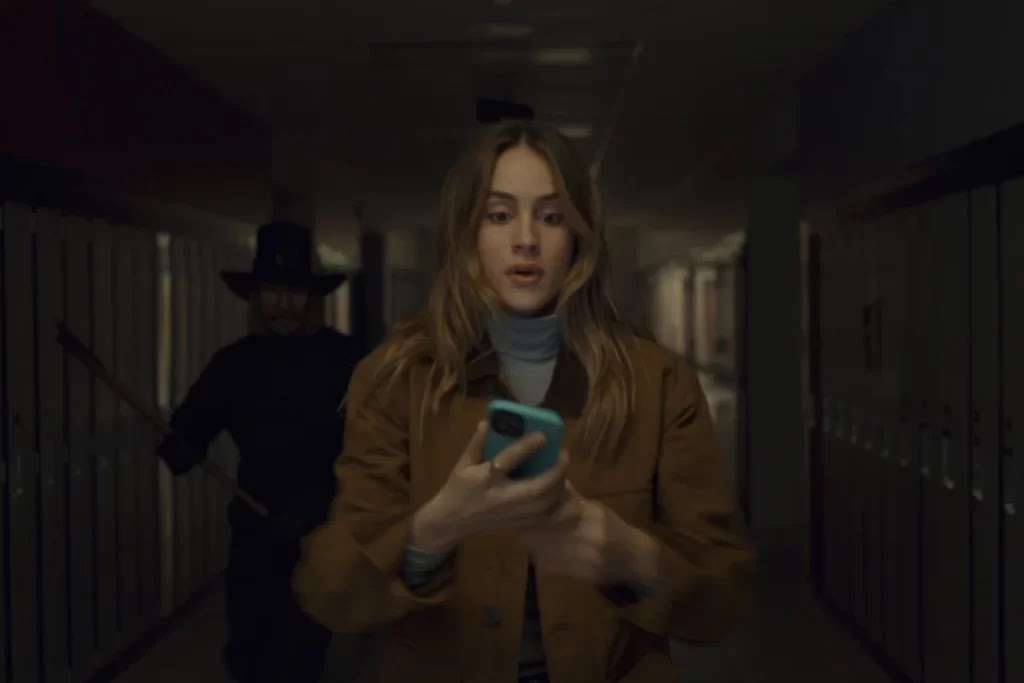
Review: BOTTOMS

PJ and Josie, two girls at the bottom of the school social ladder (being both gay and untalented) resolve to break their outsider status by forming a fight club with the pretence of empowering the female contingent of the student body but the aim of getting with the cheerleaders. The big game is coming up and the approach of the Huntington school football team is heralded with Hate Week style propaganda and mythology of ultraviolence. School life is revving up. Even more that PJ and Josie's ploy works and cheerleaders do turn up for the fight club training. Partly, this is due to the inadvertent untruth that the pair are fresh out of Juvie with grim records.

If this makes you think of the quirkier or edgier high school comedies like Booksmart or Heathers you're close but not quite there. Bottoms is reminiscent of those and more but its tougher cartoony approach takes it way out of that area. While it observes the three act arc of conventional narrative it also allows an unsettling imbalance to thrive which ensures that as soon as something gets too familiar there will be something to pull the rug on it. 

This is a school run by a principal whose stake in the team quarterback lies somewhere between an eye for future funding and pagan idolatry, and the football teams only wear their football gear. In warning the school on the PA about the advent of the feared Huntington team he gets a girl to deliver a testimony about how she was cornered by a Huntington player one night. The account is delivered flat, like an alpha girl getting out of detention and ends with, "and now I'm fucked!" Characters react with identical complex lines that would be impossible in real life but they also respond to other situations realistically and without wisecracks. The sense that the chaos is only just likely to rebalance itself is palpable. 

However, this keeps the cuteness in check with grimmer moods and material. In a script that has more throwaway one-liners than a week of Tina Fey's dreams there is a surprising level of sobering material on abuse and even rape. As a film that is undeniably a black comedy it keeps the easy charm of girls playing tough vulnerable to bruising. In a South Park way, the final act triumph (not saying how) serves both the satire-lover's thirst for punchy retribution and the comedy audience's need for brightness.

Good writing needs good playing. Rachel Sennot and Ay Edeberi as PJ and Josie respectively provide a core of two life long friends with real chemistry. If you saw Sennot in Bodies Bodies Bodies, she's even faster talking and more solidly grotesque here. Ruby Cruz as an uncharacteristically developed quirky character kept reminding me of Meg Tilly whom she resembles physically but also behaviourally. Nicholas Galitzine as the team QB surprises with his miasmic mix of machismo and prissy self-absorption. Really, the whole cast brings it.

With new things to say within the niche but well loved sub-genre and a very deft hand that steers between light and tough nimbly, Bottoms is one of the very best comedies I've seen in years. It's dizzying but committed. How dizzying, how committed? Well, I was a young adult in the early '80s and hated the Song Total Eclipse of the Heart more than any other musical statement of the time. It's used here in a way that is belly laugh funny and also culturally vengeful. Bottoms is a film of extremes and contrasting extremes. It is a chaos given form by the most moreish icing you've tasted since childhood. Dig the fuck in!

Tuesday, December 12, 2023

Review: GODZILLA MINUS ONE

Koichi cheats death by landing his kamikaze plane at an island maintenance base instead of the side of an American ship. The ground crew don't have a lot of time for recriminations over this as what they at first take to be a new Yankee weapon reveals itself to be the massive roaring reptile that the locals call Godzilla. Everyone is hurled about like rags and all but Koichi and the chief of the crew who knows the pilot's secret.

Back in the wreckage of Tokyo Koichi fails to find his family whose house is entirely at street level but gets involved with a young woman who has just saved a baby from a bomb site. Back at her place the story morphs into the kind of people first neo-realism Japanese cinema was good at after the war. Time passes and the pair, still not officially married, get jobs that help them climb out of their slough. She commutes to Ginza for an office job. He gets good hazard pay cleaning up American mines in the ocean. He has nightmares of the monster from the island, they haunt him like his war guilt. They are about to come true right where he lives.

Japanese cinema took decades to address its war history and the spectre of the atomic bomb bled into the least expected places like samurai movies or folk horror like Onibaba where distant clouds from battles or despoiled cities filled the medieval skies. In 1954 Ishiro Honda made Godzilla which directly dealt with the bomb and its effects, giving birth to a mythology where science in the service of warfare brought forth monsters the size of city blocks. The pushback against the monster is through an equally terrifying weapon developed during the war in Japan. The film, monster movie or not, examines the ethics of this and the emotional darkness of its potential use. The inventor needs rescue from depression, skulking in his home, hiding his face. The war and its cataclysmic finale was to keep rumbling in the cinema.

Godzilla Minus One's title refers to Japan being returned to zero by the war and plunged into the negative by Godzilla, brought forth by the war. The central notion haunting characters is how the war has left them, particularly those for whom there has bee no resolution, Like Koichi the kamikze. Godzilla's natural nuclear weaponry adds a heavy despair to the spectacle of its city-demolishing walk. That nightmarishly gigantic spectre of Hiroshima is there to return for as long as the monster can roam. Koichi getting speckled with splats of black rain while Godzilla bashes his city, is heartrending.

But this is a Kaiju movie and knows it. The humbler family scenes to begin with have their resonance and keep the stakes in our recall but Kaiju movies demand spectacle and we get just that. The huge spikes rising from the waves like a forest of shark dorsal fins are a terror. The sight of the monster rising from the waters and suckerpunching warships is powerful and thrilling. The city scenes of destruction will test your sense of vertigo as train cars are hurled through the air (one of which has a major character holding on to a rail too far above the ground to witness easily.

Gareth Edwards' 2014 U.S. reboot was a thrill, as well. I saw it in 3D and it played as you might imagine, with the action leaving everything else behind. There is a moment in it where Ken Watanabe calls the monster Gojira. Less than a minute later, one of the military types around him turn that into Godzilla and we never hear the Japanese pronunciation again. Godzilla Minus One doesn't need the translation. Nor does it need the transport to a comfort point of familiar Western settings. A Japan exhausted by war is asked to exhaust itself all over again. And as we look upon the wreckage of the bombed cities and then those devastated by monstrosity we cannot fail to recall the look of the vision leading news video for the past few years in Kiev and now Gaza City. Godzilla Minus One did not have to have those in mind when it went into production, it only had to remember the urgency of the original and repeat its plea for the people of the Earth to end the war, whichever one it happens to be, all war, finished, silence, birdsong. It is fitting that Gareth Edwards said after a screening of this film, "this is what a Godzilla movie should be like." Too bloody true.

Friday, November 24, 2023

Review: THE ROYAL HOTEL

Hannah and Liz, two American backpackers in Australia, run out of money and have to work locally. The only gig they are offered is as bar staff at a pub in the back of Bourke. It's a mining area so, the agent tells them, they will need to put up with a bit of male attention. From EDM parties on boats on Sydney Harbour they travel to the diesel and dust of nowhere where their instructions are brusque and without a lot of  form, meaning they'll need to learn as they go and it's easy to make a faux pas and cause brooding offence. But hey, it's money.

Then again, what's money? An extended sequence of the two women working at the bar is like something from the final act of Mother! But for the counter, the seethe of toxic masculinity on the other side would consume them and they get busy picking up every unwritten rule that presents itself. Between this and the lack of sympathy from their supposedly protective employers the night feels punitive and endless. Upstairs (and then on the counter of the bar) the two departing British packers show nothing but debauched hulls, regaining life only on the way out. This is only night one.

Kitty Green's fiction adaptation of the documentary Hotel Coolgardie does not repeat all the interpersonal atrocities of the source material. This time there is more examination of nuance, the ambiguity that transform a character from shy benignity to gorilla-like violence, from effortless charm to mounting threat. The interplay between the various locals and the women runs a gamut rather than describe a constant pushback. This prevents the film as a whole of falling into flat allegory. The differences between Hannah and Liz alone prevent that but the trouble taken to seek the vulnerability behind the brutality (where plausible: sometimes there's just brutality) keeps things edgy and realistic.

Aside from that there's not a lot of plot to The Royal Hotel. A few strands of narrative involving Liz and Hannah's various responses to the culture around them to open things up but the rest is a series of incidents within the hellish dark khaki brown interior of the pub sessions. Then again, the plot is best served by sparseness; it's the issue more than the fable of it that matters here. The scene of their first night serving is epic and interminable but it shows exhaustion without being exhausting. This is because it reveals fascinating truths about a culture of men forced by lucrative but agonising work to ease the toll on their nerves through a deteriorating restraint and galloping sense of licence.

Jessica Herwick shows the most flamboyant chops as the more outgoing Liz, frequently troubling in her proximity to ugly danger. Julia Garner keeps a sober iciness as defence but even this can be moulded by the more skilled advances of one of the younger men. Hugo Weaving is almost unrecognisable as the shifty and chaotic owner Billy. Ursula Yovich's Carol strikes poignant notes as his wife and the wisdom to control where she can and give up and run when she can't, fight or flight as a lifestyle.

Is The Royal Hotel an update on Wake in Fright? Not really. That was a man in a world of men stripped of his civilisation to the point where that quality might well have been more of an affectation than a cultured state. Liz and Hannah are barred from this by their gender and its value by that similar world of men. If there is a need to defend themselves against anything it is less the earlier film's corrosive sheen of mateship than a continuous threat of sexual assault. What it does share with Wake in Fright is the confronting reality of a culture that doesn't simply have a dark side but is busy obscuring such a thing. Recent public campaigns to render the wide brown land a better and more inclusive place, regardless of their success, have told us as much. The Royal Hotel is not a cover version of Wake in Fright, the pair of films are companion pieces which might easily swap time periods without too much change. If you don't find that confronting in itself you need to see the newer film and rewatch the older one. 

Saturday, November 18, 2023

Review: THANKSGIVING

After a Black Friday sale stampede goes horribly wrong, people are left variously dead or seriously injured, engendering a mass of motivation. A year later, the group of teen friends at the centre of the tragedy find themselves being picked off in an elaborate grand guignol dinner setting/murder scene. Race against time, need to unmask the killer and end him. Kills, kills, lots of kills. Roll credits. What do you want, it's a self-avowed teen slasher?

Eli Roth made a trailer for a non-existent film called Thanksgiving. It's part of the double act Grindhouse movie with a mini feature from Quentin Tarantino and Robert Rodriguez who directed a story each. You can find the trailer on YouTube. It is meant to look like a trailer from an old VHS rental with video glitches, gluey visuals and audio and a subterranean voiceover making words like "terror" sound like solid artefacts emerging from deep within their being. It's a funny piece but also reflects Roth's nasty side and willingness to go that one step further within genre boundaries. His latest offering is the feature length version of that trailer.

With some changes. The original was meant to look like it was from the mid 1980s which sealed it into a cube of pastiche. The feature is set in the twenty-first ce3ntury. This allows Roth to dispense with a truckload of period cuteness so he can concentrate on making a slasher for today. Some of the more elaborate kills are ported to the movie and in one case the version in the trailer is far more extreme. But that's the strange thing about this outing, it works very hard to create a standard genre piece, solid enough but not what you might expect of its writer/director.

Eli Roth made his name with horror movies that were highly derivative but more extreme than their influences. Cabin Fever gets a lot yuckier than Evil Dead or The Curse. Hostel goes so far further than the serial killer movies of its previous decade that it infamously drew the term torture porn into use in a review. Roth's all but self-avowed reputation for nastiness precedes him and leads us to expect a level of violent misanthropy. The more recent Knock Knock promised to turn the tables on the frat-boy sensibilities he'd been accused of but it was so self-consciously responsive to the criticism it came across as absurdly contrived. So, here we are at a point where he can bounce back with a realisation of the idea in the faux trailer that would not only fulfil its brutality but extend it. And we get an assembly line slasher.

What should we expect, though? For all the boundary pushing of Roth's earlier career there has been very little follow through. His more recent involvement in more scholarly pursuits like the History of Horror have served to soften his image but none of this should be enough to compel him to change his approach, especially in a sub-genre he clearly delights in (go and take a look at that Grindhouse trailer again). Even if he were to do that he supplies us with the basics: group of teen friends with some internal tensions, a series of thanksgiving and retail related kills, a good handful of suspects with strong motives and a pace that, if it lags here and there, always gets back into gear. All those elements fall into place with some fun punning dialogue and a snappy third act twist. And when it's over we feel we've seen something that has done its job. Curiously for a film maker who has been good at turning derivative material into something that feels fresh, a late scene completely lifts a brooding twist from a recent thriller. It feels as though he had to include the final sub-generic note somehow. 

I suppose I just wanted a little more tension and strain in a newly made slasher. If Eli Roth can't bring something new to the table that is not already being done by the restlessly resurrecting Scream franchise than why bother? It gets those Grindhouse trailer kills into serviced housing but now they have narrative context and aren't that scary anymore, we can't just imagine them finished the way we wanted now. But finish might be what this is all about, polish and form for the old standards. 

I wonder if a studiously recreated '80s video version brazenly projected in a modern cinema might not have appeared more daring with more obsolete ethics on savage display. What an opportunity for cultural commentary that would be, and how far beyond Knock Knock it might go. Eli Roth has to pay his bills like anyone else and the era of daring auteurs dazzling at ground level in the old arthouses is a memory that has long faded. It's set up for a sequel and so it should be and now there's a new Halloween costume for trick or treaters. Let's not judge this harshly, cinema has always had a commercial core, but by the same token let's remember that we don't have to reward what we reserve judgement on. If something reaches the OK barrier, let it, sometimes OK will have to do.

Sunday, November 5, 2023

Review: SANCTUARY

Young heir to rich hotel business, Hal, orders room service when there's a knock at the door. It's a perfectly presented corporate woman with a briefcase. Hal's father has just died and the young patrician is about to ascend to the CEO position by inheritance. Rebecca is here to finalise matters and begins with a questionnaire which gets increasingly invasive. When he demurs over a difficult one, Rebecca turns harder. So hard, in fact, that he interjects that she has gone off script. 

She regroups and resumes but the questions just get tougher. Hal gives up, exploding over the breaches. Rebecca pushes back and gives him a humiliating task which he does in apparent relief. Frequent glimpses of the script reveal that even these breaches are scripted. While he is down on the bathroom floor, cleaning around the toilet she joins him on the floor, assuaging him with platitudes. Later, when they enjoying some very spiffy post-session nosh and a martini each, Hal wistfully says he'll miss these appointments. She asks what he means. Well, he's going to be a CEO. He can't be known as a Sub if he wants to be a hardarse business leader. Rebecca is not pleased. She is not pleased initially from the surprise of it and increasingly from a sense of betrayal and callous use. Her displeasure balloons in the plus hotel room and takes on new facets and characters until Hal has to manage some push back of his own.

From this point more plot reveals would only turn into spoilers. This high energy two hander of dominance and struggle, of business intimate to corporate, takes dizzying turn after turn, revealing weakness in the dom and strength in the sub whose intellect and deluxe articulation make for a sharp and compelling ninety-six minutes. Despite the lushness of the setting, this premise of a constantly shifting dialogue is under continual threat of collapse, point and counterpoint can get exhausting rapidly and twists will need to be ironclad if they are to pass an audience on high alert.

There are lags in the middle, expectable in this setup but the reason that it regathers strength again and again to the solidly wonderful finale goes beyond the writing, already accomplished and muscular. It's all about a pair of performers who are made for their roles. Christopher Abbott, though young, is a veteran of difficult parts in films like Piercing and Brandon Cronenberg's Possessor in which he plays a man hosting a cybernetic puppeteer, cowering into himself or bursting out with the fury of an assassin grown too fond of her work (it's a complicated piece). Hal lets him do something very similar as he variously breaks his role in the professional relationship but must at times retreat hastily to the shell of the submissive. His vocal work alone, whether in howling pain or fury, might be enough but the interplay is also intensely physical.

That's where counterpart Margaret Qualley comes in. Andie McDowell's daughter, Qualley might get nailed up as a nepo kid but for some impressive stripes earned in things like the weirdo apocalypse series Leftovers. Luminously beautiful, she shows a tough readiness to subvert expectations and come out growling with force. Alternatively, she sculpts lines hard with threat in a gentle croon. Also, she brings her dancing training to the role with some impressive movement. Her character's professional insistence on a contact-free liaison is kept through the wildest pas de deux. If it breaks we know it's serious.

I could see audiences falling away at some points where the writer wants to introduce a complication that he has not earned. This happens more than once and can overpower the best that the performers can muster but some patience will reward the viewer when the pieces of the extraordinary final moments fall into place and feel as though they had been falling from the opening. Is this a BDSM rom com or a message of gloom for the future of business? You could really take it either way but to do that you will need to keep with it and suffer a little. That is in line with Rebecca's profession and Hal's kink and maybe, our own lives which might be simmering under masks of such invention. Try it out for yourself.


Viewing notes: Because of its short run at Nova I had to miss this at the cinema during October as it doesn't qualify as horror. I found it for rent on Prime (at post-cinema run prices so it won't break the bank). Also available on Apple TV and Google Movies.

Saturday, November 4, 2023

31 Nights o' Horror: HALLOWEEN @ 45

Young Michael Myers slashes his older sister on Halloween night in 1963. In 1978 he's back, breaking out of maximum security, with a fanatical shrink on his trail, and heading back home for more slashing. Meanwhile, a trio of girlfriends plan their Halloween babysitting with a mix of teenage earnings and sex in locations classier than the backseats of cars. Michael's hijacked government car crawls over the map of small Haddonfield, Illinois, like a serpent, noticing the children and the girls. Happy Halloween! The trick, as the original poster had it, is to stay alive.

This was not the first slasher. That argument starts sounding like what was the first punk record very quickly. Nevertheless, it's worth nodding to a few formative titles. Peeping Tom had a serial killer using an unusual weapon tied to his mental state. Psycho swapped parents for its killer's drive but kept it deadly. Black Christmas had the killer make crazy phone calls to terrorise young students before doing them in by a variety of ghastly means. And then John Carpenter, at the dawn of a career that had already produced a smartly funny sci-fi and keen update on a western siege at an outer suburban cop shop, thought this up. Originally titled The Babysitter murders because the '70s, Halloween had significant traits that were used in the decade to come and beyond it like moulded parts.

In a decade busily attempting to remake The Exorcist as horror moved to the better budgeted mainstream, plain old murder might have seemed passe as the feature of a movie. Carpenter and writing partner Debra Hill had to think small budget and spare means and found a series of killings by a perp without apparent motive of the kind of people who would be paying to see the movie. They hung it on a popular holiday, already rich in macabre iconography, made the bad guy look like a deranged, overgrown trick or treater like the charges under the care of the babysitting teens so there seemed to be no escape from him. That's why he just walks.

Why should he run? He's the boogeyman, he can take his time. Not only that, sometimes he doesn't move at all. There he is in the distance, his white and featureless mask glowing in the autumn afternoon. Standing firm among sheets flapping on a clothesline; there one glance, gone the next. Even when he drives it's slow, the pace of assurance. In the screenplay he bears the name Michael Myers but in directions and descriptions he is known as The Shape. The Shape, expressionless, form without substance, a ghost with a kitchen knife, strolling through your neighbourhood. Later imitators tried a tweak here and there but everything just came back to the mask and the silence.

But for this to work you need victims to care about. The kids might seem bratty but at least one of them really does see the boogeyman through the loungeroom window and isn't believed when we know he's telling the truth. We've already seen him bullied at school. We've even seen him saved from them by The Shape with what feels like affinity. When the shot through Myers' car windows following little Tommy turns the corner with the boy as the creepy theme music plays, it's hard to tell if the boogeyman is feeling protecting or menacing.

We are not allowed to forget Michael's power, craft or violence because Dr Loomis reminds us of it in almost every scene he's in, railing against the man in language less like a psychiatrist than a holy rolling witch burning preacher. Donald Pleasance, one-man lynch mob, who carries a revolver in the patient-retrieval mission he is one, leaks his fear and awe: when seeing a mauled corpse of a dog he murmurs, "he got hungry". In a well turned moment he begins casually describing Myers as a patient which finishes with, "he had the blackest eyes ... the devil's eyes". This would stick out as histrionic bombast in a demonic possession movie but Loomis is not a priest and Michael is not Pazuzu, the fact that the profession has been driven to these terms gives us pause. Pleasance's crisp nasal transatlantic keeps us wary of The Shape that quietly appears through rear windows and the shade of the footpath trees.

And then it is the girls we care about. Whether it's the wisecracking sarcasm of Annie or the goofy Linda with her constant interjection, "totally", we are soon to view them as victims and, for all the venereal larking of their talk and the fragile triviality of their concerns we get to know them just well enough for us to want them to emerge safely from a night that rasps with blades and tightens like garottes.

Finally, it's Laurie. Laurie Strode is the bookish virgin with the sensible attitude. She's so good at school that she can give an articulate answer to a literary question in class just after she's seen the creepy car across the road stop where it shouldn't. The sassy duo of Annie and Linda tease her but it's gentle, the sense that they value her company deeply for her stability and gravity is strong. Debra Hill's teen dialogue is a hit, here, letting this kind of information through the perky, quirky cascade. Laurie with her autumnal brown shades and low-styled hair carries her own power even if she doesn't know it yet. Between the three of them, she is the only one who can see Michael in his overalls and white mask, standing out among the lawns and hedges of the tree lined neighbourhoods. She saw the car while in class, the distant figure on the footpath and then among the sheets of the clothesline, there then not there, but witnessed. Their bond is clear and sealed.

This theme of  a bond between final girl and killer became a frequent resort in the genre that this film started. It's own sequel did this and was taken by parts of every franchise that followed. Mostly, it's a quasi supernatural element to cast in among the scares and occasionally it's there to bump the tension by suggesting links along moral lines. In Halloween it is a kind of presage of the confrontation to come, the spectre of the worst thing that could happen and the desperate real-time scramble for courage in the dark.

Too often, teen slashers have been dismissed as puritanical for killing off the players of premarital sex. In later sub-genre entries this is unarguably the case (Friday the 13th made it the base motivation for the violence). Of seven kills in the film, only two are sex related (I'm not counting one which is only indrect) and two are animals. But the charge goes deeper than body counts, suggesting that slashers generically punish teen sex. Sometimes, yes, but not here, and actually not in most of them. Separate for the moment, the killer and the film that features the killings. As one of the Faculty of Horror cohosts said perfectly well (but I have to paraphrase): the film is radical, the killer is puritanical.

Back to Laurie, for a moment, her gravity is given life by the debuting daughter of an already famous screen victim of slashing, Jamie Lee Curtis. Just as Janet Leigh's Marion Crane was famously stabbed in a frenzy, JLC's Laurie will be up against a monster who has appeared as a spectre but made the leap into the brutal third dimension to come unstoppably at her. And then it's flight or fight. And think of it: she lets slip her crush in the car with Annie and her barrier in realising it has nothing to do with sexual ethics, it's just shyness. If she could overcome that, according to the death-fuck commentators, she'd be slasher meat. Well, she is anyway so what does that say? On the other hand, Jamie Lee Curtis' iconic and resonant turn as the nebbish who surprises herself with her own action, is tested to the point of annihilation and stands up to it. Halloween is the story of her breakthrough, not someone knocking off horny teens. Jamie Lee Curtis' performance from passive to solid pragmatic pushback cast the mold.

No appreciation for this source point can be signed off without mentioning the music. Carpenter couldn't afford a Hollywood composer and so fell back on to his own resources and wrote and played it himself in partnership with Alan Howarth. That had already happened in Dark Star and more impressively with Assault on Precinct 13 (whose theme was good enough for triphop legend Tricky to lift wholesale). The Halloween theme is set in the uneasy time signature of 5/4. Instead of counting to four and looping it, try adding one to each loop. If you don't add another to normalise it you'll run into trouble in a hurry.  Add to that a simple figure that played with the fifth and flattened sixth of a scale while subverting that in the bass and you have something concentrated and intense. And, guess what, it's a real theme, it goes well beyond the credits and accompanies Michael on his escapes, street crawls and lurking throughout the movie. There are other music cues but the continuous use of the dididi dididi didi didi tinkling piano and growling synthesised bass grabs us by the neck and pulls us in. Clearly influenced by Tubular Bells after its use in The Exorcist all but dictated what horror movie music should sound like (try, also, Goblin's scores for Deep Red and Suspiria) Carpenter's music for this film was another notch on its influence weapon.

A recent watch also brought to light something more generational but still significant do do with music. When Annie and Laurie are driving through the streets to their babysitting gigs the song (Don't Fear) the Reaper comes on the radio. From the mid '80s needle drop bonanza to the current day this moment would end with the song exploding from its tinny radio sound into a massive blooming blast taking it from the world of the movie into our own. But here, it's just a song on the radio. If you catch it under the dialogue it feels like a warm wink.

Seeing this at the drive-in in 1979 (Townsville: we didn't always get them on time) I was wowed by the thrill and the immersion (yes, even with those tinny metal speakers) but it's the rewatches since that have impressed this film on me. On tv here, on crumbly old VHS there, through to the one I most recently put on, the incredible 4K with Dolby Vision and Atmos, this lean and mean ninety minutes can be repeated like a favourite album. Many shared viewing experiences through that time I recall one more than any other. A woman I was courting said she wanted to see something scary so I put this on. By the finale's white knuckle tension, she was curled in a ball at the other end of the couch. This is after showing her Suspiria and the Exorcist. Yes, you can look at the incredibly resurrecting murder machine coming back to life from repeated deathblows as cliché but you need to recall that this is where that cliche was just a narrative decision, not a trope. If you let tightly-constructed horror cinema in, relax and let it work, the catharsis of it will exhilarate you. And that's the game of the name.


Viewing notes: as said above, I watched the recent Scream Factory 4K release of Halloween. Dolby Vision image is deep and dynamic. Dolby Atmos audio is immersive. I watched it on Halloween night. An old '70s slasher still compelling? "It was doing very well last night!"


Friday, November 3, 2023

Review: FOE

Young married couple Hen and Junior live on their lapsed farm in a near future when water is more precious than cobalt and people are being encouraged to move off world. A stranger knocks on their door and tells them that Junior is to be conscripted into the space program. The pair was already drifting and now with enforced separation they are compelled to reassess their situation. Later, the stranger returns and lets them know that Junior will be replaced by an AI version of Junior. Huh?

If their shared introspection before took them into depths unaccounted for, now they are going to need  some serious shared experience to get to the furthest depths of their lives, what they mean and what each is to the other. And then it gets complicated.

That's as plotty as I'll get in this review. There are twists here and some of them are backward-folding and I'm just not going to navigate that. this film is about asking what we want from our lives. Hen and Junior examine what made them a couple. As they variously resist and welcome the solid changes that face them they are left with more questions than answers. If the conclusion doesn't make you think about every single longer term relationship you've had then you need to go back and watch it again. It will please some greatly and probably disgust others. This only glances at the notion of possession, it blossoms into much more of a life definition tale. That's where it gets dangerous.

Saoirse Ronan and Paul Mescal, bearing the burden of almost all of the screen time, convince us of a couple whose bonds are held in great fragility, as physical as vocal. Their interplay frequently approaches dancing. At the film's best, this is a pas de deux of tension, of rediscovery, of attraction and revulsion. Aaron Pierre who is far sexier than anyone from a government agency ever could be, plays up his jazzy suavity, frequently crossing lines that increasingly look like tests. This is a story where sensuality comes with a grimace.

It reminded me strongly of a film that, while it tackles a different subject, commits to its odd narrative to the point where a sudden leap into a mental reframing is essential to keep watching. This doesn't have to be a violent shift, just an acknowledgement of the change and a readiness to return. Denis Villeneuve's similarly titled Enemy, uses a doppelganger figure and the spectre of spiders where Foe keeps it tidier with an AI clone but the pair of films both keep their focus on life choices and the workings of notions like love and bonding. The difference is that Enemy, for all its abstractions and looseness of connection between the real and the allegorical, is a tightly told story. Foe isn't. If I were being mean I'd say that Foe was Enemy as remade by Terrence Malik. But I'm not inclined to risk revealing things about Foe or damning it with a cheap quip, so I won't.

Foe is too long. The scenes of its conclusion are concise and eloquently stated in cinematic form but we are given too much repetition of information with too little nuance to distinguish one iteration from the next. This works well if the scenes of shared adventure are considered a dance but the film doesn't quite commit to that. To say it's too long, though, is not to call it boring, only that it lacks economy with its points. This might be a problem of the source material: the film was being adapted before it was published and the author of the novel was a writing partner. It's hard to say. What I can say is that by the time I got to the credits I was not surprised by the conclusion but nor was I robbed by it. Recalling the good bits, the same way Hen and Junior do with their own history, I felt it found its justice where others would definitely not.