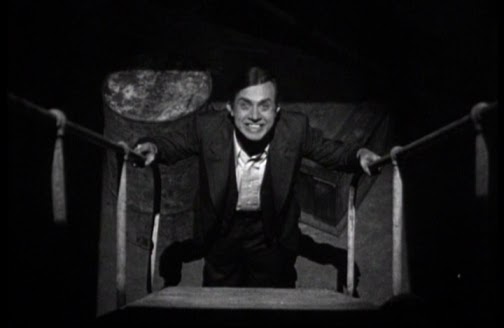
This is a largely single set film that treats a survival situation as an internal power struggle. If ever the personal was political it was here. Is it better in the basement where they can hold out sturdily or upstairs where they at least can run if they have to? Should the generally calm and rational Ben be in charge or the hothead Harry? These decisions are given to the young couple Judy and Tom but they fall into the problem that plagues every living character of the story: negotiating chaos.
That comes from a brilliant thought in the conception of this film whereby no definite explanation is given for the revived corpses that are roaming the land in murderous hordes. Zombies in horror fiction had been the products of creepy engineering made by magic and religion. They were the slaves of bad guys and a potent allegory of the mass control that seemed to be all the rage in the dictatorships of the '30s and '40s when the likes of White Zombie or Revolt of the Zombies were made. Romero took the magic away and left the phenomenon of revived corpses who were violent, hungry and incapable of communication. Also, he was decidedly non-discriminatory about it. His zombies are from all walks, they're just the dead not the hippy dead or the Vietnam dead or the rich dead. Don't ask why, deal with your own survival first. It was at the end of a decade that matched all that psychedelic positivity with nightmares of racial violence, an ugly and unpopular war, dispiriting high profile assassinations and everything else that was kicking at the shell of the American dream. Who had the time to talk it out when you could get 'em in the head and throw 'em on the fire?
The celebrated colourblind casting of Duane Jones as Ben. He is a young black man with a decisive manner, both rational and assertive. He delivers a snap-out-of-it slap to white bread and wavering Barbara which, while it might seem an archaic solution to her distress now would have felt like an electric charge to the audiences of 1968, even in the Yankee stronghold of Pennsylvania where the film was made and first screened. But Ben's entrance is so confident, urgent and assured that we pretty much snap in behind him. He's well written and plays the authority without a moment's machismo. Later when he shouts that he is in charge if it's to be upstairs to Harry he is pushing back against the incendiary white man's flex, not flexing himself.
Judith O'Dea's Barbara unfairly gets little acclaim but her trek from proper middle class young adult through survivalist action figure, to traumatised living zombie is essential to the workings of the film. It is her apparent fragility that attracts Ben's care, her vulnerability the object of protection. When she thaws out the role transfers to the child Karen on the table in the basement, bitten by zombies and deteriorating steadily. Karen's revival is the other end of this decaying metamorphosis from helpless and gormless to dark and brutal as she murders her mother with a trowel.
In the world outside, seen mostly through the TV, scientific, military and political figures are either guessing or attempting to save themselves. The sole force in the land to be taking action is one remove from a lynch mob. And in the end, as the zombie crowds are breaking down the doors and crawlling through the windows and everyone is getting torn to pieces to feed hunger that knows neither taste nor satisfaction, Ben finally takes refuge in the basement that he so passionately argued against and survives ... until the next morning when one of the extermination squads mistakes him for a zombie and shoots him in the head. The final montage of stills looks like authentic journalistic photography of atrocities as the dead are hauled and piled on to burning mountains of putrescence.
At first it might feel a little older than it is with the stark black and white and public domain orchestral score. Some of the performances can feel like television drama. All that is so but Night of the Living Dead is compellingly cinematic. It's not just the Dutch tilts of a lot of it that emphasise the weirdness of the situation or the expertly choreographed zombie mob scenes, it's the forward bursting situation expanding in the increasingly claustrophobic area of sanctuary, the accelerating hopelessness, the big ideas about what it means to live and how to maintain the value of it when the whole cosmos seems to be on the other team. The surprising gore, also, keeps our attention the way that even the best television dare not try (at least at that time).
Night of the Living Dead is not just a celebrated genre classic, though, it has a legacy that has to do with all the cinema in its wake, the same way that Easy Rider has. As a little movie that could and did, it paved the road to the marvels of the movie brats whose scaled down realistic dramas in the '70s took more chances with less money and, now and then, hit. Night is a source point in independent cinema. Just as punk rock would show how little you needed to make great music at the level of the audience, it offered a sizeable and deep world building that looked like next door but played out like something fantastic. Leonard Maltin nailed it when he described the film as a cinema verite record of a nightmare.
By such means films like Halloween were made. Films made for a pittance which then broke through the blockbuster-dominated late '70s. All of the rising tide of indy cinema in the '80s and onward that became indistinguishable from the arthouse is a throwback to Romero's tiny epic. And then, after a '90s of bloat-budgeted ever larger and ever unscarier bullshit it took a movie made on maxed credit cards to overcome the problem by taking it back to first principles: The Blair Witch Project. The Canadian indy Skinamarink is currently dividing audiences from the serious core of horror fans by not only stripping back but presenting an intentionally disagreeable front of challenging stillness, going perhaps into proto rather than first principles.
Romero himself benefitted from his own legacy when he made Martin in the late '70s, the vampire flick that was also a realistic depiction of adolescent angst. The year after that, his Dawn of the Dead, a massive expansion of Night, stopped the slates of world cinema which now lined up behind the redesigned zombie, still free of magic (with a few exceptions) but still relentlessly shambling toward the living for its satisfaction. This is the zombie pattern right up to Walking Dead and beyond. Even the point-missing running zombies of Dawn's remake couldn't conquer this principle.
Romero then proved that, if anything, he did his best work with the least as almost all his larger budgeted movies were constrained into blandness and convention. The found footage style Diary of the Dead is a superior outing to its multimillion dollar predecessor Land of the Dead. That aside, if Night of the Living Dead had been his only film, Romero would still be celebrated. It changed the game. It's also a really, really good movie.
Viewing notes: I've seen this on tv, VHS, owned two DVDs of it, Criterion's beautiful Blu-Ray presentation and now the one I put on for this article, Criterion's UHD 4K. The finish on this is pretty astounding and it's good to listen to a well mastered original mono track without distortion or wavering levels.