Showing posts with label Suspiria. Show all posts

Sunday, July 10, 2022

Suspiria @ 45

Suzy flies to Germany to study advanced dance but gets knocked back at the door after getting all but knocked over by a raving student who flees into the storm, finds a friend in town who gets murdered in a brutal knife attack along with the panicky one. The next day Suzy gets into the school but doesn't have a room so she has to flat up with the scratchiest cat at school but then after a weird moment with the light of the hallway flunks her first class by staggering and collapsing. She wakes up in a dorm room, ditched by Olga the Catty. Way to start the school year, Sooozeee.

All that plot happens in the first twenty minutes of this film that is often derided as a plotless exercise in style over substance. Of course, if you do see it there's every chance you might agree. The richness of the visuals, bludgeoning of the score and the intensity of the violence really can distract folk from what is a pretty eventful ride along the darker side of Supernature Strasse. Director and co-writer Dario Argento, having made the monumental giallo movie Deep Red broke from his string of bloody thrillers to venture into horror. But due to a few twists and turns and telephone game developments he made Suspiria which, while it often looks like all out horror, forges its own path beside the genre.

Argento began with De Quincey's essay on European occultism Suspiria de Profundis about a network of powerful witches. Daria Nicolodi added a lot of folklore and one of her own dreams that informed the finale of the film. She also wrote the characters of the students, as violent as it always was, as children. Put all that together and you will have a densely structured mystical epic with unwatchable violence against children. So take some stuff away, bit by bit, but keep everything that still stands pushed forward and you get this film: a sleepwalking sprint through a nightmare.

So when Sarah is trying to escape from the shadowy assailant in the back corridors and stops to build a staircase to the window with old travel trunks while the latch is being caressed teasingly with a cut throat razor, it feels like a dream where the threat could be something innocuous by day, and barriers to action can be gratingly stubborn. The town square scene's alternating pace adds anxiety to the thick eeriness. To any who complain that there's not a lot of witchiness on display for a witchy movie but that scene, the opening murder extravaganza and all of the other kills take on a queasy feel when considered as acts of the witches. The one time we do see anything like a ritual it is set in the tense climactic finale and its calmness feels very ugly. Monsters can look like anyone on the electoral roll in a dream. Argento wanted an intense colour pallet dominated by blue and red. Intentional use of old filmstock and the soon to be outmoded Technicolor process he sought a oversaturated look like a live action Disney animation. The near-psychedelic effect of this drives the nightmare.

Argento again paired up with Claudio Simonetti's Goblin for the score. Their music for Deep Red had already added power to an already charged film. Here it ranges from the fragile but insistent short modal melody on a celesta so perfectly sealed it can be repeated at length without exhausting its listeners. Under its medieval delicacy a raft of other voices waft or rasp or thud or groan as synthesisers, tom toms, harsh voiced whispers and wails can build to a cyclonic roar or fall to a tiny jangle. If Deep Red's music had boldly gone prog baroque this one seems to grow from the visuals like a fungus. I was lucky enough to witness a live performance of it by Goblin to a projection of the film at ACMI a decade ago which was a hell of a thrill.

The end credits make a big statement out of how this film was shot in English. This really means that the Europudding cast had to learn their lines phonetically which can give their performances a stilted quality that in turn can leave the impression that no one in the movie can act a single line. Well, all dialogue in Italian films at this time and many years afterwards was post synch. Even the native or fluent Anglophones like star Jessica Harper or Udo Kier recorded their lines post production. But for me this really just feeds the dream logic tone by keeping the action a step shy of realism.

That said, Jessica Harper's Suzy is an unexpected centre of gravity, a foot on the floor while trying to sleep drunk. She undercuts her  childlike doe eyed beauty with New York smarts, giving us an effortlessly assured guiding presence, even in peril (and peril in Suspiria is hard edged and bloody)  We watch her and think she'd make a great lifelong friend. 

That's another thing; friend, not lover. For all the potential sexiness in the setting of leotard nirvana sex  is the one thing that does not visit the screen. Like the too high door handles and puerility of some of the spatting dialogue, this is the original intent of casting children showing through. The problems of presenting children under such attack and then possibly worsened by erotic suggestion pretty much forbade that approach before it could take wing. What remains is more unreality, more nightmare.

Joan Bennett shows as a Mme Blanc as porcelain white as her name with a pair of sapphire eyes that attack. Udo Kier as Mr Exposition keeps to himself in a thankless role (which I use to call the infomercial scene), needing only a little gravitas to augment his prettiness. But it is Alida Valli who really shines here, barnstorming as the strutting Miss Tanner, as gleefully Teutonic as close to a Swastika-ed camp guard as you'd expect in a serious teacher of dance. While she does take pains to add a little range to her character, she leans on her sheer magnetic force, the perfect nemesis for Harper's affable modern woman.

I first saw this as a rented VHS. It's a very different experience from the wide screen spectacle of seeing it at a venue like Melbourne's Astor picture palace. In 4X3 the academy looms out as a great red wall, offering no relief. The pool scene is far more intimate and the murder scenes pop from being magnified. A little while after, I bought the Anchor Bay triple DVD set with extras and a soundtrack CD. The remastering job was stellar with intense colour, crystal audio and a big washy surround mix. From there the presentations only improved right up to the stellar Synapse 4K that I watched for this article. If I miss the look of it on video tape it has more to do with the thrill of the first viewing of a favourite than the medium but the memory of the claustrophobic version remains. 

A friend of mine remarked, as I was running the 4K, that he doesn't think he even sees the film anymore when it's on. It is so eminently rewatchable that many full or partial views later the violence, once confronting and merciless, now feels safely familiar and the slight feel of the plotting lets it down. But last night I watched it without distraction or breaks with the Dolby Atmos on high, enveloping me in its restless energy, and just let the force of it in. One complaint I recall, especially when people were comparing it to the pointless reimagining from 2018, that this dance movie has no dancing but that's all I can call the Sarah chase scene. People who direct fight scenes in films are credited as choreographers for good reason. Even the first eyepoppingly violent murder scene has a balletic sense of movement. I suppose that's the trouble with some viewers and this movie. The ballet looks like murder and the horror looks like a dream. Well, works for me.

Saturday, November 3, 2018

Review: SUSPIRIA 2018

A young woman barges in on her psychiatrist on a bleak Berlin day in the late '70s. He shifts an appointment with her and makes notes about her delusions as she acts erratically in his office. She tells him she fears for her life and the lives of her friends back at the dance academy because it's run by a coven of witches. Exit screen left and that's the last of her ... maybe.

Elsewhere, amid scenes of stret protest and news commentary about the Bader Meinhoff gang, young Susie Bannion gets off a train and makes her way to that academy. She makes a big impression at her audition. So much so that the chief instructor, Madame Blanc is psychically alerted to her performance and abandons the class she is taking to witness this new raw talent. She's in!

From this point we follow Susie's progress through favour and skill at the school while we learn of her childhood in a forbidding ascetic Christian group and the psychiatrist's back story that has to do with the war years. Also, just as the political strife is on the boil in the streets and the world's stage the witches at the school are heading for a leadership spill. Yes, this time around they are revealed as witches from the get go. There's a point to this and it forms the wedge between this and the original version of the story from the real 1970s. But I don't spoil movies.

I am well behind on the works of Luca Guadagnino but do know he has risen from arthouse fare that has divided audience to more generally celebrated films like Call me By Your Name and A Bigger Splash. I might well choose to catch up with those but it won't be on the strength of this one. Not that it's a bad film. It is very well crafted and above all deliberate in the choices that give us its muted '70s pallet, underplayed score and character arcs. Cinematic quality is not the issue here.

This might well have been, given its troubled pre-production history, a tawdry point-missing Americanised travesty. There are pointers to that but Guadagnino steers those elements away from the mainstream cliches they might have been in the hands of David Gordon Green (who went on to yet another unbidden remake, Halloween 2018). And there is much to be admired in the way Guadagnino blends the supernatural with the socio-political elements so that without too much hammering they feel as though they belong on the same screen.

He's no slouch with horror, either, in this remake of a horror milestone. The scene in which Susie's dance seems to twist and rupture the body of a character in another room is terrifying. It isn't played for the slightest laugh and is richer for it. Other excursions into unironic horror work as well for that same commitment. Tilda Swinton is at her most intimidatingly confident as Mme Blanc. Her counterpart, Susie, is given real range and nuance by Dakota Johnson. No one the large multinational cast disappoints. So why don't I like it?

The original film is not something I grew up with but I only had to see it once, on a crumbling rental VHS at the end of the '90s, to be completely captivated by it. Why? Yeah, why? The thing has no depth, it's plot is a scattered and unconvincing mystery and is played by a cast who mostly are mouthing their lines which are very obviously dubbed by the stilted delivery of voice-over talent who sound like they're paid by the day. There is backstory but it's left till late, is dull in delivery and jolts the viewer out of the world of the rest of the film. There's a stupid and needless scene with a bat that leaves a bad taste in the mouth by its suggestion of animal cruelty. So, why do I love it?

Well, because it packs a wallop with ultra-violent kill scenes from the off, in eye popping deco settings in a pallet intentionally torn between deep reds and blues from a choice to shoot it with expired film stock. Suspiria 1977 does not pretend to be anything other than a scarefest. The whispered detective work between some of the characters is enjoyable but there's only a tiny fraction of the work given to the plotting of Argento's earlier Giallo films. It's witches/bad vs Suzy/good with a barnstorming score that sounds like the best prog rock ever. I love it because it gives all this in 98 minutes.

The new Suspiria adds almost an hour of screen time spent setting up relationships and contexualising witches and then what always feels like too long on back stories. In the end this is only in the service of an overall twist in a single character arc. Is that really worth adding a two thirds of the original's screen time: you want us to be a little more understanding about witches?

Backstory incursions are (to be in theme) a curse to horror stories if they take more than the equivalent of a few lines of a prose tale. There are exceptions but only very few. Mostly they add drag as they do here. If you've seen Sleepaway Camp you might know of a very late insert along these lines but it adds with its brevity and weirdness (which helps the otherwise too-bizarre revelation). It was backstory that turned the tale in Ringu from a freezing weird revenge story into a big bloated character piece as The Ring. Backstory allows the viewer too much control over the narrative: the horror of the original depends on the viewer's lack of this. While Guadagnino does this better than that his efforts suggest a question that is not answered by seeing the result of his efforts. Why?

Guadagnino stated that he wanted this to be different in every way? Why? You get a few extra themes in there but these have nothing to do with the intentions of the original. Reclaim witchcraft as part of the feminist narrative? Lovely, but go and make something new. To be iconoclastic? Suspiria isn't E.T. or Gone With the Wind, it's a cult favourite, tiny in the timeline. Do you really need to punish its fans with a contemporary history re-jig? The problem of this version is not whether it's well made but why it should exist at all. The recent Netflix series The Haunting of Hill House, similarly told a story that did little more than appropriate the branding for what turned out to be a rather anodyne purpose that used a lot of exhausted special effects.

The main fracture between the two films really stresses the question of why we needed this. That is the issue of control. The point of the scares in Suspiria is that they are not easily controllable by the viewer. It's hard to rationalise them beyond the great sense of menace they give and the cold-sweat violence that ensues. This is nightmare logic. You can feel terror at anything in a nightmare, an ice cream cone will do, the effect of terror is your powerlessness to best or escape it. The new one is all about characters vying for control (including the offscreen terrorists). The audience in this just needs to sit back and follow, feeling at no time under threat from the film itself. This removes the power of the original. Why? You change the arc, rename characters but put the red and blue of the original in the shading of the subtitle font? That's just insulting. There is no point to this film taking the title of the earlier one. It simply doesn't earn it.

I'd planned on ending with the pun: there oughta be a lore. But there is one. Want to try a remake about witches? Do a real one on the backstory of The Blair Witch Project. Not the good but irrelevant sequel and certainly not the assembly line recent remake but something about the character of the Blair Witch herself. Or, really, if you really want to remake Suspiria and have something like the impact of the original, go all out and make it as the first drafts by Daria Nicolodi had it with the characters of the dancers being children. That's right, six to nine year olds. Make that one. Then you've got some real horror and the institutional darkness thrown in.

Tuesday, October 23, 2012

Top 13 horrors for Halloween


Okay, as this is an occasion for my favourite film genre I'm doing two unusual things in my tops lists: there are more titles and Eraserhead isn't one of them.

What's the same is that this is not an attempt at a definitive list. Horror is my favourite genre and I like far more than thirteen. I left the inclusion entirely up to what I could think of at the time. This would almost certainly change if I thought about it again this time next week. So, sorry if your favourites aren't here, a lot of my own aren't either.

Halloween: This bloodless coup of a film was the most profitable independent American film until The Blair Witch Project. Through the kill scenes and an atmosphere of undiluted and understated creepiness there is a powerful arc of nerd girl Laurie finding her courage and standing up to the monster. It was this where the masked killing machine who just keeps coming back originated. Original still best. Oh, and one of the best realised music scores for any film in any genre, by director Carpenter himself.

Dark Water: Shivery ghost tale remembers that the best of them include a tragedy at their centre. The convergence of this and the haunting results in a powerful and heartrending climax. Wash this down with a creepy and crushing coda and you have the logical end to the J-horror genre.


The Blair Witch Project: Campfire tale as cinema verite. Three students try and make a film about a witch in the woods and either fall under her control or get literally scared out of their wits. Not the first found footage film but still the most effective.


Ringu: The man who ended J-horror also began it with this tale of a curse and race against time. Like Dark Water this is also the story of a mother's bond with her child and the rediscovery of mutual respect between a woman and her estranged husband. Climax still freezes me and it's still better than the exponentially higher budgeted American re-bloat.


Suspiria: Giallo maestro Dario Argento's apex drives to the heart of why our nightmares scare us (we have no control over them) and serves one up with frozen blues and thick blood reds. Some of the most tightening murder scenes you'll see and a music score on a par with Halloween.


Martyrs: Outside of Asia contemporary horror has fallen to cliche and uninterestingly slick digital effects but this French/Canadian entry not only gives us gore that is painful to the eye but concepts that make us feel ashamed to be alive. The really nasty stuff has less gore but the ideas behind it are petrifying.


The Haunting: Citizen Kane alumnus Robert Wise made one of the finest haunted house movies of all time with this adaptation of a popular novel. Some still impressive special effects, almost three dimensional lighting design support a very very sad central story. Could watch this on a weekly basis.


The Exorcist: A story of doubt, faith and mother and daughter. You don't need to be religious to get into this one anymore than you need to believe in ghosts to dig The Haunting. As a girl goes through severe changes in mind and body her famous and inevitably neglectful mother is drawn to attention. The father who is only suggested by the gaps in an international phone call has been absent for years. As the tumult within the girl explodes into freakish violence the priests are called in. One is a skeptic, grieving for his recently deceased mother and the other is an old stager who has met this demon before. A mix of tough seventies drama and supernatural pyrotechnics, The Ex remains a wonder of the medium. Try to find the original cut as the "version you've never seen" aka the director's cut just adds bloat and removes power.


Night of the Living Dead: Throw out the magic and ritual of the traditional zombie story and all you have is the dead come back to life. All? Romero's fable of fate, made for the shoe polish budget of a contemporary quirky indy gets everything it tries for right.

The Changeling: Effectively eerie haunted house film builds to a conclusion of real dread. Atmosphere and strong performances lift this already fine story into the ether.


Kairo: Would you like to meet a ghost? So asks the website visited by most of the characters in this apocalyptic tale. No you wouldn't, is the correct answer, not if they're anything like the ones here. A chaos of mass loneliness, Kairo (or Pulse or Circuit as it's variously known in English) was once beautifully described as The Omega Man as directed by Tarkovsky. Yup!

Prince of Darkness: Dismissed even by Carpenter fans my near favourite JC film has ideas worthy of its chief inspirator Nigel Kneale and a human diminishing concept at its centre AND another great music score by Johnno himself. I can watch this just for the atmosphere but love the rest of it too much.


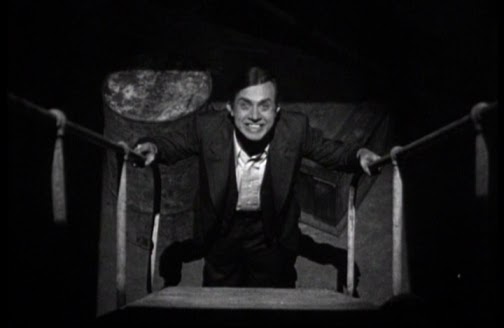
The Cabinet of Dr Caligari: Silent wonder as sleepwalker terrorises town at the same time as sinister bullish carny seems also to run the local asylum. Crazy expressionistic backdrops suggest a constantly unsettled state of mind which might be as easily fallen into as a gutter. Like a nightmare that has sneaked out from an Edvard Munch woodcut.